Table of Contents (click to expand)
- How Thin Is The Edge Of A Straight Razor?
- What Happens To A Razor's Edge When You Shave?
- What Is A Burr, And Why Does Sharpening Leave One?
- Does A Plain Leather Strop Actually Do Anything?
- Why Do Barbers Rub Green Paste On Their Strops?
- Is A Strop The Same As A Honing Steel Or A Whetstone?
- So, Why Do Barbers Strop A Straight Razor?
A straight razor's edge is less than half a micron wide, nearly 200 times thinner than a human hair, so it bends, chips and grows a tiny flap of metal called a burr when it is sharpened or used. A leather strop rubbed with fine green abrasive paste is a proven ultra-fine polisher: under an electron microscope it beat a smooth steel and a buffing wheel at wearing the burr away, leaving an edge as thin as a factory razor blade's. Plain leather did almost nothing measurable to a knife edge under the same microscope, and the plain-leather stropping barbers do before every shave has never been checked on a razor in a peer-reviewed experiment, so it is plausible but unproven.
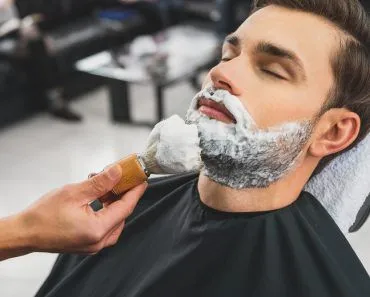
The barber finishes lathering his customer's face and turns his back on him. A strip of leather hangs from the chair. He lays the open razor flat on it and draws it up and down a dozen times with a slapping rhythm. Then he turns around and shaves the man with it.
None of that adds up. The razor is hardened steel. The strop is cowhide, the same stuff as a belt. Sharpen a kitchen knife on your belt and you get a shinier knife and some strange looks. Yet barbers have stropped before every shave for as long as straight razors have existed. Most will tell you the shave is worse without it.
So what is leather doing to steel? The answer sits at a scale no barber has ever seen. When razor edges went under an electron microscope, half the folklore held up and half did not.
How Thin Is The Edge Of A Straight Razor?
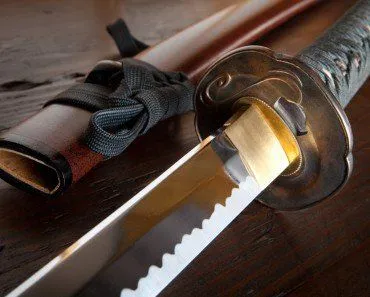
Seen end-on in an electron microscope, the tip of a freshly stropped straight razor is about 0.4 microns wide. A micron is a thousandth of a millimeter. The average human hair is about 70 microns across. So the edge is nearly 200 times thinner than the hair it cuts (70 divided by 0.4 is 175).
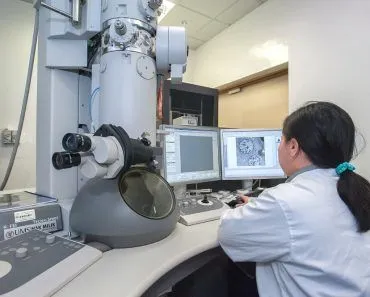
Those numbers come from John Verhoeven, a materials scientist at Iowa State University. He spent a year putting blade edges under his department's microscope. His gold standards were a German straight razor and an early-1980s safety-razor blade. Both met at an angle of 17 degrees, with the same hair-splitting tip. The kitchen knives he tested met at about 40 degrees, more than twice as blunt a wedge.

A finer measure, the roundness of the point itself, comes out at about 40 nanometers. Gillette's engineers set their target for a good shave at under about 50 nanometers. Either way, the business end of a razor is a few hundred atoms across.
What Happens To A Razor's Edge When You Shave?
An edge that thin behaves less like a block of steel and more like a strip of foil. Press on it and it bends. Catch it at an angle and it cracks. Razor steel is about 50 times harder than hair, and it still loses. We covered the mechanics in our article on what a knife edge does at the atomic level, so the short version will do.
Engineers at MIT filmed single hairs being cut inside an electron microscope. When the blade met the hair square-on, the steel was untouched. When the hair could bend and the blade came in at a slant, small chips broke out of the edge. Each chip left a notch, and notches gather stress, so one chip made the next one easier. A blade that shaved well on Monday tugs by Friday because of a line of microscopic bites.

A chipped edge has lost metal, and no amount of rubbing puts it back. An edge pushed out of line without breaking is another matter, and that is the only job a strop could ever do.
What Is A Burr, And Why Does Sharpening Leave One?
Now for the bit that even keen knife sharpeners rarely hear about. A stone does not shave a blade's faces down to a clean point. Think of each grain of grit as a tiny plough. It scrapes up metal and pushes it along the face. When the plough reaches the edge, the scrapings have nowhere to go but over the top. At the same time, the tip is so thin that the pressure of the stone bends it away. The result is a ragged flap of metal hanging off the edge. Sharpeners call it a burr, or a wire edge.

Grinding wheels in the same tests left burrs one to four microns wide, depending on the grit. Even a fine Japanese waterstone left about half a micron. A freshly ground edge is several razors wide, with a floppy ribbon of metal on top. It will cut arm hair, but it will not shave a face in comfort.
Burrs also hide. One of his first pictures shows a blade whose top face looked perfect along its whole length. Flipped over, the other face carried a large burr the whole way along. Sharpeners feel for it with a thumbnail, and the finishing step after the stone exists to deal with it.
Does A Plain Leather Strop Actually Do Anything?
Verhoeven expected plain leather to work. His guess was that cowhide holds enough natural grit to polish steel slowly. So he started with clean leather: a shop-bought strop, plus shoe-repair leather used on both sides. He sharpened knife blades on a fine waterstone, stropped them forty strokes, and looked.
Almost nothing had changed. The scratches on the faces were still there. The burr "may be just a bit smaller, but it is only a minor effect." On blades with bigger burrs from a coarser wheel, the clean leather did not remove them at all. Both leathers, both faces, same result.

Before you throw out the barber's strop, notice what was tested. Those were kitchen-knife blades, honed to a stout 48-degree edge, nearly three times a razor's angle. A razor's edge is far thinner behind the tip and bends far more easily. The usual explanation is that a shave nudges the edge out of line and leather pulls it straight again. For a foil-thin edge, that is a reasonable story. It is also a story nobody has checked. No peer-reviewed study has put a stropped razor under a microscope before and after a shave.
Why Do Barbers Rub Green Paste On Their Strops?
The second round is where the strop earns its reputation. He rubbed the strop with a green wax bar of honing compound. Its grit was chromium oxide, half a micron across, far finer than any stone.
The difference was, in his word, dramatic. The scratch marks from the stone were smoothed almost away. The pasted leather cut even the wide burrs from a coarse wheel down to the half micron a fine waterstone leaves. Measured against the two razors, the edges came out close: straight, smooth-faced, and about as thin at the tip. He compared three finishing methods: a smooth steel, leather and a buffing wheel. Pasted leather was the best at removing the burr. A pasted strop is a fine, soft sharpening stone, and the leather is what holds the grit.

Softness is why the stroke runs backwards. On a stone you can push the edge into the surface. On leather, every stroke moves the blade spine-first, with the edge trailing. Lead with the edge and the tip digs into the leather like a plough into turf, and you have made a burr instead of removing one. The hollow grind of a straight razor, that scooped-out blade, lets spine and edge rest on the strop together. The angle then stays the same on every stroke.
Can you overdo it? On pasted leather, pressing harder or doubling the passes changed nothing he could see. The risk with leather is the angle, not the count.
Is A Strop The Same As A Honing Steel Or A Whetstone?
The stone removes metal. It is the only thing that sets the edge angle, grinds back a chipped edge and gets you to a fresh point. It also always leaves a burr. The smooth steel rod that chefs wave about before carving does not "realign the molecules," magnet or no magnet. It bends the burr round to one side of the blade and plasters it flat against the face. The edge gets straighter and feels sharper. But the tip is still about two microns wide, with the burr folded under rather than gone. More than a couple of light strokes made things worse, as bits of the edge broke off. The pasted strop wears the burr away, which is why it finishes at a razor's width and a steel does not.

This also explains why nobody strops a cartridge razor. Disposable blades leave the factory already stropped on an abrasive, then coated. Once the chips arrive, the blade goes in the bin. King Camp Gillette's 1904 patent for a safety razor with thin, cheap stainless blades ended stropping for most men. Our history of shaving covers the rest. The straight razor kept its strop because its blade is meant to last a lifetime.

So, Why Do Barbers Strop A Straight Razor?
Put the pieces together and the ritual splits in two.
The strop with paste on it is settled. A razor's edge is a sliver of steel less than half a micron wide. It comes off every stone with a burr several times wider than itself. Leather with half-micron grit is the gentlest tool for wearing that burr off without raising a new one. It works the way a polishing cloth works on a scratched watch crystal: a soft backing, a fine grit, and no pressure to speak of.
The plain strop before every shave is the part the microscope has not caught up with. Barbers have done it for centuries and say the shave is better for it. The one careful look at clean leather, on knife edges, found it changed almost nothing. Nobody has repeated it on a razor after a shave. The likeliest story is that a foil-thin edge gets nudged out of line and a few passes on leather straighten it. That is plausible, not proven, and a site about science should say so.
What the strop cannot do is fix a chipped edge, because chipping removes steel and leather cannot put it back. That job belongs to the stone. Then the barber turns back to his customer. The tip of his blade is nearly 200 times thinner than the whisker it is about to cut. For all the theater, it is the finest-grained piece of engineering in the room.
References (click to expand)
- Experiments on Knife Sharpening — John D. Verhoeven, Department of Materials Science and Engineering, Iowa State University, 2004 (archived PDF)
- How hair deforms steel — Roscioli, Taheri-Mousavi & Tasan, Science 369(6504), 2020
- Why shaving dulls even the sharpest of razors — MIT News
- Particulate Matter (PM) Basics — US Environmental Protection Agency
- US Patent 4,122,602, Processes for treating cutting edges — The Gillette Company, 1978
- US Patent 775,134, Razor — King C. Gillette, 1904