Ostriches don’t bury their heads in the sand and imagine that they’re successfully hidden. That’s just a myth. In reality, ostriches stick their heads in the ground to dig a shallow hole, where they can subsequently make their nests
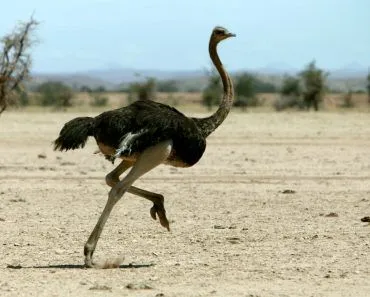
Struthio camelus – the Sparrow camel. That is what Carl Linnaeus, the man famed for being the father of taxonomy, christened the ostrich. Apparently, he thought they look like camels from far away (or if you have terrible eyesight).
These lumbering birds lack the grace of swans, the song of a robin, and the beauty of a peacock, but they have managed to strike a chord with the our imagination. Particularly, their odd behavior of sticking their head in the sand.
In English, we use the phrase, “to bury one’s head in the sand,” when one is hiding out of fear. It was believed that ostriches stuck their head in the sand to hide from predators.
Interestingly enough, ostriches don’t actually stick their head in the sand.

So, where did this myth come from? And if ostriches aren’t simply ignoring their problems, what are these underground “head holes” for?
Where Did The Phrase ‘To Bury Your Head In The Sand’ Come From?
We might have Pliny the Elder (23-79AD) to thank for the myth.
A Roman scholar, Pliny was a curious man, working tirelessly throughout his life to understand the world around him. He had such a passionately curious soul that he died attempting to “understand” the eruption of Mt. Vesuvius, as it erupted.
However, before he died, he wrote one of the first Natural History encyclopedias, a 37-book attempt to catalogue the entirety of Roman knowledge. In Book 10, Chapter 1, he mentions the ostrich’s head-in-the-sand habits. He wrote, “…they imagine, when they have thrust their head and neck into a bush, that the whole of their body is concealed”.
Then again, Pliny also thought that swallows (a species of bird) went underground when they migrated away every winter. I wonder why the idea that birds could simply fly away never struck Pliny as obvious!
Ostriches Build Their Nests In The Ground, Which Requires Them To Stick Their Head In The Sand
Birds make nests to house their eggs. Ostriches are birds too, meaning that they also create nests. The problem is, ostriches can’t fly and have no way to get up into trees to make traditional nests that we normally imagine for our avian neighbors. The option they’re left with is to make a nest on the ground, but this exposes their eggs to the danger of predators.
They get around this problem by digging a shallow hole in the ground and making their nests there. Once the female ostriches have laid their eggs, the male ostrich sits on the nest to heat the eggs. This behavior is called incubation, and provides the eggs with an optimal temperature to grow into healthy little chicks.
However, sitting on the eggs isn’t enough. Birds must often move or roll their eggs from time to time. There are two reasons for this. The first is temperature, since the temperature in the center of the egg is warmer than at its edges. Birds will rotate their eggs to make sure the temperature remains more or less even throughout the egg.
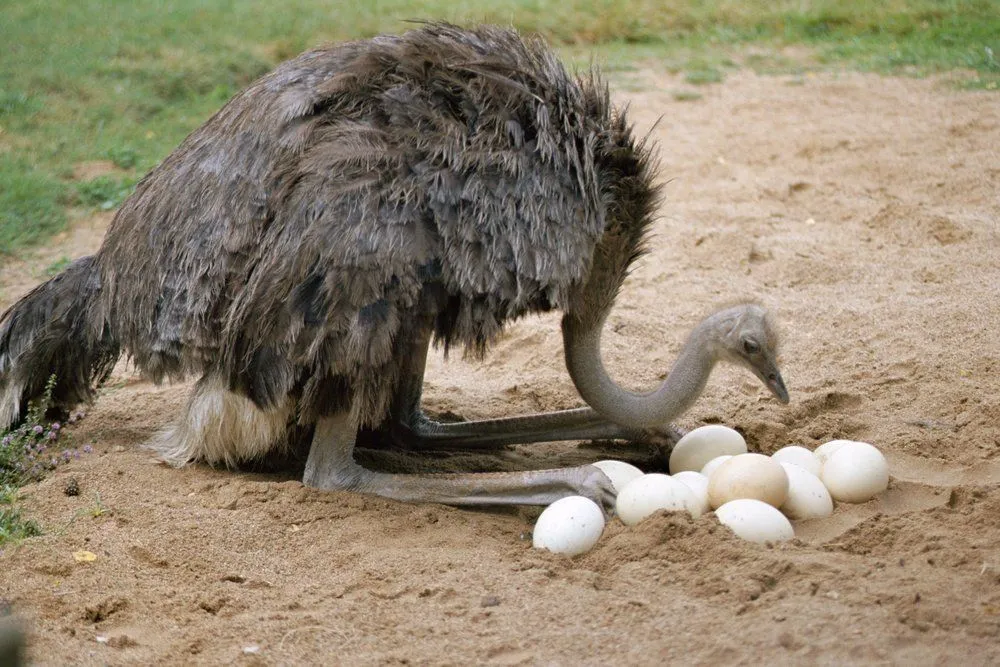
The second reason is the embryonic development. The embryo is floating in a sea of albumen inside the egg. The albumen is the transparent white part of the egg, rich with the protein albumin, along with water and certain minerals. Turning the eggs, scientists believe, gives the embryo enough albumen for proper development.
We see most birds do this, but with ostriches and their underground nests, this scene becomes quite a bit more conspicuous. Since ostriches have relatively small heads compared to their massive bodies, it’s easy to think (especially if you’re watching from a distance) that the big birds are actually burying their heads in the ground!
Ostriches aren’t the only birds with underground nests. Most of the ostrich’s relatives—emus, kiwis, and rheas, collectively called the ratite birds—are flightless, so they all have on-the-ground or underground nests.
How Do Ostriches Actually Sleep?
If ostriches don’t plunge their heads underground to nap, how do they actually catch some rest? For a long time nobody really knew, because a sleeping ostrich barely looks asleep at all. In a 2011 study, a team led by John Lesku, then at the Max Planck Institute for Ornithology, fitted six ostriches with small EEG data loggers (nicknamed Neurologgers) and tracked their brainwaves, eye movements, and neck muscles, both in an enclosure and across a 51-hectare South African reserve.

The birds turned out to be masters of the stealth nap. During slow-wave sleep, the deep, restorative phase, an ostrich simply sits down on the ground and holds its neck straight up like a periscope, with both eyes open. To a passing predator (or a puzzled tourist) it looks completely alert, which is probably why wild ostriches were long thought to barely sleep at all.
Things get stranger during REM sleep, the stage linked to dreaming. Here the ostrich finally closes its eyes, its neck goes slack, and its head droops and sways toward the ground, jerking back up now and then like a student nodding off in a lecture. Seen from a distance, that drooping head is yet another reason people assumed the bird was tucking its face into the sand.
Ostriches devote roughly a quarter of their night to REM sleep, the highest share recorded for any bird. Stranger still, their sleeping brain often blends REM activity with the slow waves of deep sleep at the same time, a mixed-up pattern otherwise seen mainly in the platypus. And unlike perching birds that grip a branch to sleep, the flightless ostrich just settles onto the sand for the night.
Ostriches Lay Their Head Flat Against The Ground To Hide From Predators
Pliny wasn’t entirely wrong though. It turns out that ostriches do pull the odd ‘Oh look, I’m a bush’ trick. When danger is close, ostriches are known to get really close to the ground and lay their necks and head flat.
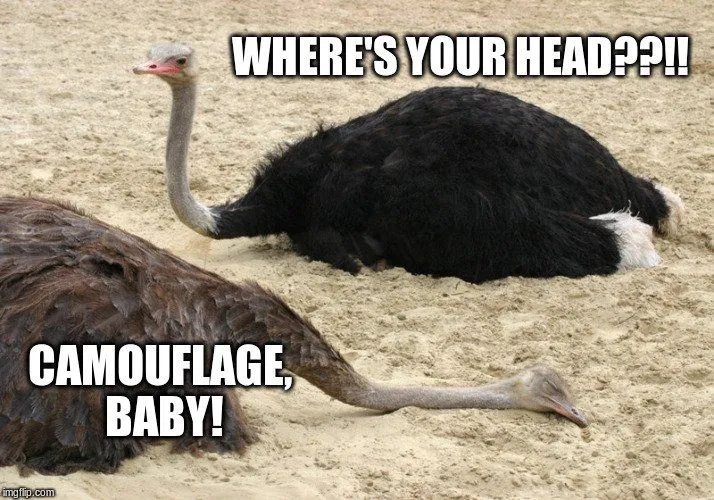
From a distance, the predator might think it’s looking at some kind of massive dark bush. The male ostrich’s dark feathers make it appear that way, especially at night or near dawn.
The ostrich lays in this position, as still as possible, until the danger has passed. Again, from a distance, it’s easy to think that the ostrich is actually sticking its head in the sand, due to how small the head is and the fact that the neck and head are so easily camouflaged against the sandy ground.
Therefore, the next time someone tells you to stop burying your head in the sand (implying that you’re avoiding a problem), let them know that ostriches aren’t actually dumb enough to do such a thing. Not only is that a ridiculous idea, but it gives ostriches a bad reputation as stupid birds, when in actuality, they’re just being good parents!
References (click to expand)
- Boulton, R. L., & Cassey, P. (2012, June 14). How avian incubation behaviour influences egg surface temperatures: relationships with egg position, development and clutch size. Journal of Avian Biology. Wiley.
- Shaffer, S. A., Clatterbuck, C. A., Kelsey, E. C., Naiman, A. D., Young, L. C., VanderWerf, E. A., … Bower, G. C. (2014, June 2). As the Egg Turns: Monitoring Egg Attendance Behavior in Wild Birds Using Novel Data Logging Technology. (Y. Ropert-Coudert, Ed.), PLoS ONE. Public Library of Science (PLoS).
- Westhrop, H. (2011). Pliny’s Historia Naturalis. University of Reading Special Collections Services, 1-8.
- Williams, E. (2013). Ostrich (Animal Series). Reaktion Books
- Lesku, J. A., Meyer, L. C. R., Fuller, A., Maloney, S. K., Dell'Omo, G., Vyssotski, A. L., & Rattenborg, N. C. (2011). Ostriches Sleep like Platypuses. PLoS ONE, 6(8), e23203.