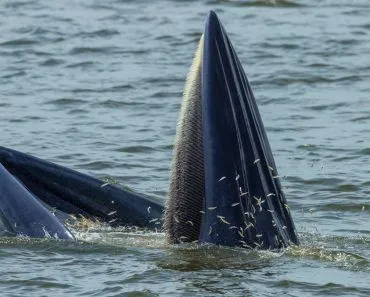
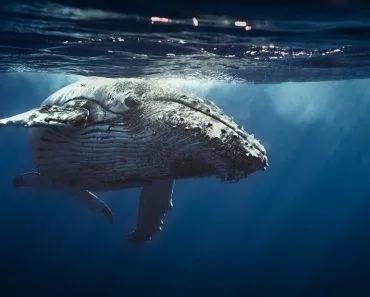
Marine mammals like whales grow far larger than land mammals because water supports their weight, removing the gravity limit that constrains land animals. In cold water, staying big also helps them retain body heat. The blue whale, up to about 30 m (98 ft) and 180 tonnes, is the largest animal known to have ever lived.
“Oh, man! admire and model thyself after the whale! Do thou, too, remain warm among ice. Do thou, too, live in this world without being of it. Be cool at the equator; keep thy blood fluid at the Pole. Like the great dome of St. Peter’s, and like the great whale, retain, O man! in all seasons a temperature of thine own.”
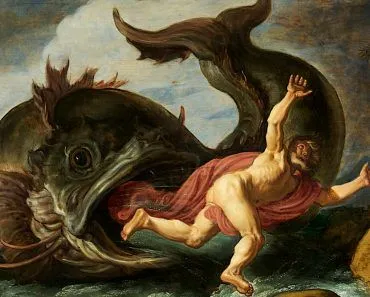
In Herman Melville’s seminal work, Moby Dick, Captain Ahab is obsessed with getting revenge against a white whale. However, his bloodthirst doesn’t stop him from marveling at its gigantic beauty. Very few animals on land have reached such gigantism as the mammals of the oceans.
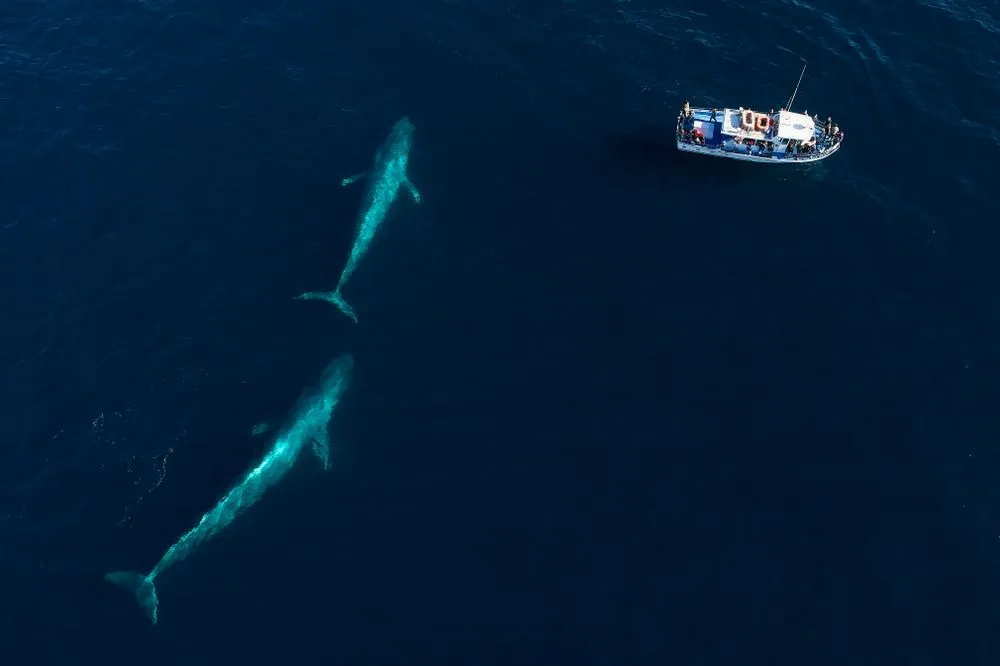
Blue whales are the largest animals known to have ever existed on Earth. An adult blue whale can stretch 23 m (75 ft) to 30 m (98 ft) from head to tail, about as long as a 7-to-10-story building, and can weigh up to roughly 180 tonnes (around 200 short tons). Compare this to the largest land mammal today, the African bush elephant, which stands about 3.2 m (10.5 ft) at the shoulder and weighs 3 to 7 tonnes (a record bull reached close to 10.4 tonnes). Why don’t we have mammals the size of blue whales on land?
Terrestrial Constraints: Gravity
The physics of size work differently depending on one’s environment. One of the biggest limiting factors on size is gravity. On land, the effect of gravity is much greater than in water.
Square-Cube Law
This limits the size of an animal to as much as its skeleton can support the weight of its body. As far back as 1638, Galileo Galilei wrote about a gravity-imposed limit on the size of animals. He noted in his paper Dialogues Concerning Two New Sciences that the “…ratio of two volumes is greater than the ratio of their surfaces”. This is what came to be known as the Square-Cube Law.
Imagine if we were to expand an elephant to 10 times its original size. This doesn’t just mean that the elephant is 10 times as big as it was before. In height and length and width, sure, but not for all of its other size-related properties.
There are two other size-related properties to consider: surface area, or the skin that covers an animal, and volume, or all its organs and other stuff on the inside. When the elephant expanded, its surface area or the skin cover increased 100 times, and its volume increased by 1000 times! This is the Square-Cube Law.

One square inch of the larger elephant would have to support 10 times as much weight as a normal elephant’s bones. This is a tremendous amount of pressure for the elephant’s legs to withstand. It probably wouldn’t be able to walk. To endure the extra weight, it would have to either have stouter legs (imagine a stout short elephant running around) or it could take a more “giraffe route”, setting its legs up obliquely and compressing its body.
The larger an animal gets, the more it must deal with the force of gravity acting on its body.
Gravity In Water
Gravity acts in water too, but a little differently. The buoyancy of water and that of air is different. Buoyancy is the upward force exerted by a fluid on an immersed object that opposes it. Water offers more buoyant force to an object in it than air can offer. If you’ve ever noticed, things fall through water much slower than they fall through air.
This means that animals, especially mammals, can get much larger in water without experiencing the same strain on their skeletons. Marine mammals don’t have to worry too much about how much weight their skeletal structures can support (although it is somewhat important).
Metabolic Rate And Temperature
Evolutionary biologist and geneticist J. B. S. Haldane says in his essay ‘On Being the Right Size’: “For every type of animal there is a most convenient size, and a large change in size inevitably carries with it a change of form.”
Size is important in biology. Knowing about how large or small an organism is, scientists can predict other aspects of its biology. Haldane refers to the inevitable changes that must occur within an organism’s body and physiology as they scale up or down the size charts.
Every living thing produces heat when they consume food to produce energy. These chemical reactions in cells are generally known as the metabolism. Many of these reactions are related to breaking down food to yield energy, producing heat as a byproduct.
Smaller animals tend to have more surface area compared to their volume. This means that they lose heat generated through metabolism through their skin faster than a larger animal with a smaller surface area-to-volume ratio. This “forces” smaller animals to have a faster metabolism, which means eating more food to keep their body temperature stable. For example, a small rat eats a large fraction of its body weight in food every day, far more in relative terms than a large animal does, just to keep its furnace running.
Without a fast metabolism, small animals might freeze.
Kleiber’s Law
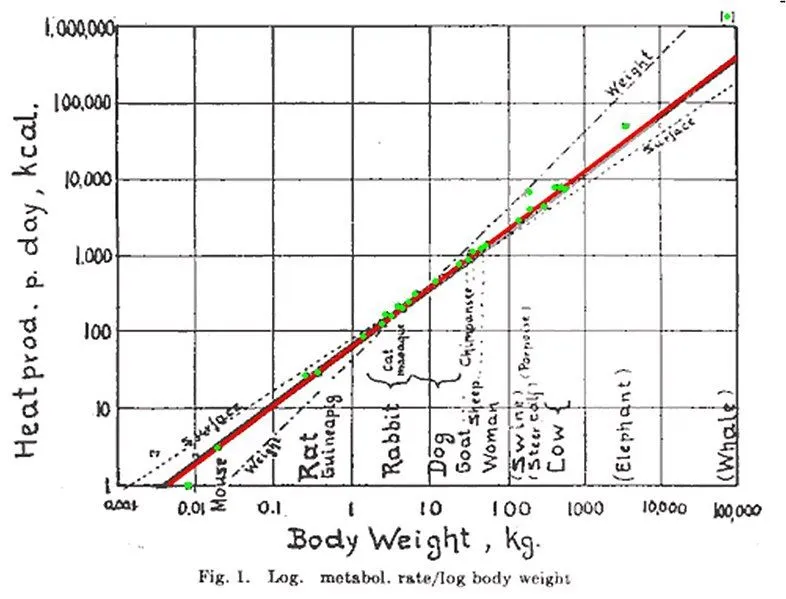
Large animals face the opposite problem. If their metabolism functioned the way rats did, they would combust due to all the heat their body produced (well, they wouldn’t literally combust, but they certainly wouldn’t survive long). So, these large animals slow their bodies down, and as a result, they have to eat less to sustain their bodies, as compared to smaller animals.
This is called Kleiber’s Law, which is modified from Rubner’s Rule.
An investigation on size and temperature led by William Gearty of the Department of Geological Sciences at Stanford showed that water drives mammals towards largeness. This is due to water’s heat conductance.
Water is a good conductor of heat. For marine mammals, the only way to not freeze is to get large enough that your insides are producing enough heat to combat the loss of heat to the water. More cells means more units producing energy, which means more heat.
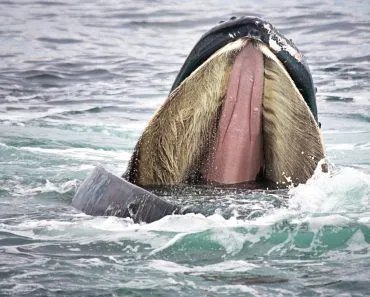
The blue whale, it should be noted, can reach such massive proportions because it doesn’t have to spend much energy on eating. Its filter-feeding strategy means that it simply sucks in water filled with tiny microscopic particles of food. There is no need for swimming around or strategizing on how to catch food when it’s already floating in the water around you.
What Is The Largest An Animal Can Get?
On land, we can look to extinct dinosaurs for the extremes of length and weight that an animal could reach. The titanosaur Patagotitan mayorum stretched around 31 meters (~102 feet) in length. Its weight is debated: early announcements put it near 69 tonnes, but later volumetric models scaled that back to roughly 50 to 57 tonnes. Either way, giant sauropods like this sit at the upper limit of what a land animal’s body could support.
Mammals could reach such proportions as the titanosaurs, but none have gotten there yet. The largest land mammal is an extinct rhinoceros Paraceratherium. Its exact largeness is still unknown, but estimates from the incomplete fossil evidence we have suggest that it was 4.8 meters (15.7 feet) tall and 7.4 meters long (24.3 feet), weighing 15 to 20 tons.
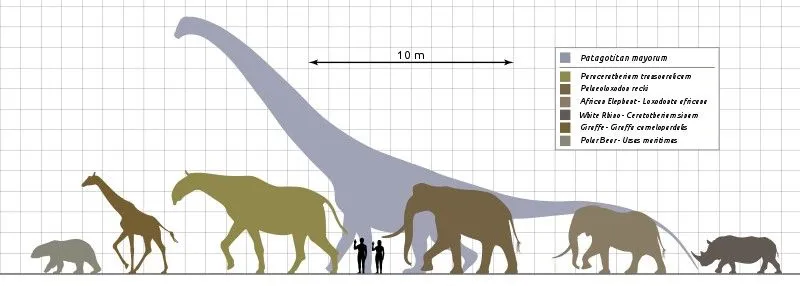
Why mammals haven’t reached titanosaur-like massiveness on land might be due to how much food was available, as well as different physiologies. According to research, dinosaurs didn’t burn through their energy as fast as mammals did. This slower and potentially more efficient energy metabolism, along with the abundance of food, allowed many dinosaurs to reach sizes that mammals haven’t been able to achieve.
The blue whale is the current all-time champion of size. It beats all other beasts of the land, oceans and skies to take the top spot for the largest mammal, and animal. For marine mammals, the blue whale sets the upper limit.
Largeness is fascinating, but that doesn’t mean all animals should strive to become a blue whale or an elephant. Evolution works to find the best possible solution that allows a creature to adapt to its surroundings. Perhaps its best for a pigeon to remain, well…. pigeon-sized, rather than become the largest flying bird around. It would be an interesting sight to see an elephant-sized pigeon flying through the skies, but that will probably have to stay in the realm of fantasy!
Why Are Whales Classified As Mammals, Not Fish?
Here is a puzzle that trips up a lot of people: an animal that spends every moment of its life in the ocean, and looks for all the world like a colossal fish, is not a fish at all. A whale is a mammal, just like an elephant, a mouse, or you. So what earns it that label?

According to the Whale and Dolphin Conservation, a whale checks every box that defines a mammal. It breathes air with lungs rather than pulling oxygen from the water through gills, which is why it has to surface and exhale through the blowhole on top of its head. It is warm-blooded, holding a steady internal temperature instead of matching the water around it. It gives birth to live young rather than laying eggs, and the mother nurses her calf on milk from mammary glands, something no fish does. Whales even have a little hair, usually just a few bristles around the snout that are easiest to spot before birth.
So why does a whale look so fish-like? The answer is convergent evolution, in which unrelated animals evolve similar shapes because they face the same challenge, here the problem of moving efficiently through water. The deeper reason whales are mammals is their family history. As the fossil record assembled by the University of California Museum of Paleontology lays out, the first whales evolved more than 50 million years ago from four-legged, hoofed land mammals. Transitional fossils like Pakicetus, a land-dwelling animal whose skull already carried whale-like features around the ear, capture that slow walk back into the sea. Whales did not come from fish; they came from land, and they never stopped being mammals.
Why Can't Whales Survive On Land?
If buoyancy is what lets a whale grow so large, then taking that support away should be catastrophic, and it is. A whale stranded on a beach is in serious trouble within hours, and the reasons trace straight back to the physics we have been discussing.

The first problem is the animal's own weight. In the water, a whale's bulk is cradled evenly by buoyancy; on land, gravity presses down with nothing to push back. According to NOAA Fisheries, “the weight of a large whale onshore can result in pressure necrosis on the underlying muscles, and their lungs can collapse when a whale is not supported by water.” The same agency notes that these “gravitational effects (increased pressure from being out of the water) can lead to respiratory and circulatory collapse.” The skeleton that works beautifully in a near-weightless ocean simply cannot hold the animal's organs off the ground.
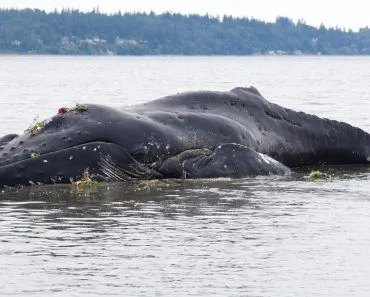
Overheating is the second killer. A whale's thick layer of blubber is superb insulation in frigid water, but on a warm beach it works against the animal, trapping body heat with no cool water to carry it away. Whales cannot sweat, so a stranded whale steadily bakes from the inside, a danger NOAA lists as hyperthermia. Add dehydration, since a whale's skin needs to stay moist, and the outlook is grim. This is why rescuers pour seawater over stranded whales and shade them while waiting for the tide, and why, sadly, even a whale that frees itself after a long stranding often does not survive. It is also part of the reason a dead whale washed ashore becomes such a hazard.
Do Marine Mammals Live Longer Than Land Mammals?
Size and lifespan tend to travel together. Across mammals, bigger bodies usually pair with slower metabolisms and longer lives, and since the ocean pushes mammals toward gigantism, it is no coincidence that the longest-lived mammal on Earth is a marine one.

That record holder is the bowhead whale. NOAA notes that the bowhead “has the longest lifespan of all marine mammals” and “may live 200-plus years,” which would make it the second-longest-lived animal known, behind only the ocean quahog clam. Some bowheads taken in recent decades have been found with old harpoon points lodged in their blubber, hardware left over from hunts they had survived many decades earlier.
How does an animal built from so many cells avoid wearing out, or developing cancer, for two centuries? A bowhead carries roughly a thousand times more cells than a human, which should mean a thousand times more chances for something to go wrong on each round of cell division. Yet researchers who sequenced the bowhead genome found part of the answer written into its DNA: bowhead-specific changes in genes tied to cancer and aging, along with extra copies of genes involved in DNA repair. Combined with the slow, cold-water metabolism we met earlier, those repair systems appear to let the bowhead keep going long after other mammals would have given out. It is a fitting coda to our story: the ocean does not just let mammals grow large, it can let them grow old.
References (click to expand)
- ON BEING THE RIGHT SIZE - J. B. S. HALDANE : J. B. S. HALDANE : Free Download, Borrow, and Streaming : Internet Archive - archive.org
- Body Size and Temperature: Why They Matter - Nature. Nature
- McNab, B. K. (2009, July 21). Resources and energetics determined dinosaur maximal size. Proceedings of the National Academy of Sciences. Proceedings of the National Academy of Sciences.
- Gearty, W., McClain, C. R., & Payne, J. L. (2018, March 26). Energetic tradeoffs control the size distribution of aquatic mammals. Proceedings of the National Academy of Sciences. Proceedings of the National Academy of Sciences.
- Clauset, A. (2013, January 10). How Large Should Whales Be?. (R. Lambiotte, Ed.), PLoS ONE. Public Library of Science (PLoS).
- Are whales mammals or fish? - Whale and Dolphin Conservation USA
- The evolution of whales - University of California Museum of Paleontology
- Frequent Questions - Live Large Whale Strandings on the West Coast - NOAA Fisheries
- What is the longest-lived marine mammal? - NOAA National Ocean Service
- Insights into the Evolution of Longevity from the Bowhead Whale Genome - Cell Reports (PMC)