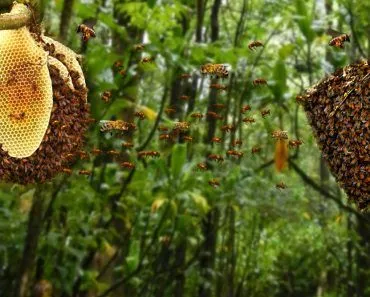
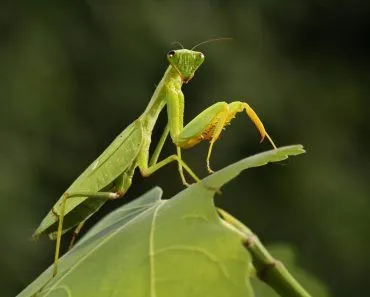
Only worker honeybees die after stinging. Their stinger is barbed, so when it pierces the thick skin of a mammal, it stays lodged. As the bee tries to fly away, it rips out the stinger, venom sac, and part of its abdomen, and dies within minutes to a few hours. Other bees, wasps, and hornets have smoother stingers and can sting repeatedly without dying.
Ever wonder why bees sting? It isn’t for an aggressive reason, as we often assume and depict in media. Bees only sting when they feel the need to defend themselves; it is a defensive, rather than an offensive maneuver.
However, did you know that in defending themselves from danger, bees unintentionally sacrifice their own life when they sting you? Honeybees self-amputate a part of their abdomen, much like frontline defense soldiers being killed in action, to protect the hive.
Can All Bees Sting?
No. To begin with, male bees of every species are physically incapable of stinging. The stinger evolved from the ovipositor, the tubular egg-laying organ found only in females, so males simply never had one to begin with. Then there are the so-called ‘stingless bees’ (the tribe Meliponini), where the females do have a stinger, but it is so reduced and vestigial that it can’t be used for defense at all.
The males of Xylocopa, a genus of carpenter bee, may follow you with an air of intimidation, but they’re pretty harmless and don’t sting. The same goes for bumblebee males. And even though female solitary bees do carry stingers, stings are quite uncommon from the most prevalent species (mason bees, mining bees, and leaf-cutters), because without a colony to protect, they have no reason to be aggressive.
A Female Bee’s Sting
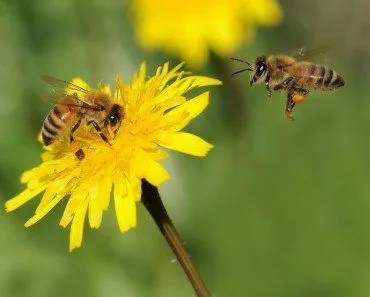
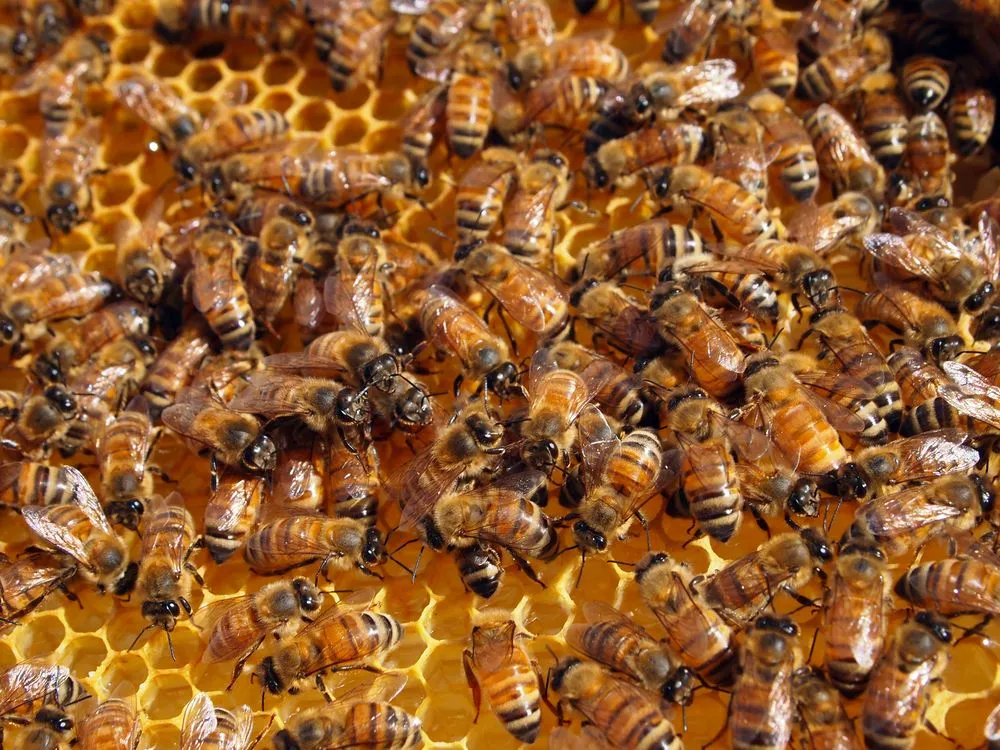
Looking at the constitution of a hive, each will typically have hundreds of male bees (drones), a reproductively active female queen bee, and 20,000-80,000 worker (all females and all sisters) bees. However, their abundance and infertility make them somewhat disposable. Additionally, as the main workforce of the colony, defense is one of their top priorities. When aggravated, they do sting. These females form the only proportion of the colony that will use their stinger for its painful purpose!
What Is A Bee Stinger?
A stinger is present in all species belonging to the infraorder Aculeata, which includes ants, bees, and the stinging wasps (a group that contains hornets and yellowjackets).
The stinger is a modified ovipositor connected to a pair of venom glands.
The body of a honeybee is divided into the head, thorax, and abdomen. The abdomen itself is made up of ten segments, although only six or seven are easily visible from the outside. The last visible segment houses the sting apparatus inside a cavity called the sting chamber. Because this chamber is continuous with the rest of the abdomen, it also contains the final part of the bee’s digestive tract, nerve ganglia, the retractor and protractor muscles that drive the stinger in and out of the prey, and a bulb-shaped venom sac.
The stinger is a modified ovipositor, a tubular female organ that is used to deposit eggs. Thus, it makes sense that only the female bees have a stinger that actually works!
Though their ovipositor no longer functions as an egg-laying organ, the workers have retained it across evolutionary time for use in defending their home.
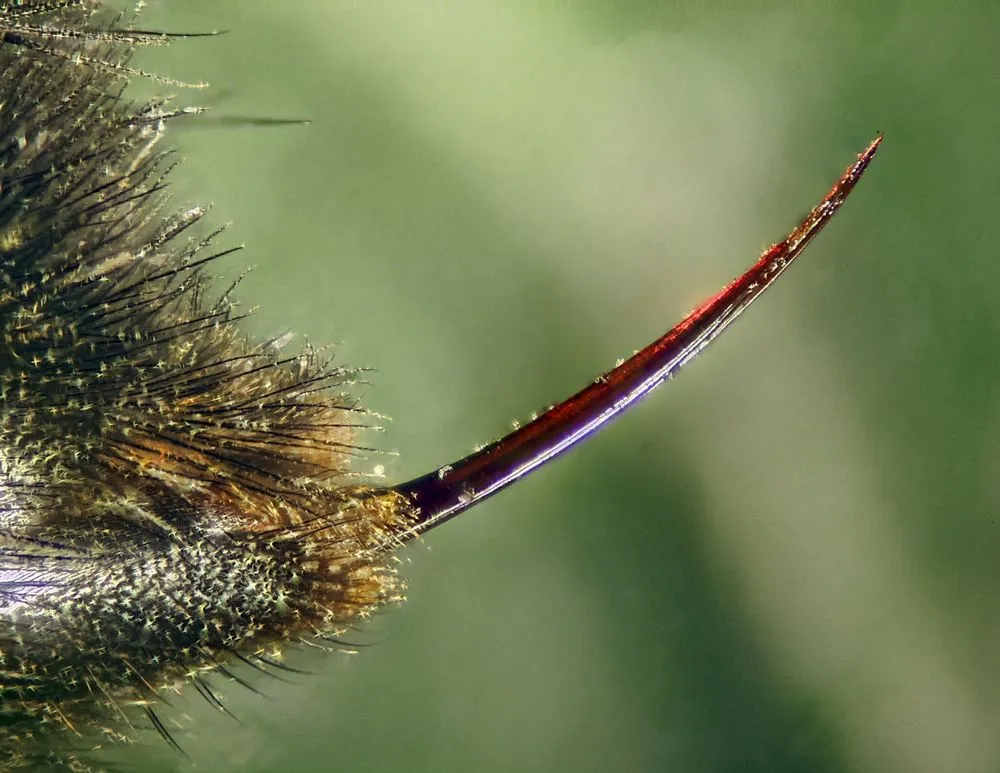
A queen bee can also sting, but she only puts her stinger to use when facing competition from another potential queen.
How Does A Stinger Work?
Morphologically, the stinger is hollow and pointy, with two rows of serrated and barbed blades, resembling a harpoon.
Upon encountering a potential threat, a worker bee will decide to use its go-to defense mechanism. The protracted muscles accompanying the stinger apparatus will move the stinger down, enabling the bee to penetrate its prey. To create enough thrust to penetrate through thick skin (if need be), the bee additionally uses its legs and abdominal muscles. Once the stinger is driven in, the venom sac releases its contents through a channel in the stinger. Subsequently, the retractor muscles will help in the retrograde movement of the stinger shaft.
Research has shown that the stinger moves both helically and in a clockwise direction as it penetrates its target. However, as the stinger is barbed, it offers a lot of resistance, making it almost impossible for the bee to remove it after making the strike.
Most bees and their queens, along with wasps and hornets, may have a reputation for being fierce stingers, but thanks to their smooth stingers, they don’t necessarily have to die after they sting you. The stinger will release its venom and effortlessly slide out.
The worker honeybee, unfortunately, has a barbed stinger that only gives them one chance.
The instant her stinger pierces the target, it gets lodged in the prey’s skin. In an attempt to fly away, the bee tries to break free, but in the process ruptures the lower portion of her abdomen. Everything present in the last abdominal segment, including muscles, digestive material, venom sac, and glands, is left behind with the strongly anchored stinger.
Even more remarkably, the abandoned apparatus doesn’t go quiet right away. The detached venom sac keeps pulsing on its own for about a minute, with the sting’s own nerve ganglion driving the lancets deeper and pumping venom into the wound long after the bee has flown off. That is why the standard first-aid advice is to scrape the stinger out quickly rather than wait.
Needless to say, having a hole in their abdomen doesn’t do the bee any good. The injured worker dies within minutes to a few hours. This is an act of autotomy, in which an organism deliberately sheds part of its body to escape a predator or any other form of danger.
Do Bumblebees Die After They Sting?
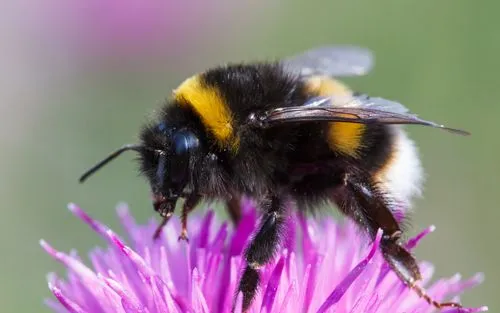
No, and this is one of the most common cases of mistaken identity in the backyard. The idea that a sting is always a death sentence is borrowed straight from honeybee biology, and it simply does not carry over to the bumblebee (Bombus). Where the worker honeybee is stuck with a barbed harpoon, a bumblebee's stinger is smooth and un-barbed. It slides in, delivers its venom, and slides right back out again, leaving the bee's abdomen intact. She keeps her stinger, flies off unharmed, and, if she feels the need, can sting you more than once.

As with every other bee, only the females are armed. The stinger is a modified ovipositor, or egg-laying tube, so male bumblebees have none at all and cannot sting you no matter how boldly they hover around your head. Among the females, both the queen and her workers can put theirs to use. The reassuring part is that bumblebees are famously easy-going. They are far less likely to sting than honeybees, hornets, or yellowjackets, and they generally reach for their stinger only in self-defense, when their nest is disturbed or when the bee itself is pressed or trapped against your skin.
Do Honeybees Bite?
Stinging is not the only weapon in a honeybee’s arsenal. When an intruder is too small to sting (think of the wax moth larvae that tunnel through honeycomb, or the parasitic Varroa mites that cling to a bee’s body), a worker will simply bite it with her mandibles instead. And that bite is more than a nip. A 2012 study in PLOS ONE found that as a honeybee bites, glands in her mandibles release a compound called 2-heptanone (2-H) straight into the target.

2-heptanone turns out to be a local anaesthetic. The researchers watched tethered wax moth larvae freeze the instant they were bitten, then stay paralysed for an average of about seven minutes before slowly coming round. Varroa mites given a heavier dose were knocked out completely, with no recovery even after 12 hours. The dose is astonishingly small, less than one nanolitre (a billionth of a litre) per bite.
To confirm it really was an anaesthetic, the team tested 2-H on an isolated rat nerve alongside lidocaine, the numbing agent your dentist uses. The two behaved remarkably alike, with 2-heptanone only around 1.4 times weaker. In effect, a honeybee carries its own tiny bottle of local anaesthetic and uses it to stun the pests it cannot skewer.
Best of all, biting costs the bee nothing. Unlike her single, suicidal sting, a worker can bite over and over and walk away unharmed, which makes it a far safer first line of defence against the hive’s smallest enemies.
Closing Thoughts
A painful abdominal rupture does no good to the bee, so why do bees sting? Maybe they’re being altruistic and sacrificing their lives for the protection of their entire colony. As infertile individuals, they cannot bear offspring and directly contribute to the gene pool of their hive. Instead, they do their part in ensuring the safety of those individuals who can help in the persistence and success of the colony.
References (click to expand)
- Ab Hamid, S., Salleh, M. S., Thevan, K., & Hashim, N. A. (2021, August 8). Distribution and Morphometrical Variations of Stingless Bees (Apidae: Meliponini) In Urban and Forest Areas of Penang Island, Malaysia. Journal of Tropical Resources and Sustainable Science (JTRSS). Universiti Malaysia Kelantan.
- Carpenter Bees. DigitalCommons@USU, Utah State University Extension.
- Ch05 - FAO. Food and Agriculture Organization of the United Nations
- Barbosa, D. N., Vilhelmsen, L., & Azevedo, C. O. (2021, January). Morphology of sting apparatus of Chrysidoidea (Hymenoptera, Aculeata). Arthropod Structure & Development. Elsevier BV.
- Stephen, W. P., Bohart, G. E., & Torchio, P. F. (1969). The biology and external morphology of bees ; with a synopsis of the genera of northwestern America.
- Sting Glands in Stingless Bees: A Vestigial Character (Hymenoptera: Apidae) - archive.org
- Weyda, F., & Kodrík, D. (2020, November 3). New functionally ultrastructural details of the honey bee stinger tip: serrated edge and pitted surface. Journal of Apicultural Research. Informa UK Limited.
- Mulfinger, L., Yunginger, J., Styer, W., Guralnick, M., & Lintner, T. (1992, March 1). Sting Morphology and Frequency of Sting Autotomy Among Medically Important Vespids (Hymenoptera: Vespidae) and the Honey Bee (Hymenoptera: Apidae). Journal of Medical Entomology. Oxford University Press (OUP).
- Dotimas, E. M., & Hider, R. C. (1987, January). Honeybee Venom. Bee World. Informa UK Limited.
- Wu, J., Yan, S., Zhao, J., & Ye, Y. (2014, August 4). Barbs Facilitate the Helical Penetration of Honeybee (Apis mellifera ligustica) Stingers. (F. Frischknecht, Ed.), PLoS ONE. Public Library of Science (PLoS).
- Papachristoforou, A., et al. (2012). The Bite of the Honeybee: 2-Heptanone Acts as a Local Anaesthetic in Insects and Mammals. PLOS ONE.
- Bumble Bee FAQ. Wisconsin Bumble Bees, Department of Entomology, University of Wisconsin-Madison.
- Do Bumblebees Sting? Bumblebee Sting Facts. Orkin.