Table of Contents (click to expand)
NASA has recorded magnetic and electric field waves associated with space events and translated this data into the human audible range.
There are countless questions about the cosmos that have been haunting scientists for centuries. To answer some of them, we have sent orbiters, spacecraft and sometimes even humans to collect samples and make observations, but how do you study something that you can’t see?
Humans are naturally able to hear and see only in certain specific frequencies and wavelengths. However, space has a multitude of waves that are beyond our narrow perceptions, so how do we study them?
We translate, remodel and adapt them according to our needs so that we can observe and analyze them. There is simply no stopping science!
Why Can’t Sound Travel In Space?
Sound waves are nothing but air vibrations. When these vibrations are in the range of 20 Hz to 20 kHz, we can hear them!
Sound waves basically travel by vibrating the particles in a medium, i.e., molecules of air. These vibrations are passed on to consecutive particles in the medium, meaning that sound waves cannot travel without a medium. The reason we can’t hear sound in the space is typically due to a lack of such a medium.
We may argue that there are clouds of gases in space that can act as mediums, but gases are not present uniformly throughout the space. Moreover, gases are typically less dense in space, which means there is too large of a gap between the particles, so vibrations cannot travel efficiently.
In simple terms, sound cannot travel in space.
Can Sound Travel On The Moon?
The short answer is no, and the reason is the same one that keeps space silent. The Moon does have a faint envelope of gas around it, but it is so tenuous that scientists don't even call it an atmosphere; they call it an exosphere. According to NASA, it is just one 25-trillionth the density of Earth's atmosphere, and its molecules are so few and far between that they almost never bump into one another.

Sound works by making particles jostle against each other and pass a vibration along. On the Moon there simply aren't enough of them, so this near-vacuum leaves almost nothing for sound waves to ripple through. If an astronaut shouted to a colleague standing a few steps away, the voice would go nowhere through the ‘air’. That is exactly why the lunar surface is famously, eerily quiet.
There is one loophole worth noting: sound travels perfectly well through solids, and a solid also counts as a medium. Vibrations can still move through the lunar ground or through the material of a spacesuit. What is missing is the airborne sound we rely on every day back on Earth. So when Neil Armstrong and Buzz Aldrin needed to talk during Apollo 11, they didn't try to shout across the regolith. They used radio.
If Sound Can't Travel In Space, How Do Astronauts Talk To Each Other?
This is one of the most common follow-up questions, and it trips people up for a good reason. If sound can't cross a vacuum, how do two astronauts on a spacewalk have a conversation? The trick is that they don't send their voices through space as sound at all. They send them as radio waves.

Radio waves and sound waves are completely different animals. Sound is a mechanical wave that needs a medium to travel. Radio waves are electromagnetic waves, part of the same family as visible light, and they need no medium at all, which is why they sail across the vacuum of space at the speed of light, roughly 300,000 kilometers per second (about 186,000 miles per second), according to NASA.
Inside a sealed spacesuit or spacecraft there is pressurized air, so ordinary sound works fine in there. A microphone in the astronaut's helmet picks up their voice, and the suit's radio converts it into a radio signal. That signal zips through the vacuum to the other astronaut (or to mission control), where a receiver turns it back into sound played through a speaker or earpiece. It is the very same principle that lets distant space probes beam data home across billions of kilometers. So the next time a film has spaceships roaring past one another, remember: the only voices astronauts ever hear from each other have quietly taken a detour through the radio.
How Do Scientists Hear The Sounds Of The Universe?
To begin with, scientists cannot actually ‘hear’ space sounds, but they do have the means to examine the space waves by converting them into sound waves.
Sonification
Sonification is the conversion of any non-auditory data into sound, and is analogous to data visualization.
A conversion technique is called Sonification if it fulfills certain criteria:
- Reproducibility, i.e., important elements of the data remain the same, regardless of the conditions under which the Sonification is done.
- The data should be sonified in a way that even untrained listeners can make a distinction.
Space is full of radio waves, plasma waves, magnetic waves, gravitational waves and shock waves, all of which can travel in space without a medium. These waves are recorded by instruments that can sense these waves, and the data is transferred to earth-based stations, where the waves are sound coded.
Any audible sound has variables like frequency, amplitude and rhythm. Different space waves are matched with different properties of the sound (frequency, amplitude, etc.) in different proportions to get a sound.
EMFISIS
NASA flew an instrument called EMFISIS (Electric and Magnetic Field Instrument Suite and Integrated Science) on its two Van Allen Probes, which circled the Earth from 2012 until the mission ended in 2019. EMFISIS used three electric-field sensors to measure electric disturbances and a tri-axial search-coil magnetometer (plus a fluxgate magnetometer) to measure fluctuations in the magnetic field. Some of these electromagnetic oscillations happen to lie in the audible frequency range, which gives scientists a baseline for shifting the remaining recorded frequencies into the audible range and listening for patterns. And, of course, these are just the waves near Earth.

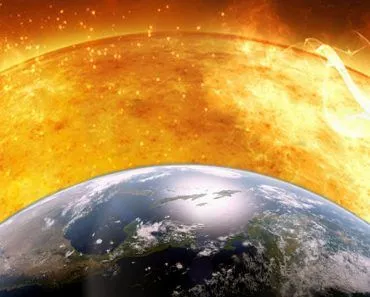
Although the scientific community has long been abuzz with questions related to the sun and its interior, we also know that it is impossible for any satellite or spacecraft to travel to the sun without burning up. The scientific observation of the sun is also nearly impossible due to its brightness. This leaves us with the option to observe the field waves that circle the sun and the natural vibrations that arise from the sun.
MDI
The Sun's surface is constantly convecting, producing very low-amplitude pressure waves that ring through the star. NASA generated solar sounds from data collected over a 40-day stretch by the Solar and Heliospheric Observatory's (SOHO) Michelson Doppler Imager (MDI). MDI was retired in 2011 and its job has since been taken over by the Helioseismic and Magnetic Imager (HMI) on the Solar Dynamics Observatory, which continues the same kind of helioseismology work today. The original MDI data was processed as follows:
- The Doppler velocity data obtained from the MDI (Michelson Doppler Imager) was averaged over the solar disc of the sun.
- Processing was done so that spacecraft’s motion effects and spurious noises were removed.
- A filter was then used to select the clean sound waves.
- Finally, the data was interpolated so that all the missing spots were covered.
- The data was then scaled to fit in the audible frequency range.
This is just one method adopted by scientists to study the sounds of space. There are also sensors that measure the electrical activity of the dust when a comet passes by a spacecraft!
‘Giant Leaps’ is a melody composed by NASA that describes the amount of scientific activity related to the moon. Every sound in the music exists because of data we have acquired. The higher the pitch in a given section, the higher the number of scientific publications during that period.
Oh, and space waves are far from what you typically hear in movies. Don’t expect the booms and whooshes. Space waves are more like sirens and whistles!

Has NASA Ever Recorded Real Sound On Another Planet?
Everything above describes sonification, which turns invisible data into audio. But there is one place beyond Earth where NASA has recorded genuine, honest-to-goodness sound, the way the microphone on your phone would: the surface of Mars.

NASA's Perseverance rover touched down on Mars in February 2021 carrying two microphones, and it captured the first-ever audio of the Martian surface. This is possible because Mars, unlike the vacuum of space, actually has an atmosphere. It is thin (less than 1% of the pressure at Earth's surface) and made mostly of carbon dioxide, but it is still a real medium, so sound waves can travel through it. These recordings sit right in the range human ears can pick up, between 20 Hz and 20 kHz.
The recordings held a genuine surprise. Analyzing sounds gathered by Perseverance's SuperCam microphone, scientists found that Mars has two speeds of sound. Lower-pitched sounds travel at about 240 meters per second, while higher-pitched sounds move a touch faster, around 250 meters per second, both far slower than the roughly 343 meters per second we are used to on Earth. This split, an effect of the cold, thin carbon-dioxide air, had been predicted in theory but was never actually observed until Perseverance heard it, in findings published in the journal Nature in 2022. In practice it means that from a distance, the high and low notes of the same sound would reach your ears at slightly different moments, a genuinely alien way to listen.
How Helpful Are The Sounds Of Space?
Dozens of space sounds have gone through the Sonification process. The human auditory system is unique in the sense that it can identify patterns, so we recognize if a certain tone is repetitive or not. This capability has been used by scientists to segregate and identify data.
If you look at a data set and decipher it, it would make more sense if you could hear it, rather than analyzing a screen of spikes or a chart. This is why Sonification has become the go-to method for analyzing space occurrences.
Robert Alexander, a sonification specialist with the Solar and Heliospheric Research Group at the University of Michigan, while studying solar data, heard a hum whose frequency corresponded to the rotation period of the sun. This sound implied that it would probably be periodic. This helped him deduce that there are both fast and slow solar winds that periodically strike the earth.
This is just one example. Sonifying Voyager 1's plasma-wave recordings of Jupiter, for instance, lets you actually hear the "whistler" signals from Jovian lightning, the same data that first revealed lightning at Jupiter back in 1979. Similar sonifications have helped researchers explore the shock waves that form when a planet's magnetic field deflects the solar wind, and much more.
Scientists have converted these sounds into music by applying digital technologies.
Sonification has also fed into accessibility projects, such as the collaboration between European Southern Observatory (ESO) astronomer Chris Harrison and visually impaired University of Portsmouth astronomer Dr. Nicolas Bonne. Through the Tactile Universe project and a planetarium show called "A Dark Tour of the Universe," they pair 3D-printed tactile models of galaxies and stars with sonified data, mapping a star's brightness to audio volume, its color to pitch, and so on, so blind and partially sighted audiences can experience objects like black holes through touch and sound.
The aim is to open up a field that is overwhelmingly associated with vision and observation. The sonified data used in these shows isn't always a direct representation of space waves, which shows just how far-reaching sonification has become, in science and beyond.
Since this article was first written, NASA has produced two more sonifications that went widely viral. In 2022, NASA's Chandra X-ray Observatory team released the Perseus galaxy cluster black hole sonification, taking pressure waves rippling through the hot gas around a supermassive black hole and shifting them up by 57 and 58 octaves to bring them into human hearing. The result is the now-famous low, eerie "black hole sound." The James Webb Space Telescope team has since added sonifications of the Carina Nebula's Cosmic Cliffs, the Southern Ring Nebula, and the transmission spectrum of exoplanet WASP-96b, with composers translating brightness, color and spectra into pitch, volume and timbre.
Science has always been multi-dimensional, and human curiosity has led to some truly amazing discoveries. The study of space by sonification is one such breakthrough that has empowered and enabled us to peer into the depths of space, even though we lack the ability to ‘look’ at the universe.
References (click to expand)
- Graham, S. (2016, June 7). The Sound of Data (a gentle introduction to sonification for historians). (I. Milligan, Ed.), Programming Historian. University of Sussex.
- Sonifications: Perseus Galaxy Cluster Black Hole. NASA / Chandra X-ray Observatory
- How NASA records eerie sounds around Earth – The Sun Spot. The National Aeronautics and Space Administration
- James Webb Space Telescope Sonifications. NASA Science
- Sounds of the Sun - NASA. The National Aeronautics and Space Administration
- What Sounds Captured by NASA's Perseverance Rover Reveal About Mars. NASA Jet Propulsion Laboratory (JPL)
- Space Communications: 7 Things You Need to Know. NASA
- What is LADEE, the Lunar Atmosphere and Dust Environment Explorer? NASA