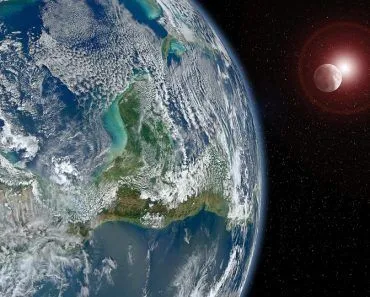
A "Flat Earth eclipse" is the Flat Earth Society’s alternative explanation for a lunar eclipse. They claim a mystery satellite of the sun – the "Shadow Object" or "anti-moon" – slips between the sun and the moon a few times a year, blocking sunlight from reaching the lunar surface. Mainstream astronomy explains the same phenomenon as the spherical Earth casting its shadow on the Moon – an explanation backed by every eclipse prediction astronomers have made for more than two thousand years.
The results of a poll conducted by YouGov revealed that about 2% of their selected batch (8,215 people) believed that we live on a pancake Earth (Source).
Flat Earthers And Flat Earth Society
2% may not seem like a big deal, but these people are just the tip of the iceberg. The same poll found that only 66% of Americans aged 18-24 said they had always believed the Earth is round – although the often-repeated "one-third of millennials think the Earth is flat" headline overstates the data, since just 4% of that age group actually said they had always thought it was flat (the rest were skeptical without committing). Together, these people are referred to as ‘Flat Earthers’ and have formed a collective community popularly known as the ‘Flat Earth Society.’
The society often puts out theories to explain day-to-day phenomena in support of their hypothesis of a flat Earth and recently have published another theory explaining how the lunar eclipse and, as a result, the blood moon appeared in the skies of January 2019.
Let’s take a look at the theory, shall we?

What Is A Lunar Eclipse Anyway?
An eclipse, in general, is when a space entity like a planet or the moon gets in the way of the sun’s light striking Earth. Currently, there are two different kinds of eclipses that we experience on our planet, namely, a solar eclipse and a lunar eclipse. In the event of a solar eclipse, it is the moon that blocks the passage of sunlight to the Earth’s surface, resulting in complete (or partial) darkness right in the middle of the day at certain locations. More information on solar eclipses can be found here – All you need to know about a solar eclipse.
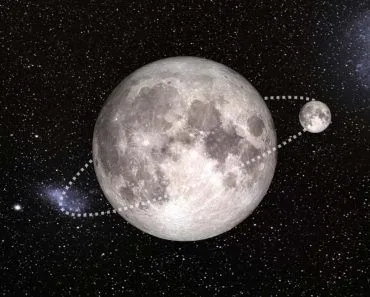
On the other hand, a lunar eclipse is when the Earth blocks the sun’s light from illuminating the moon’s surface. A lunar eclipse occurs for the same reason as a solar eclipse, i.e, the three bodies (the sun, Earth, and the moon) get aligned in a (somewhat) straight-line fashion (see the below image for reference). This configuration, also known as a syzygy, results in the central body (Earth, in the case of a lunar eclipse) shielding the terminal body (moon) from the sun’s rays.
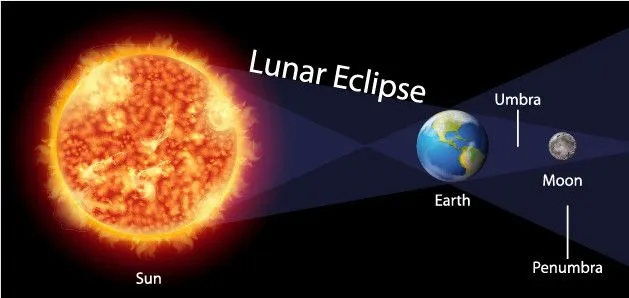
Similar to a solar eclipse, there are two types of shadows that the Earth casts on the moon. In the umbra region, the central portion of Earth’s shadow, our planet completely cloaks its satellite from the sun and causes a total lunar eclipse. Whereas in the penumbra region, the moon is partly shielded and appears to be only slightly dim, and is thus called a partial lunar eclipse.
Also, contrary to solar eclipses, lunar eclipses are safe to be observed with the naked eye and can be viewed from any location at night.
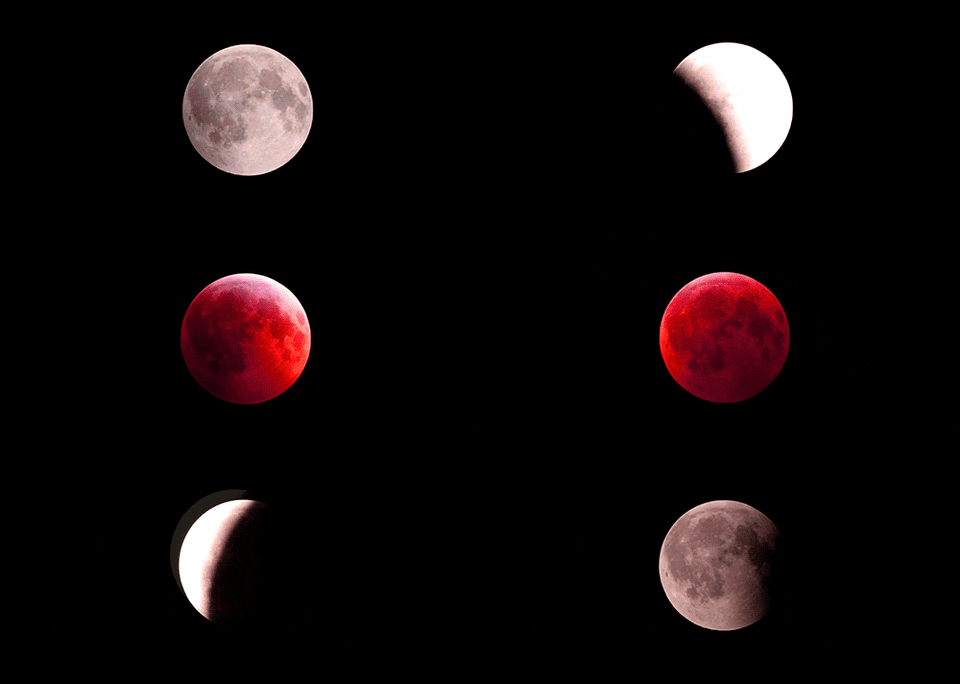
Logic dictates that since no sun rays are directly incident on the moon, no light is available to be reflected off its surface; thus, the moon should appear completely dark to all the viewers on Earth. However, a small amount of light refracted by the Earth’s atmosphere is incident on the lunar surface, resulting in a glowing reddish hue, leading to the name ‘blood moon‘.
The same phenomenon (Rayleigh’s scattering) is also responsible for many other perceptible phenomena, including the colors we see during a sunrise or sunset, as well as the color of the sky.
Now, let’s flip over to the flat side of things.
Flat Earth Eclipse
The flat Earth Society emphasizes Earth being a real-life Westeros with seven kingdoms (aka continents) laid around the north pole on a pancake Earth. At the edge of this pancake Earth are giant snow walls guarded by NASA, who either kill any trespasser in sight or hold them hostage forever. Additionally, the Earth is believed to be the center of the solar system & remain stationary, while all celestial objects hover/float over its surface (Source).
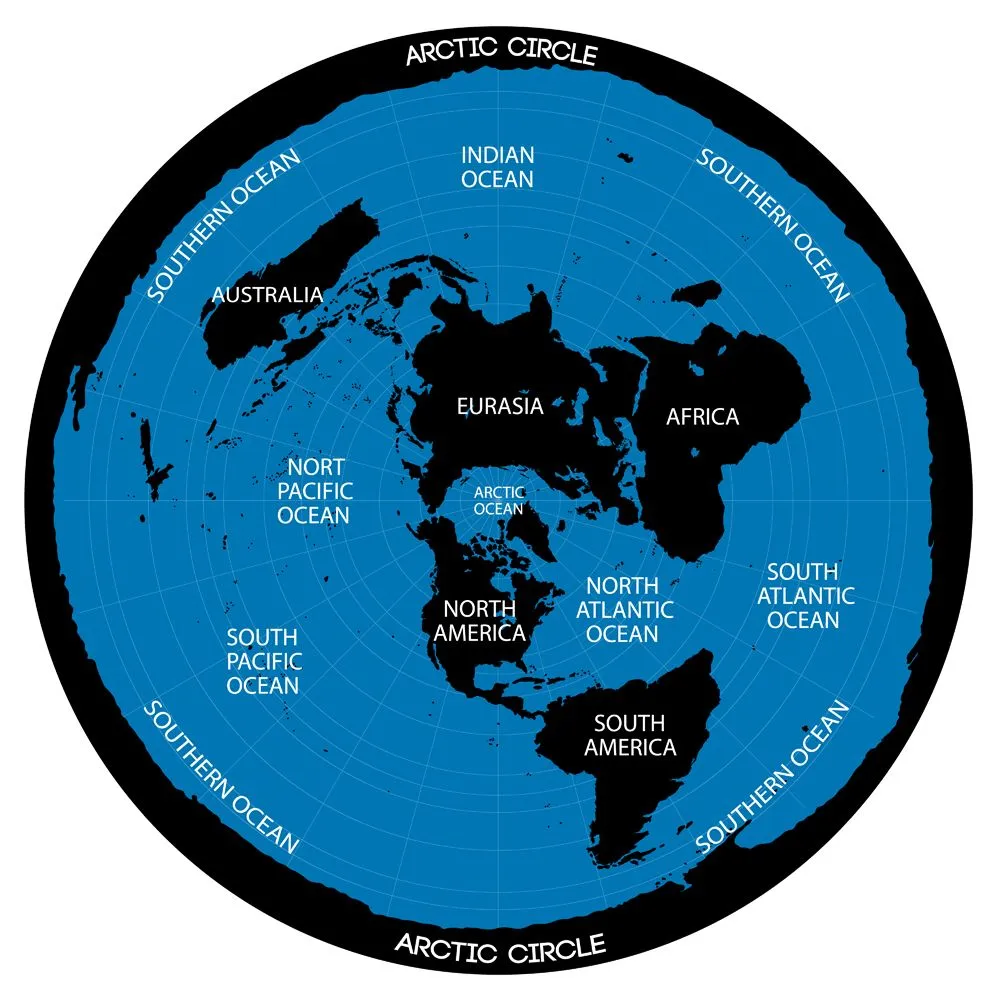
Coming back to the lunar eclipse, since the sun and moon are believed to float over our planet, the Flat Earth Society discards the alignment of the three bodies as the cause of lunar eclipses.
Instead, flat Earthers state that a lunar eclipse is caused by a mysterious satellite of the sun that finds itself between the sun and the moon a couple times every year. The mysterious entity has been given the name ‘the Shadow Object’ or ‘the Anti-moon’. According to them, the Anti-moon’s orbital plane is tilted by roughly 5°10’ with respect to the sun’s orbit and thus causes eclipses when the three (the sun, the anti-moon, and the moon) are aligned.
The mystery shadow object is also said to orbit in very close proximity to the sun and in a region where most celestial bodies are invisible to the naked eye. However, it may somehow find its way between the Solar System’s primary star, and our satellite as many as three times every year.
Pertaining to the identity of this mystery object, the Flat Earth Society claims that more study needs to be conducted in the matter, but there exists a slight possibility that it is an already known space entity.
Additionally, the theory explains the redness of the moon as a result of the Anti-moon’s density. The Anti-moon is thought to be not sufficiently dense (semi-transparent), which causes some light to leak through and fall on the moon’s surface. This occurrence is compared to the way a flashlight shines through one’s hand when placed directly over it.
For those with a curious mind, similar theories explaining eclipses can be found in Samuel Rowbotham’s (also known as Parallax) book ‘Zetetic astronomy’.
How Do Flat Earthers Explain A Solar Eclipse?
So the anti-moon takes care of the lunar eclipse. What about a solar eclipse, when the Sun goes dark in the middle of the day? Here things get oddly civil. For once, most flat Earthers agree with the rest of us: a solar eclipse happens when the Moon slides directly between the Sun and the viewer and blots it out (Inverse). NASA describes it the same way, with the Moon passing between the Sun and Earth and casting a shadow that blocks the Sun’s light. Rare common ground.

The trouble is what that agreement costs the flat model. In the Flat Earth Society’s version, the Sun and Moon are tiny, each only about 51 km (32 miles) across, hovering roughly 4,800 km (3,000 miles) above the plane and circling overhead like two lamps on a ceiling (source). For one lamp to perfectly cover the other, the two would have to be almost the same size, at almost the same height, and line up flawlessly on cue, over and over.
Real eclipses work for a far stranger reason. The Sun is genuinely enormous, about 1,392,600 km wide, while the Moon is only 3,474 km wide, so the Sun is roughly 400 times the Moon’s diameter. But the Sun also sits about 400 times farther away (some 151 million km against the Moon’s 384,400 km), and those two 400s cancel out. Both end up spanning almost exactly the same half a degree of sky, which is the only reason the Moon can just barely cap the Sun and leave its glowing corona on show (NASA). That is the trick of a big, distant Sun and a small, nearby Moon, not two lamps on a dome. It is also why totality falls along a narrow track that sweeps across the globe, exactly as spherical-Earth astronomy predicts, instead of dimming the whole flat disc at once.
Do Flat Earthers Think The Moon Is Flat?
Given the name of the movement, you might expect flat Earthers to insist the Moon is flat too. Most of them do not. The Flat Earth Society actually describes the Sun and Moon as small spheres, each about 51 km (32 miles) across, wheeling above the plane rather than pancakes stacked to match the ground below (source). So on the shape of the Moon, oddly enough, they and mainstream astronomy roughly agree: it is a ball, not a disc.

Where the two part ways is the light. Flat Earthers commonly claim the Moon shines with its own cold light instead of reflecting the Sun, an old idea that keeps resurfacing online (AAP FactCheck). NASA, and every spacecraft that has ever orbited it, says otherwise: the Moon makes no light of its own and simply mirrors sunlight off its gray rock, which is also why it always keeps the same face turned toward us.
The cleanest proof sits right in this article. During a total lunar eclipse the Earth blocks the Sun’s direct rays, and the Moon does not keep glowing. It dims to a dull coppery red, lit only by the sliver of sunlight bent through our atmosphere. A Moon with its own bulb inside would not care that Earth was in the way. And the real Moon is genuinely spherical and genuinely far off, about 3,474 km (2,159 miles) wide and 384,400 km (238,855 miles) away, close enough that we have actually flown there, not a 51 km lamp parked a few thousand kilometers overhead.
Conclusion
With the pace at which space research and space entities are discovered nowadays, one would think that the so-called Anti-moon must have already been discovered. Modern eclipses also offer a real-time stress test: the total solar eclipse of 8 April 2024, for instance, was tracked precisely as predicted by spherical-Earth astronomy across Mexico, the United States and Canada, with the Moon’s shadow racing in the direction and at the speed our textbooks said it would.
Also, no, it isn’t Mercury, Venus or Mars causing a lunar eclipse. They are millions of miles away from Earth and none of their orbits cross ours. However, this is presuming that the lunar eclipse is indeed caused by a mysterious object floating over a flat Earth.
The concept on which the Flat Earth Society anchor their hypothesis for a lunar eclipse, i.e, the Earth is flat as a pancake, has already been debunked several times. We, at ScienceABC, have also systematically exposed the Flat Earth Society’s hypothesis, which you can check out at How do we know the Earth isn’t flat?
References (click to expand)
- Lunar Phases and Eclipses.
- The Flat Earth | The Psychology of Extraordinary Beliefs - U.OSU.
- Rowbotham S. (2016). Zetetic Astronomy, Earth Is Not A Globe!: An Experimental Inquiry Into The True Figure Of The Earth: Proving It A Plane, Without Axial Or Orbital Motion; And The Only Material World In The Universe!. CreateSpace Independent Publishing Platform
- Types of Solar and Lunar Eclipses. NASA Science.
- Exploring Angular Diameter. NASA Goddard Space Flight Center.
- Moon Facts. NASA Science.
- Hess, P. How Flat-Earthers Explain the Eclipse Is Surprisingly Reasonable. Inverse.
- Flat-earthers orbit in fact-free zone with lunar light theory. AAP FactCheck.
- Modern flat Earth beliefs. Wikipedia.