Continental drift, proposed by Alfred Wegener in 1912, is the idea that the continents are not fixed but slowly drift across Earth’s surface. He argued they were once joined in a single supercontinent, Pangaea, that broke apart. Wegener lacked a workable mechanism, but his idea later became the foundation of the theory of plate tectonics.
The Earth has seven continents: North America, South America, Africa, Asia, Europe, Australia and Antarctica. These continents constitute about 29% of the Earth’s surface, while the remaining 71% is made up of water. However, did you know that once upon a time, all the continents were actually one large landmass? Believe it or not, it’s true!
Continental Drift Theory Definition
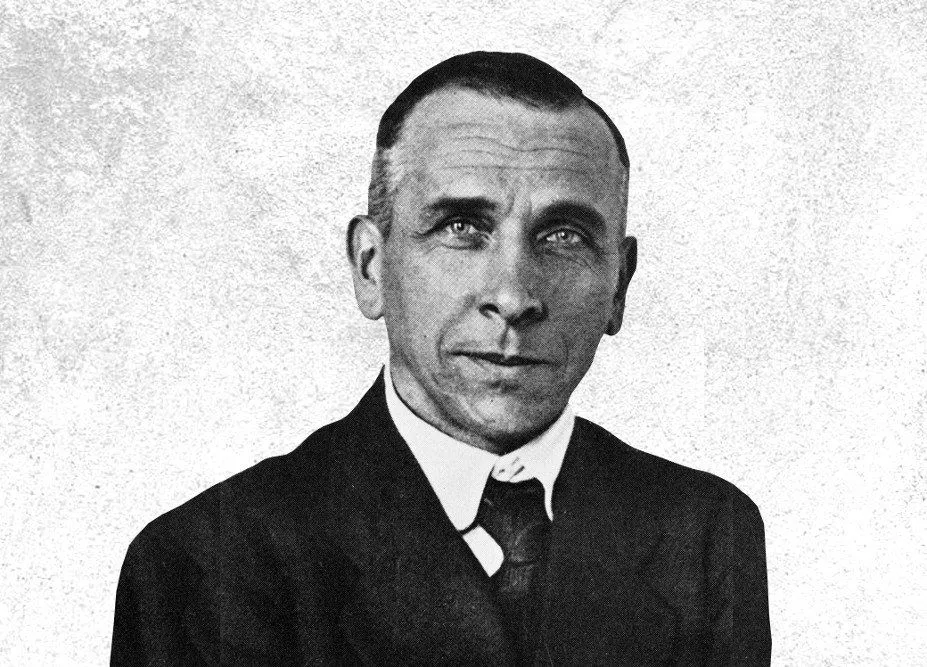
Alfred Wegener was a German scientist (a meteorologist and geophysicist by training). He first presented his theory of continental drift in lectures in 1912, then laid it out in full in his 1915 book The Origin of Continents and Oceans. In it, Wegener said that the continents were not fixed in place. He said that all the continents had initially been one big landmass, which he called Pangaea. This landmass eventually broke up and split into the smaller landmasses that are now the continents we know today. These continents are in a state of constant motion, although it is imperceptible on a daily basis. However, Wegener must have had some reason to come to this conclusion. One doesn’t just concoct such a story… so what was the basis of his theory?
Evidence Of Continental Drift
Wegener based his theory on 2 basic facts.
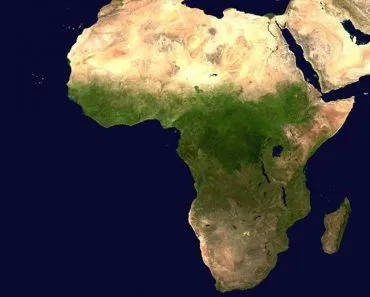
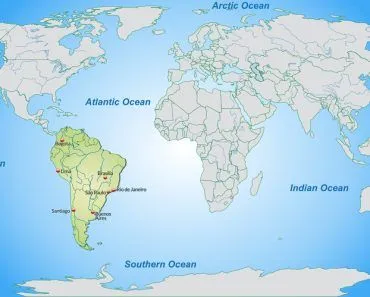
First was the geological fit. Wegener noticed that the coastlines of all the continents seemed to fit together, like a jigsaw puzzle. Even now, if you look at a world map or a globe, you will notice that the west coast of Africa fits into the east coast of South America. This is only one of many examples.
The second proof was the study of fossils. Wegener studied papers based on fossil findings and realized that fossils of various extinct animals were found in two or more disconnected regions. These animals could not have crossed an entire ocean to reach both places. One such example is the Mesosaurus, a small aquatic reptile (about 1 meter, or 3.3 feet, long) that lived in freshwater lakes and ponds roughly 280 million years ago. Because it could only survive in fresh water, it had no way to swim across the salty open ocean. Yet its fossils turn up in just two places on Earth: eastern South America and southern Africa.
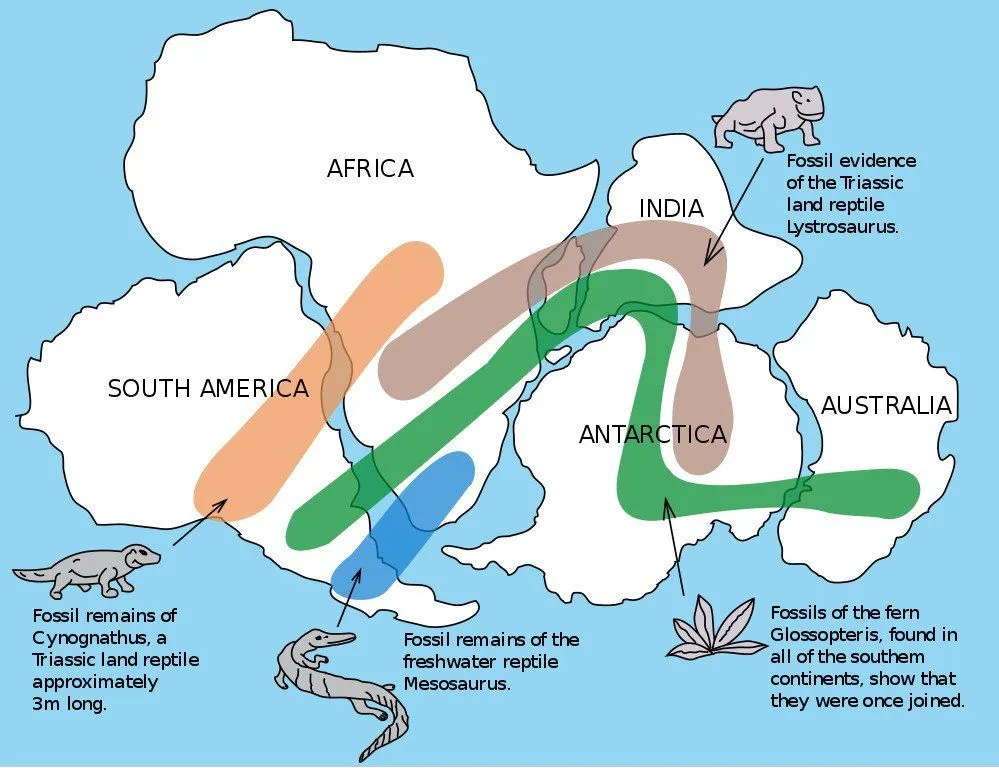
If you look at a globe, those two regions are separated by the Atlantic Ocean, which a freshwater reptile like the Mesosaurus could never have crossed. So there is no way it could have ended up in both regions unless they were once joined by land. Additionally, certain fossils were found in places that wouldn’t have been conducive to the growth of that particular plant or animal. Even the existence of certain types of rocks supported this piece of evidence.
Looking at these two main factors, Wegener built his continental drift theory. He pictured the lighter continents slowly plowing through the denser rock of the ocean floor, like icebergs drifting through water. For the force behind that motion, he proposed two candidates: a pole-fleeing force linked to the centrifugal force of Earth’s rotation, and the tidal pull of the Sun and Moon. (Notably, Wegener never invoked convection currents deep in the mantle. That mechanism was suggested later, in 1929, by the British geologist Arthur Holmes, and it eventually became part of modern plate tectonics.)

Rejection Of Wegener’s Theory
Wegener’s theory was not accepted, as those two factors were not considered good enough proof to support his claim. He was also unable to convincingly explain what actually moved the continents. Physicists ran the numbers and showed that the pole-fleeing and tidal forces he proposed were nowhere near strong enough to shove continents through solid ocean crust. This missing mechanism, more than anything else, led to the rejection of his hypothesis. However, history has proven that most theories that are groundbreaking revelations seem outlandish in their initial stages!
Plate Tectonics
Wegener’s theory did not gain the popular vote of the scientific community until after his death. Advancements in technology led to the collection of new data, which corroborated certain aspects of Wegener’s theory. As his theory was based on the data available to him then, it was proven wrong on a number of points, but it still provided the foundation for one of the most important theories in geology: the theory of plate tectonics. Plate tectonics did not come from a single person. It was pieced together by several scientists during the 1960s, building on the discovery of seafloor spreading. One key contribution came in 1965 from the Canadian geophysicist J. Tuzo Wilson, who described transform faults (a third kind of plate boundary) and is credited with coining the word "plate" itself.
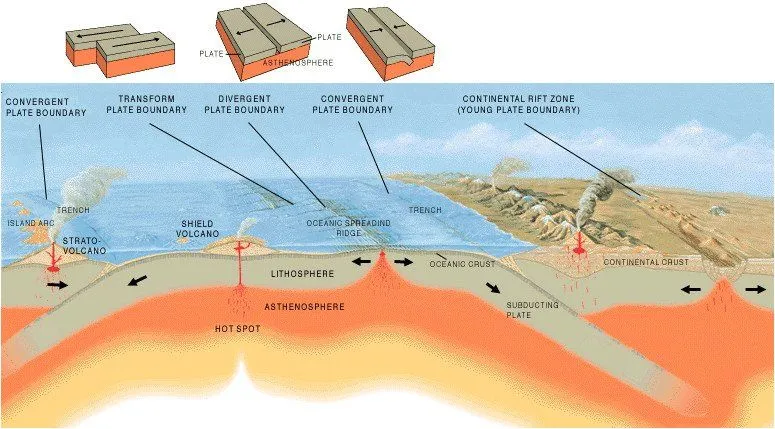
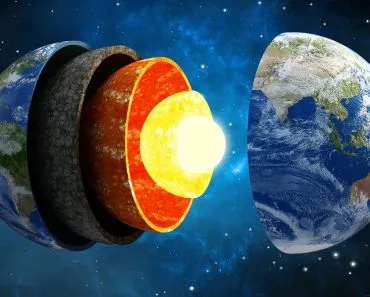
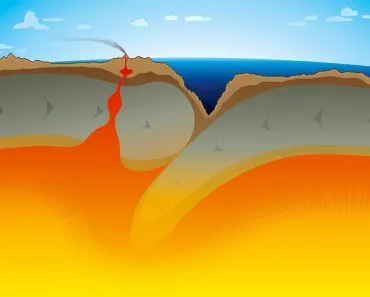
In this theory, the continents and the ocean crust together form the rigid outer shell of the Earth, called the lithosphere. The lithosphere is broken into large plates that ride on top of a deeper layer called the asthenosphere. The rock in the asthenosphere is not actually molten, but it is so hot and under such enormous pressure that it behaves like a thick, slowly flowing solid (think of how cold honey or putty oozes). The plates of the lithosphere drift on this slowly churning layer and are in constant, very gradual motion. It is this movement that broke Pangaea apart into the continents we have today.
The plate tectonics theory was essential, as it could also explain a number of irregularities in other theories. For instance, the formation of mountains. Earlier, it was believed that the Earth was initially a ball of molten mass. When this started to cool, it led to the surface cracking up in some places and folding on itself in others. This is how mountains were believed to have been created. However, according to this theory, all mountains should have been formed at approximately the same time, which is not the case. Plate tectonics provides another, more plausible explanation for this. Due to the constant movement and interaction of the tectonic plates with each other, various geological structures were formed. In places where a plate faced resistance to its movement, it would fold upward and create mountains.
The theory of Plate Tectonics is now widely accepted. There is sufficient proof to support it, and it is an important aspect of geology, oceanography, geophysics and even paleontology. Wegener’s theory may not have been entirely accurate, but with the data he had available to him at that time, it was still quite a feat.
How Is Continental Drift Different From Plate Tectonics?
It is easy to treat these two ideas as one and the same, but they are not. Continental drift was Wegener’s original hypothesis, and the U.S. Geological Survey describes it as the forerunner to plate tectonics. Plate tectonics is the modern, fully worked-out theory that grew out of it and now sits at the heart of the earth sciences. The real differences come down to three questions: what actually moves, what makes it move, and how much each idea can explain.

What moves. Wegener pictured the continents themselves plowing through the solid rock of the ocean floor, a little like icebergs shouldering through water. Plate tectonics says something quite different. The Earth’s rigid outer shell is broken into a dozen or more large slabs, and each slab carries both a piece of continent and a slice of ocean floor. The continents do not push through the seafloor at all. They ride along on top of the plates as passengers, drifting on the hotter, slowly flowing rock beneath.
What makes it move. This was Wegener’s fatal weakness. The forces he suggested, a pole-fleeing force and the pull of the tides, were far too weak to shove continents around, so his idea was rejected. Plate tectonics finally supplied a believable engine. In the early 1960s, Harry Hess of Princeton University proposed seafloor spreading: hot rock rises along the mid-ocean ridges, hardens into fresh crust, and shoulders the older crust aside, so the ocean floor itself is slowly created and carried outward. Along the Mid-Atlantic Ridge this happens at roughly 2.5 centimeters (about 1 inch) a year. Paired with the churning of the hot mantle below, it gives the plates a genuine reason to move.
How much it explains. Continental drift only tried to account for the fit of the continents and a handful of stray fossils. Plate tectonics reaches much further, tying together where earthquakes strike, why volcanoes cluster where they do, and how mountain ranges such as the Himalayas are pushed skyward, all through the way plates meet and grind at their boundaries. That reach is why one idea is now a historical stepping stone and the other is the backbone of modern geology.
References (click to expand)
- Historical perspective | This Dynamic Earth. U.S. Geological Survey
- Alfred Wegener and Plate Tectonics - www.indiana.edu:80
- Continental Drift and Seafloor Spreading - Dive & Discover. The Woods Hole Oceanographic Institution
- Alfred Wegener (1880-1930). The University of California Museum of Paleontology
- Understanding plate motions | This Dynamic Earth. U.S. Geological Survey