Table of Contents (click to expand)
- How Can A Gas Carry A Metal Like Gold?
- Where Is Mount Erebus, And Why Does It Have A Lava Lake?
- Why Does Mount Erebus Breathe Instead Of Exploding?
- Is There Really Gold In The Gas From Mount Erebus?
- How Does Gold Get Out Of Molten Rock And Into The Air?
- How Much Gold Does Mount Erebus Release Each Day?
- Why Can't Anyone Collect The Gold From Mount Erebus?
- What Would Happen If Mount Erebus Erupted?
- Is There Still Wreckage On Mount Erebus?
- What Else Comes Out Of Mount Erebus Besides Gold?
- Is Mount Erebus The Only Volcano That Emits Gold?
- So, Does Mount Erebus Really Puff Gold Dust Into The Sky?
Yes, Mount Erebus, an active volcano in Antarctica, breathes out roughly 60 to 80 grams of gold a day as tiny crystals, according to a 1991 study. The gold leaves the molten rock inside the hot gas, turns solid as that gas cools, and has been found in nearby snow and in air up to 1,000 km (620 miles) away. It was the smallest gold output of the five volcanoes the study compared, and it spreads far too thin for anyone to collect.
Picture the view from McMurdo Station, the largest settlement in Antarctica. (Yes, people do live in Antarctica all year round.) Everything is white, flat and frozen. On the horizon, 35 kilometers (22 miles) away, a mountain is smoking.
That mountain is Mount Erebus. A few years ago, news sites found a new reason to love it. One headline announced that Erebus blows USD 6,000 worth of gold into the air every day. A volcano, on the coldest continent, handing out gold.
It sounds like a legend a bored sailor made up. So is any of it true? Some of it is, and the true part is stranger than the headline.

How Can A Gas Carry A Metal Like Gold?
Step outside on a cold morning and breathe out. You see a small cloud. Now do the same in a warm kitchen. Nothing.
Your breath holds the same water both times. In the kitchen, that water stays a gas, called water vapor, and a gas is invisible. In the cold, your breath cools fast. When air cools, some of the water vapor turns into small water droplets. Those droplets are the cloud you see.
So your own breath teaches the one idea this whole article rests on. A warm gas can carry things you cannot see, and it drops them when it cools. Hold on to that.
Metals are harder to carry than water, but heat solves most problems. Volcanoes put out significant quantities of trace elements as vapor, meaning as part of the gas itself. Get the gas hot enough and even gold can ride along.
All we need now is a volcano that never stops breathing.
Where Is Mount Erebus, And Why Does It Have A Lava Lake?
Mount Erebus stands on Ross Island, just off the coast of West Antarctica. It rises 3,794 m (12,448 ft) above the sea. It is also the southernmost active volcano on the planet.
The British explorer James Clark Ross first saw it in 1841, and it was erupting at the time. He named it after one of his ships, HMS Erebus. In Greek myth, Erebus stands for darkness, which is a bold name for a mountain that glows.
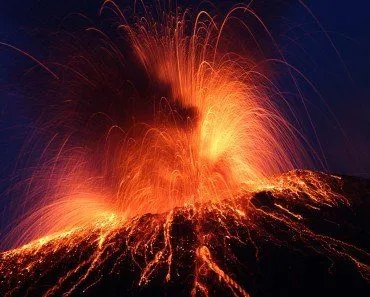
The glow comes from a lava lake, an open pool of molten rock sitting in the summit crater. The Smithsonian describes a crater about 500 by 600 m wide, with the lava lake in a smaller pit inside it. NASA notes the lake has been active since at least 1972 and is one of only a few long-lived lava lakes on Earth.
Most volcanoes keep their molten rock under a lid of solid rock. Erebus leaves the lid off.

Why Does Mount Erebus Breathe Instead Of Exploding?
A volcano turns violent when gas gets trapped inside thick molten rock. Pressure builds until the rock shatters. We cover that in our piece on why some volcanoes explode while others don't.
Erebus mostly skips that step, and the reason is water. The molten rock under the volcanoes of the Pacific Ring of Fire holds about 4% water by weight. A 2022 study in Nature Communications found that the molten rock under Erebus is dry. It holds about 0.1% water.
That matters. As wet molten rock rises, its water comes out as gas. The rock thickens and stalls on the way up. Dry rock does not stall. The same study traced an unbroken path of melted rock from deep in the Earth to within 1 km of the crater. Its authors suggest this helps explain the unusually long-standing, open conduit at Erebus. An open conduit is an open pipe.
So the gas does not build up. It leaks out, all day, every day. Erebus does not hold its breath. It breathes, and that steady trail of gas drifting downwind has a name. Scientists call it the plume.

Is There Really Gold In The Gas From Mount Erebus?
Yes. The whole story traces back to one four-page paper. In 1991, Kimberly Meeker and three colleagues reported gold in the Erebus plume in the journal Geophysical Research Letters.
They had sampled in three places. They caught particles from the plume at the crater rim, 210 m above the lava lake. They flew a plane through the air between Ross Island and the South Pole. They also melted and filtered snow from Ross Island.
All three held the same thing: tiny particles of pure gold. The ones in the air ran from 0.1 to 20 micrometers across. A micrometer is a thousandth of a millimeter. The ones in the snow were bigger, up to 60 micrometers, which is 0.06 mm. That is small enough to lose on a fingertip.
They were not shapeless specks. Under an electron microscope, the team saw clusters ending in "octahedral crystals". An octahedron looks like two pyramids glued base to base. (ScienceABC has a guide to how scientists work out a crystal's structure.) The gold had grown, neatly, in midair.
Gold turned up in 11 of 33 air samples and 3 of 11 ice samples. The plane still found it up to 1,000 km (620 miles) from the volcano.

How Does Gold Get Out Of Molten Rock And Into The Air?
Remember your breath on a cold morning. The same thing happens here, with far more heat and a better payload.
Deep molten rock holds a trace of gold. It also holds chlorine, the element in table salt. The 1991 team proposed that the two pair up, and the gold leaves the lava lake as a gold and chlorine gas. It is invisible, like the water in your warm breath.
Then that gas meets Antarctic air and cools. It can no longer hold its gold. The gold drops out as solid crystals, the way your breath drops water droplets.
The team had evidence for the chlorine idea:
- They caught one particle made of gold and chlorine together, right at the crater rim.
- Erebus gas is rich in chlorine. Its ratio of chlorine to sulfur was 10 to 100 times higher than at Kilauea in Hawaii.
- Kilauea put out more gold than Erebus, yet nobody had found gold particles in its plume.
There is a second reason the crystals showed up here. The paper found hardly any ash in the Erebus plume. At an ashy volcano, the authors note, gold may coat the ash grains and hide. At Erebus it builds its own crystals. It is the same metal that makes gold look golden in a ring.
Here is the honest part. The authors could not prove the chemistry. They wrote that missing lab data "precludes modeling at this time". Later work elsewhere points to more than one gold-carrying gas. Your breath is simple. A volcano's is not.

How Much Gold Does Mount Erebus Release Each Day?
Not much. Under three ounces.
The 1991 paper gives two figures, and they do not match. Its text says 0.06 kg a day. Its own table says 0.08 kg. So the fair answer is 60 to 80 grams (2.1 to 2.8 oz) a day. The press picked the bigger one. Nobody seems to have asked the table and the text to settle it.
Nobody weighed falling gold dust. The team measured the ratio of gold to sulfur on their filters. Then they multiplied by the volcano's known sulfur output. It is an estimate built on an estimate.
Now the part the headlines left out. The paper compared seven estimates from five volcanoes. In its own words, the gold output from Erebus "is the lowest measured". Etna in Italy came in at up to 2.4 kg a day. Kilauea came in at 0.5 to 0.8 kg. Erebus is not the richest volcano. It is the one where someone looked closely enough to find the crystals.
And the dollars? Follow the arithmetic:
- A metric ton of gold is 32,150.7 troy ounces, so one troy ounce is about 31.1 grams.
- That makes 80 grams about 2.57 troy ounces.
- The U.S. Geological Survey puts the average 2024 gold price at $2,400 a troy ounce.
- 2.57 × $2,400 is about $6,200.
That is where "$6,000 a day" came from. It is a 1991 estimate times the gold price on the day the headline was written. Nobody measured a dollar. The same sheet lists gold at $1,774 in 2020, so the volcano's "income" rose by about a third while the volcano did nothing new. We explain why humans value gold so much elsewhere. Erebus has no opinion on the matter.

Why Can't Anyone Collect The Gold From Mount Erebus?
Because the wind gets it first.
The paper worked out how a gold crystal travels. A 15-micrometer particle falls through still air at about 8 cm a second. Antarctic air is rarely still, so the crystals ride for hours and land far away.
Now spread the gold out. Take 80 grams and scatter it evenly over a circle 1,000 km in radius. That circle covers about 3.1 million square kilometers. Each square kilometer gets about 25 millionths of a gram a day. Sweep one square kilometer clean every day for a year and you would hold about 9 thousandths of a gram. Good luck finding it in the dustpan.
The gold does land. A 1997 study of Erebus gases found that the plume can be detected in snow "over a wide area of the continent". Its predicted levels of gold in Antarctic snow were close to the levels reported by others. (Polar snow holds odder things. See why Antarctica's snow is changing colors.)
Compare that with mining. The world's gold mines produced about 3,300 metric tons in 2024. At 80 grams a day, Erebus makes about 29 kg a year. Miners beat the volcano more than 100,000 times over.
There is also a legal lock on the door. The Antarctic Treaty has an environmental protocol, and its Article 7 is short. "Any activity relating to mineral resources, other than scientific research, shall be prohibited." The physics had already closed the mine. The lawyers just added the sign.

What Would Happen If Mount Erebus Erupted?
It already is erupting. The Smithsonian lists the volcano's last known eruption as 2026. It has not stopped.
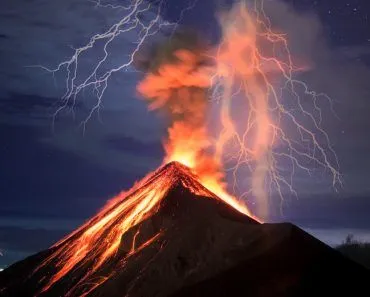
For Erebus, erupting is a lifestyle, not an event. The Smithsonian describes a lasting lava lake with minor explosions. Now and then come larger explosions that throw lumps of molten rock onto the crater rim. Scientists call these Strombolian eruptions, after Stromboli in Italy. Satellites now do most of the watching, since few people want to stand guard at a lava lake through a polar winter.
Could it do worse? Erebus erupts a rare rock type called phonolite. The 2022 study notes that phonolite has been "explosively destructive" in other settings. At Erebus, the dry rock and the open pipe let the gas out gently. The same leak that spares McMurdo is the one that carries the gold.

Is There Still Wreckage On Mount Erebus?
Many people search for Erebus for a sadder reason. On 28 November 1979, Air New Zealand Flight TE901, a sightseeing flight from Auckland, crashed into the lower slopes of the mountain. All 237 passengers and 20 crew died.
The Antarctic Treaty system now protects the crash zone as a Specially Protected Area. Its record says the site was designated a tomb, to be "left in peace". It is kept that way as a mark of respect for the victims. A steel memorial cross stands about 3 km away. The Treaty's summary does not list what remains on the ice, and this article will not guess.
What Else Comes Out Of Mount Erebus Besides Gold?
Gold is the smallest item on the list.
In 1983, Erebus was putting out about 230 metric tons of sulfur dioxide a day. For every gram of gold, the volcano breathes out nearly three tons of sulfur dioxide. The plume is a gas cloud with a rounding error of treasure in it.
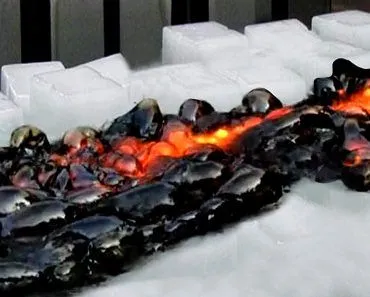
The gas also leaks through the mountain's sides. There it meets ice, and builds chimneys. Warm, wet gas freezes as it escapes and forms hollow towers of ice. One survey measured carbon dioxide at 43 actively degassing ice towers near the summit. For the messier version, see what happens when lava meets ice.
The plume also carries bromine, a chemical cousin of chlorine. A 2011 study found that bromine chemistry could explain a 35% loss of ozone inside the plume, about 30 km downwind. The famous hole high over the continent has other causes. We cover those in why ozone loss is worse over Antarctica.

Is Mount Erebus The Only Volcano That Emits Gold?
No, and the 1991 authors never said so. Their claim was narrower. Erebus was "the first volcano" where crystals of pure gold were found and recorded. They also guessed that such particles "might exist" at other volcanoes.
They were right. In 2000, a team working at Colima volcano in Mexico slid a silica tube into a vent at 800 °C. Gold crystals 3 to 40 micrometers across grew on its inner wall. Some were octahedra, the same two-pyramid shape. A 2006 study at Kudryavy volcano in Russia's Kurile Islands found grains of native gold in crusts left by its hot gas.
What still sets Erebus apart is where its gold ends up. At Colima, the crystals grew inside a tube. At Erebus, they fly. Over ten years of sampling air from 75° north to the South Pole, the 1991 team found gold crystals nowhere except Antarctica.
So, Does Mount Erebus Really Puff Gold Dust Into The Sky?
Yes. Just not the way the headlines tell it.
Put the pieces together. Erebus has dry molten rock and an open pipe, so it breathes all day and rarely blows. Its breath is hot and rich in chlorine, so it can carry gold as an invisible gas. Antarctic air is bitterly cold, so that gas cools fast and drops its gold as crystals. The plume is almost free of ash, so the crystals stay clean enough to find.
The amount is tiny, 60 to 80 grams a day, the lowest in the 1991 comparison. The dollar figure is a gold price with a volcano attached. And the crystals spread over a continent of ice, where the law forbids mining anyway.
That is fine. This gold was never going to be jewelry. It came from deep in the Earth, and before that from somewhere far stranger. Now it drifts over the coldest place on the planet as crystals too small to see, because a mountain breathed out on a cold morning.
References (click to expand)
- Meeker, K. A., Chuan, R. L., Kyle, P. R. & Palais, J. M. (1991). Emission of elemental gold particles from Mount Erebus, Ross Island, Antarctica. Geophysical Research Letters, 18(8), 1405-1408
- Hill, G. J. et al. (2022). Trans-crustal structural control of CO2-rich extensional magmatic systems revealed at Mount Erebus Antarctica. Nature Communications
- Erebus. Global Volcanism Program, Smithsonian Institution
- Erebus Breaks Through. NASA Earth Observatory (29 November 2023)
- Mount Erebus, Antarctica. NASA Earth Observatory (5 February 2016)
- Zreda-Gostynska, G., Kyle, P. R., Finnegan, D. & Prestbo, K. M. (1997). Volcanic gas emissions from Mount Erebus and their impact on the Antarctic environment. Journal of Geophysical Research: Solid Earth
- Wardell, L. J., Kyle, P. R. & Campbell, A. R. (2003). Carbon dioxide emissions from fumarolic ice towers, Mount Erebus volcano, Antarctica. Geological Society, London, Special Publications
- Boichu, M., Oppenheimer, C., Roberts, T. J., Tsanev, V. & Kyle, P. R. (2011). On bromine, nitrogen oxides and ozone depletion in the tropospheric plume of Erebus volcano (Antarctica). Atmospheric Environment
- Taran, Y. A., Bernard, A., Gavilanes, J.-C. & Africano, F. (2000). Native gold in mineral precipitates from high-temperature volcanic gases of Colima volcano, Mexico. Applied Geochemistry
- Yudovskaya, M. A. et al. (2006). Gaseous transport and deposition of gold in magmatic fluid: evidence from the active Kudryavy volcano, Kurile Islands. Mineralium Deposita
- Gold. Mineral Commodity Summaries 2025. U.S. Geological Survey
- Protocol on Environmental Protection to the Antarctic Treaty (1991), Article 7. Secretariat of the Antarctic Treaty
- ASPA 156: Lewis Bay, Mount Erebus, Ross Island. Antarctic Protected Areas Database, Secretariat of the Antarctic Treaty
- Erebus disaster. NZ History, New Zealand Ministry for Culture and Heritage
- How Clouds Form. UCAR Center for Science Education
- Mount Erebus blows USD 6,000 worth of gold into the air every day. Polar Journal (cited only as an example of the press claim)
How this article was made. It was researched from the sources cited above and drafted with the help of AI, then fact-checked, edited and approved by Abhishek Jain before publication. Illustrations that are not credited to a photographer are generated diagrams or illustrations, not photographs.