Earth's core stays roughly 3,400-5,700 °C (6,150-10,300 °F) for three reasons working together. First, leftover primordial heat from the planet's violent formation 4.6 billion years ago is still locked inside. Second, slow radioactive decay of uranium-238, uranium-235, thorium-232, and potassium-40 keeps generating fresh heat. Third, latent heat is released as the molten outer core slowly crystallizes onto the solid inner core.
Imagine it’s the dead of winter and you are soaking up a good night’s sleep tucked inside your blanket. The next day is already planned, and you’ve decided to take your dog for a stroll in the park. You wake up feeling pretty excited, but alas, when you look outside the window, the snow has covered every single speck of soil.
Suddenly, you remember one of the topics you were studying yesterday and begin to feel confused. You’re sure that you read that the Earth’s core is bubbling hot. If that’s the case, where is all that heat disappearing to, and why does the snow pile up if there’s so much heat down there?
If this thought process has ever passed through your head, it seems like you may have missed out on a lot of important points about the Earth’s core!
Yes, it is extremely hot, but it has been like that since the birth of the Earth. Instead, the hot core is why you are able to exist on this planet! Does that sound strange? Well, it’s not. Earth’s hot core is crucial for our ongoing existence.
Before we travel down to the deepest point inside the Earth, let’s try to understand a bit more about the layers of the Earth.
The Earth – Layer By Layer
Although we humans have progressed to the point where we are able to take a photograph of a black hole, unraveling the mysteries of our own planet has never been easy. However, the analysis of rocks brought out by volcanic eruptions and the study of seismic waves (waves generated inside the Earth due to earthquakes, volcanic eruptions, or any other disturbance) has helped us better understand the internal structure of our planet.
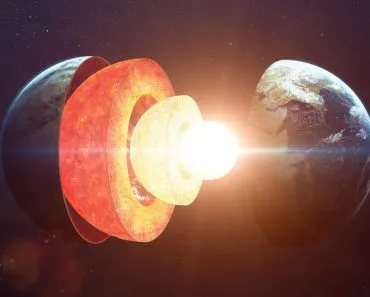
The Earth is not one homogeneous solid, but is instead composed of a number of layers. Earth was created with the birth of the solar system around 4.6 billion years ago. Initially, it was just a ball of gases, but as the gases reacted with each other and materials of varying densities began separating, Earth became what it is today, a huge rocky planet with an onion-like interior.
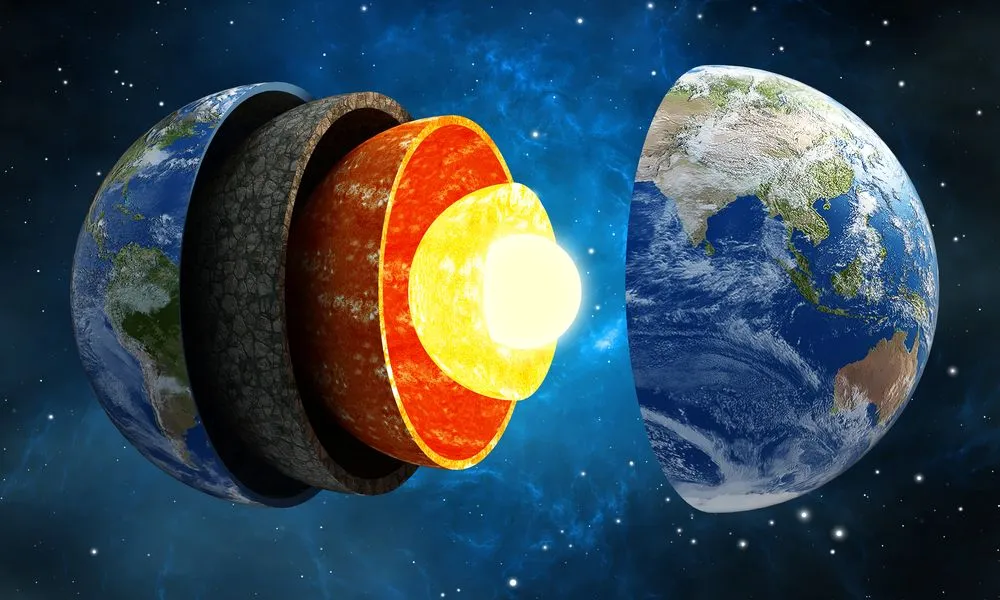
The outermost layer of the Earth is the crust. This is the layer where we live, build houses, and plant trees. The crust is pretty thin compared to the layers underneath. Oceanic crust is about 8 km (5 mi) thick and is mostly composed of basalt; continental crust averages around 30-50 km (19-31 mi) thick and is mainly composed of granite.
The next layer present just below the crust is known as the mantle. This section is 2,900 km thick. The upper mantle is rigid and brittle, but the lower mantle flows like a semi-molten rock. The upper layer of the mantle, in combination with the crust, is known as the Lithosphere, whereas the semi-molten layer is called the Asthenosphere.
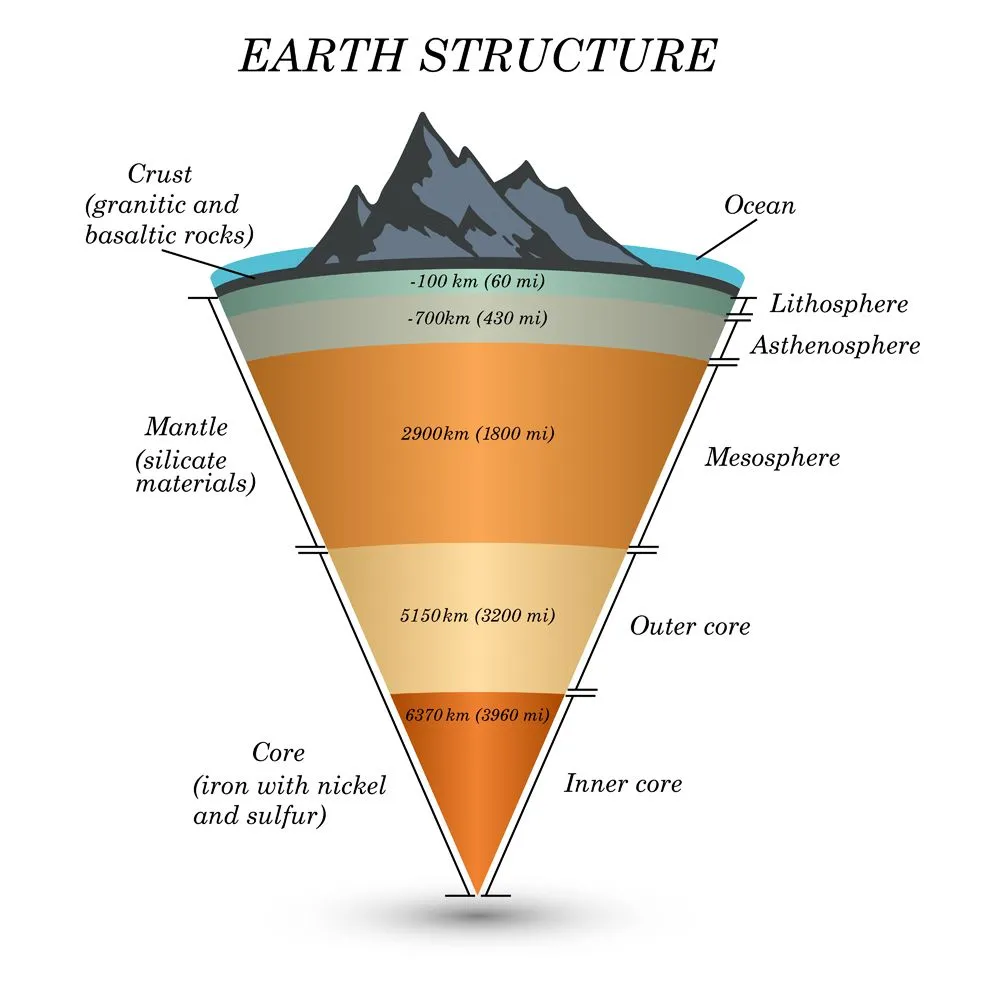
Below the mantle lies the core, which is divided into two portions: the outer core and the inner core. The outer core is mainly composed of iron and nickel (with a few percent lighter elements like sulfur, oxygen, and silicon) and is completely molten. Its temperature climbs with depth, from roughly 3,400 °C (6,150 °F) where it meets the mantle to around 5,200 °C (9,400 °F) at its boundary with the inner core, and it is approximately 2,260 km (1,400 mi) thick.
Crossing the outer core, we reach the hottest part of the planet, the inner core. Its temperature is estimated at roughly 5,200-5,700 °C (9,400-10,300 °F), comparable to the surface of the Sun. The most surprising part is that, even at those temperatures, the inner core is solid: the immense pressure (more than 3.5 million atmospheres) squeezes iron into the solid phase. Its radius is about 1,220 km (760 mi).
Why Is Earth’s Core So Hot?
For we humans living merrily on the crust, it's hard to imagine that the Earth's core can have a temperature comparable to the Sun's surface. The real question naturally follows… how is our 4.6 billion-year-old Earth still generating so much heat? There are three main reasons behind the Earth's flaming core: leftover primordial heat, radioactive decay, and the latent heat released as the molten outer core slowly freezes onto the solid inner core.
Primordial Heat
Firstly, it is due to the process by which our planet was formed: accretion. When the solar system came into existence, our planet also began its journey around the sun. The gravitational pull was so strong that a number of meteorites and several other objects came together to form a large planet. Whenever such accretionary processes occur, the amount of heat produced is humongous.

After this planetary formation process was over, materials started separating into layers according to their density. The densest materials settled in the core. Even this settling process produced a lot of heat.
This primordial heat of Earth is still present in the core because our large Earth was unable to dissipate it quickly when it was created and now this heat has settled. It can only dissipate through the crust, but since the plates act as a blanket and the mantle is not a particularly good transporter, the heat is here to stay for a long time.
Radioactive Decay
The second reason behind the heated interior is the slow decay of long-lived radioactive isotopes (mainly uranium-238, uranium-235, thorium-232, and potassium-40) concentrated in the mantle and crust. Each decay event releases energetic alpha and beta particles whose kinetic energy thermalizes (turns into heat) as the particles slam into surrounding atoms.
One important distinction: primordial heat is mostly stored in the core, while the heat from radioactive decay is generated throughout the silicate mantle and crust. Modern estimates from KamLAND and Borexino geoneutrino measurements put the present-day radiogenic contribution at roughly half of Earth's total heat flow of about 47 terawatts.
Latent Heat From The Crystallizing Inner Core
The third source is more subtle: as Earth slowly cools, the boundary between the liquid outer core and the solid inner core inches outward. Iron freezing onto the inner core releases latent heat (the same way water releases heat when it freezes), and that energy helps power the convection currents in the outer core that generate Earth's magnetic field.
However, is this hot core really helping us in any way? Let’s find out more!
Importance Of Earth’s Core
While Earth’s core rivals the temperature of the Sun’s visible surface, it is paramount in sustaining life on our planet. The outer core is liquid and thus keeps flowing. Convection currents are generated due to this motion, which is the cause behind Earth’s magnetic field. This magnetic field in turn saves us from solar flares and maintains Earth’s habitable atmosphere. The inner core helps in stabilizing this magnetic field.
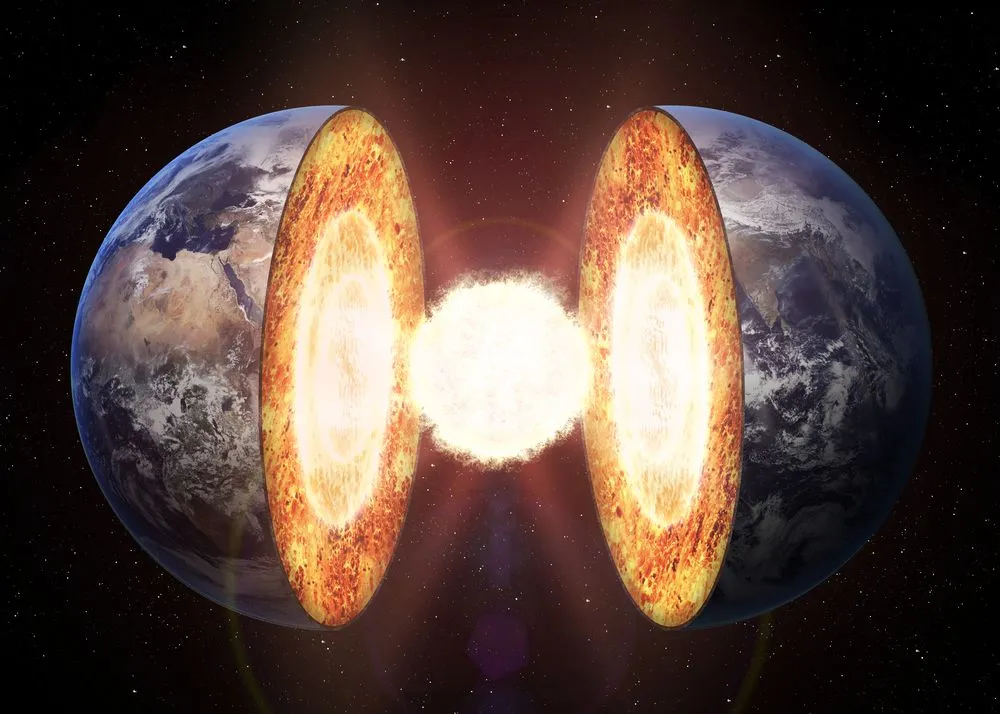
The convection currents in the outer core and the heat it generates create motion in the above layers, especially in the mantle. This movement helps the plates in shifting, thus leading to the shifting of continents and the creation of new landmasses.
If Earth’s Core Is So Hot, Why Is The Deep Ocean So Cold?
This is exactly the puzzle we started with. If a ball of iron nearly as hot as the surface of the Sun is sitting a few thousand kilometers beneath our feet, why does the water at the bottom of the ocean hover just above freezing? Below roughly 200 meters (660 feet), the average temperature of the deep ocean is only about 4 °C (39 °F), and near the seafloor it stays close to that no matter which ocean you are in.

The first reason is that the core’s heat barely reaches the seafloor. The amount of heat leaking up through the ocean bottom (the geothermal heat flux) averages only about one-tenth of a watt per square metre. The Sun, by contrast, pours hundreds of watts per square metre onto the surface, so the star overhead delivers well over a thousand times more energy to the ocean than the planet does from below. The thick, poorly conducting rock of the crust and mantle acts like a blanket, so the core’s warmth simply cannot flood the water above.
The second reason is that cold water is heavy. Cold, salty water is denser than warm water, so it sinks. Near the poles, chilled surface water plunges to the bottom and spreads out across the ocean floor as part of a slow global loop known as the thermohaline circulation, or the “global conveyor belt”. This constant delivery of fresh cold water keeps replacing anything the feeble trickle of geothermal heat might warm. Add in the fact that sunlight only heats the top few hundred meters, and the deep ocean is left permanently cold, no matter how fiercely the core burns below. If you want the full story, we have a whole article on why the bottom of the ocean is so cold.
If The Inner Core Is The Hottest Part, Why Is It Solid?
Here is a fact that sounds like a misprint: the hottest place on the planet is a solid ball of metal, and it is wrapped in a layer of liquid metal that is cooler than it is. Everything you know about heat says it should be the other way around.
Start with the number that makes the puzzle sharp. At the pressure you are sitting in right now, iron melts at about 1,538 °C (2,800 °F). The inner core sits at roughly 5,200 °C (9,400 °F), more than three times that. By everyday logic it should have melted long ago, and stayed melted.
The thing everyday logic leaves out is pressure. Melting is really just atoms gaining enough energy to break out of their fixed positions and slide past one another. Squeeze those atoms hard enough and there is nowhere left to slide to, so you have to add even more heat before the solid finally gives way. In other words, for a metal like iron, pressure raises the melting point.
And the pressure down there is not a minor adjustment. At the boundary where the inner core meets the outer core, the weight of the entire planet bears down at about 330 gigapascals, roughly 3.3 million times the air pressure at sea level. In a 2013 study published in Science, researchers squeezed iron inside a laser-heated diamond anvil cell and used X-ray diffraction to catch the moment it melted, then extrapolated to core conditions. Their answer: at 330 GPa, iron does not melt until roughly 6,230 K (about 5,960 °C or 10,750 °F). The inner core is ferociously hot, but it is not that hot, so it stays solid.

The same idea explains the liquid layer above it. The outer core is cooler, but it also sits at lower pressure, which means its melting point is lower too. The temperature there is high enough to clear that lower bar, so the iron flows. The boundary between the two is simply the depth where the planet's own temperature and iron's melting point cross paths. There is one more wrinkle: the core is not pure iron. It carries lighter elements such as sulfur, oxygen and silicon, and those push the melting point down by several hundred degrees, which is why scientists quote a range here rather than one tidy number. If you are wondering how anyone works this out without ever going there, we have a separate article on how we know what is inside the Earth’s core.
How Far Down Is Earth’s Core?
If you could somehow drill straight down, you would not reach the core for a very long time. Earth’s average radius, the distance from the surface to the very center, is about 6,371 km (3,959 mi), and the crust you are standing on is only a thin skin on top of all that.
The mantle stretches down to the core-mantle boundary at a depth of roughly 2,900 km (1,800 mi), which is where the outer core begins. The liquid outer core reaches down to about 5,150 km (3,200 mi), and below that the solid inner core continues all the way to the center. The inner core alone has a radius of around 1,220 km (760 mi). So the deepest and hottest point on the planet, its very centre, lies about 6,371 km beneath your feet, farther than the width of the continental United States.
Conclusion
Earth’s core is vital for the existence of not only humans, but all living beings, including plants. If it went cold, became too solid or too liquid, there would simply be no way for life to survive or thrive. Such is the precious balance that Earth’s core brings to our world!
References (click to expand)
- The Earth's Layers Lesson #1 (Volcano World, Oregon State University)
- Why is the interior of the Earth hot. earthobservatory.sg
- Earth's Core Is in the Hot Seat (Eos, American Geophysical Union)
- What is Earth's inner core made of? (US Geological Survey)
- Earth: The interior (Encyclopaedia Britannica)
- Multidecadal variation of Earth's inner-core rotation (Yang & Song, Nature, 2023)
- Why does the ocean get colder at depth? (NOAA National Ocean Service)
- How does the temperature of ocean water vary? (NOAA Ocean Exploration)
- The interior structure of the Earth (University College London, Seismology)
- Melting of Iron at Earth’s Inner Core Boundary Based on Fast X-ray Diffraction (Anzellini et al., Science, 2013)
- Core (National Geographic Education)
- Iron: Periodic Table of Elements (Los Alamos National Laboratory)
- Sun: Facts (NASA Science)
- Estimating core-mantle boundary temperature from seismic shear velocity and attenuation (Frontiers in Earth Science, 2022)