Table of Contents (click to expand)
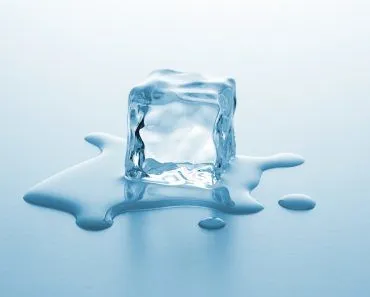
Ice water chills a can far faster than a pile of loose ice cubes, even though both settle at the same 0 °C (32 °F). Water floods every gap and hugs the whole can, while a hard cube touches the curved can at only a few tiny spots, with insulating air filling the rest. The water also carries warmth away as it flows and soaks up heat as it melts, so ice water can cool your drink in roughly half the time.
Picture a backyard barbecue on a hot afternoon. Two coolers sit by the grill. One holds a pile of loose ice cubes straight from the freezer. The other holds ice cubes swimming in cold water. A friend bets you a dollar that the loose ice, being dry and frozen solid, chills a warm can faster. Dry cubes feel colder to the hand, after all.
Take the bet. You will win.
Here is the strange part. Give the fresh ice a few minutes, and both coolers sit at the exact same temperature. Ice and its meltwater sit together at 0 °C (32 °F), no colder, no warmer. Every instinct says the result should be a tie. It is not a tie. Ice water wins, and it wins by a lot. To see why, we need to follow the heat.
How Does Heat Move Out Of A Warm Can?
Start with the basic idea. Chilling a drink is not about adding cold. There is only heat flowing out: your warm soda has heat in it, and the ice pulls that heat away. Hold on to that. It is the whole article.
Heat can travel in three ways. It can travel by touch, which physicists call conduction: a hot thing presses against a cold thing, and the heat marches across the border. It can travel by flow, called convection, when a warm liquid or gas moves off and carries its heat with it. And it can travel as invisible rays, called radiation, the way a campfire warms your face from across the yard. A thermos flask works by blocking all three at once.
In a cooler, radiation barely matters. The real contest is between touch and flow. And touch has one strict rule. Heat can only cross where two things actually meet. Think of the can as a crowded room and the heat as the crowd trying to get out. Wherever something cold touches the can, there is an open door. No touch, no door. That rule is about to decide the whole thing.
One more point. We are not asking which cooler ends up colder; both end up at the same 0 °C. We are asking which one gets there first. This is a race, not a destination, which is exactly where most people's guess goes wrong.

Why Your Ice Barely Touches The Can
Here comes the trap. Look up the numbers to settle the bet, and you find something odd. Solid ice carries heat better than liquid water, by more than double. So the loose cubes should win the race, right?
They lose anyway. Badly. That is the clue. If the material that carries heat better still loses, the ice itself was never the bottleneck. The bottleneck is at the border, where the cube meets the can, and at that border sits a third material we have not counted yet: air.
Set a hard ice cube against a round can and look at where they meet. A flat, rigid cube against a curved wall touches at a few tiny points, no more. Press any two solid surfaces together and they meet only at scattered high spots, never across the whole face. The cube opens a few tiny doors.
What fills the rest of the space? Air. And air is one of the best insulators around, roughly 25 times worse than water at carrying heat. Every gap between the cube and the can is a pocket of insulating air, a stretch of blank wall with no door in it.
Now pour in water. It floods into every gap and hugs the whole curved can, top to bottom, with no air pockets left. The can now touches a heat-hungry material across its whole skin instead of at a few freckles. Every wall has become a door. The ice carries heat better, but it never gets the chance to prove it, because the heat cannot reach it.

Water Moves, And Loose Ice Cannot
Touch is only half of the water's advantage. The other half is that water flows.
Watch the surface of the can. The water right against the metal warms as it steals heat, and warm water is a touch lighter than cold, so it drifts upward and away. Cold water slides in to take its place, grabs more heat, warms, and leaves too. The ice water keeps feeding cold water to the can and hauling warm water off. This is the flow we met earlier, the same engine that drives weather and boils a pot of pasta. In the crowded room, the hallway outside every door keeps clearing, so the crowd never backs up.
Loose ice can do none of this. The thin film of meltwater and air next to the can just sits there, warms up, and turns into a blanket. So loose ice loses twice over. It touches less, and it cannot flow. A little meltwater pooling at the bottom of the cooler helps a bit, which is a quiet hint that water was the hero all along.
This is also why stirring helps. It does not make ice water colder; it pushes the warmer water up against the ice so the glass reaches the freezing point sooner, and the faster water moves past a surface, the faster it carries heat away. Spinning a can in ice water is the flow trick on fast-forward.

The Melting Ice Is A Heat Sponge
There is a third trick, and it is the most powerful of all. When ice melts, it soaks up a startling amount of heat without getting any warmer. This hidden heat is called the latent heat of fusion, and it is the star of its own full ScienceABC explainer.
Melting a gram of ice into water, with both stuck at 0 °C, takes about 80 times as much heat as warming that gram of water by a single degree. Cold water alone can only warm up as it takes heat in. Melting ice keeps soaking up heat at a fixed 0 °C and never budges. Back in the crowded room, the ice is a hall beyond the doors that never fills.
Put it on a real can. Chilling a can of soda from a warm 25 °C (77 °F) down to a crisp 4 °C (39 °F) melts only about three or four ice cubes' worth of ice. In ice water, that melting happens right at the can's skin, where it does the most good.

Isn't Ice From The Freezer Colder Than Ice Water?
A sharp-eyed reader will object here. Ice straight from the freezer is not at 0 °C at all. A home freezer should sit at about -18 °C (0 °F), so a fresh cube starts a good 18 degrees colder than ice water. Doesn't that hand the loose ice a head start?

A small one, and only for a moment. Ice cannot melt until it warms to its melting point, so a frozen cube first has to soak up heat just to get there. That climb is worth roughly one-ninth of what the melting itself soaks up. A nice bonus, not the main prize.
That bonus also gets spent fast. The outside of a cube, the only part that ever touches your can, warms first, and once a wet film forms on it, that surface sits at the freezing point like everything else in the cooler. The extra chill does nothing about the real problem: a freezer-cold cube still touches the can at a few tiny points, with insulating air in between. Colder ice behind the same few doors is still a few doors.
So when people ask how melted ice can chill better than a colder cube, this is the answer. The meltwater is not colder than the ice. It is simply better at reaching the drink.
So What Is The Fastest Way To Chill A Drink?
So far both coolers sat at the same 0 °C. There is one way to break that tie, and bartenders and ice cream makers have used it for ages. Add salt.
Salt does not make ice colder by magic. It lowers the temperature at which water can stay frozen. Toss salt into ice water, and the ice starts to melt even below freezing. Melting soaks up heat, so the whole mix chills down past the normal freezing point, as low as about -21 °C (-6 °F) before it finally freezes solid. This is the same freezing-point trick that lets salt melt the ice on a winter road, run backward to make things cold.
Salt is a different lever from the other three tricks. Touch, flow and melting all speed up how fast heat crosses at 0 °C. Salt instead makes the ice water colder, which widens the temperature gap that drives the whole race, and a bigger gap means faster cooling. It is why the crank tub of an old ice cream churn is packed with rock salt and ice, not ice alone.
Now put it all in order. Fastest is salted ice water, because it stacks full touch, flowing water, melting ice and a below-freezing temperature. Next is plain ice water, which still has three of those four working for it. Then the freezer, slower than people expect, because dry cold air moves heat about as badly as the air gaps around a cube. Loose ice on its own comes after that. Dead last is the fridge, which was built to hold food cold, not to chill a warm can in a hurry. The container matters too: a thin aluminum can gives up its heat fast, a glass bottle is slower, and a thick plastic bottle slower still.

So, ice or ice water? Ice water, and it is not close. The surprise fades once you stop thinking about temperature and think about the doors instead. Both coolers are the same 0 °C; that was never the question. The question was how fast the heat could get out.
Loose ice offers a handful of tiny doors and a wall of insulating air. Ice water opens every wall, keeps the hallways clear with its flow, and soaks up heat by the bucket as it melts. Same coldness, wildly different exits.
The next time someone bets you the dry cubes win, take the dollar. Then hand them a cold drink from the ice water, and let the physics do the bragging.
References (click to expand)
- Thermal Conductivity of Common Materials — HyperPhysics, Georgia State University
- Thermal Contact Conduction — DSPE Knowledge Base
- The Latent Heat of Melting (Fusion) of Ice — Physics 524, University of Illinois
- Specific Heat — HyperPhysics, Georgia State University
- Learning Lesson: We All Scream for Ice Cream — NOAA JetStream
- Refrigerator Thermometers: Cold Facts about Food Safety — U.S. Food and Drug Administration
- Table of Specific Heats — HyperPhysics, Georgia State University
- Forced Convection Heat Transfer — ENSC 388 course notes, Simon Fraser University