Newton’s cradle is a desk toy and an educational tool that demonstrates the laws of conservation of energy and momentum. When one of the balls is lifted & released, it strikes the subsequent stationary balls and through a series of swift energy transfers, the last ball gets propelled outwards.
Seen on the desk of every Fortune 500 CEO, psychotic villains, or protagonists in movies, Newton’s Cradle is a corporate toy most of us wish to have on our work tables. This swinging ball setup relieves stress in some and inspires creativity in others, but for the majority of people, it is little more than a fascinating distraction.
The device is named after Sir Isaac Newton and is also known as Newton’s pendulum, Newton’s rocker, and more casually, Newton’s balls. Newton’s cradle, apart from being an elegant decorative piece, also demonstrates two very important and fundamental laws of physics, namely the law of conservation of momentum and the law of conservation of energy.
History Of Newton’s Cradle
Contrary to popular belief and its naming, the swinging ball setup was not actually invented by Newton, nor was he the first to ink the laws that the toy demonstrates.
The principles demonstrated by such a cradle were first mentioned in a paper presented by John Wallis, Christopher Wren, and Christiaan Huygens to the Royal Society in the year 1662. Christiaan Huygens, in particular, contributed the most to the cradle’s invention. Huygens’ work, De Motu Corporum ex Percussione, discusses the collision of suspended bodies and the transfer of motion from a moving body to the one at rest. He was also the first to report that explaining the mechanics behind a cradle-like system required the use of conservation of momentum and a quantity proportional to mass times velocity squared. The quantity mass times velocity squared is, of course, the kinetic energy of a moving body; even so, the term was coined nearly a century after Huygens’ discovery.
On the other hand, the law of conservation of momentum was first suggested by Rene Descartes. Although, the mathematical representation he put forth incorporated speed instead of velocity. Rene’s formula, momentum = mass x speed, did work in certain scenarios, but couldn’t explain the collision of objects and the ensuing momentums. Huygens replaced speed with velocity, a vector quantity, and was therefore more successful in explaining the collision of objects.
Nevertheless, Abbé Mariotte, a French physicist & priest, was the first to properly conduct and record experiments on pendulum balls. Newton mentioned Mariotte’s work in his book, the Principia, and that’s the entirety of contribution to the setup that now goes by his name.
But why “Newton’s Cradle”? you may ask.
Because Courage, the cowardly dog’s computer said so!
Well, it wasn’t the computer, per se, but it was the actor (Simon Prebble) who voiced the computer in the classic cartoon series who named the swinging ball setup Newton’s Cradle.
The cradle is believed to be named after Newton for two reasons. First, one can derive the law of conservation of momentum from Newton’s second law of motion (Force = mass x acceleration), and second, as an ode to Newton’s far greater contribution to the field of physics than Huygens or Mariotte.
Construction & Working
Over the years, Newton’s cradle has undergone quite a few facelifts. However, the basic outline remains the same and is quite simple. An odd number of balls, usually five or seven, that barely touch each other are suspended on a wooden or metal frame. The balls are normally made of stainless steel and on rare occasions, titanium. Stainless steel is an ideal choice to construct the balls, due to its superior elastic properties and inferior price.
Each ball is identical in properties (size, weight, mass, and density) and is suspended using two wires of equal length. The wires angle in from either side of the frame to form an inverse baseless triangle with the balls. They also help restrict the pendulum balls’ movement to a single plane that is parallel to the crossbars of the frame.
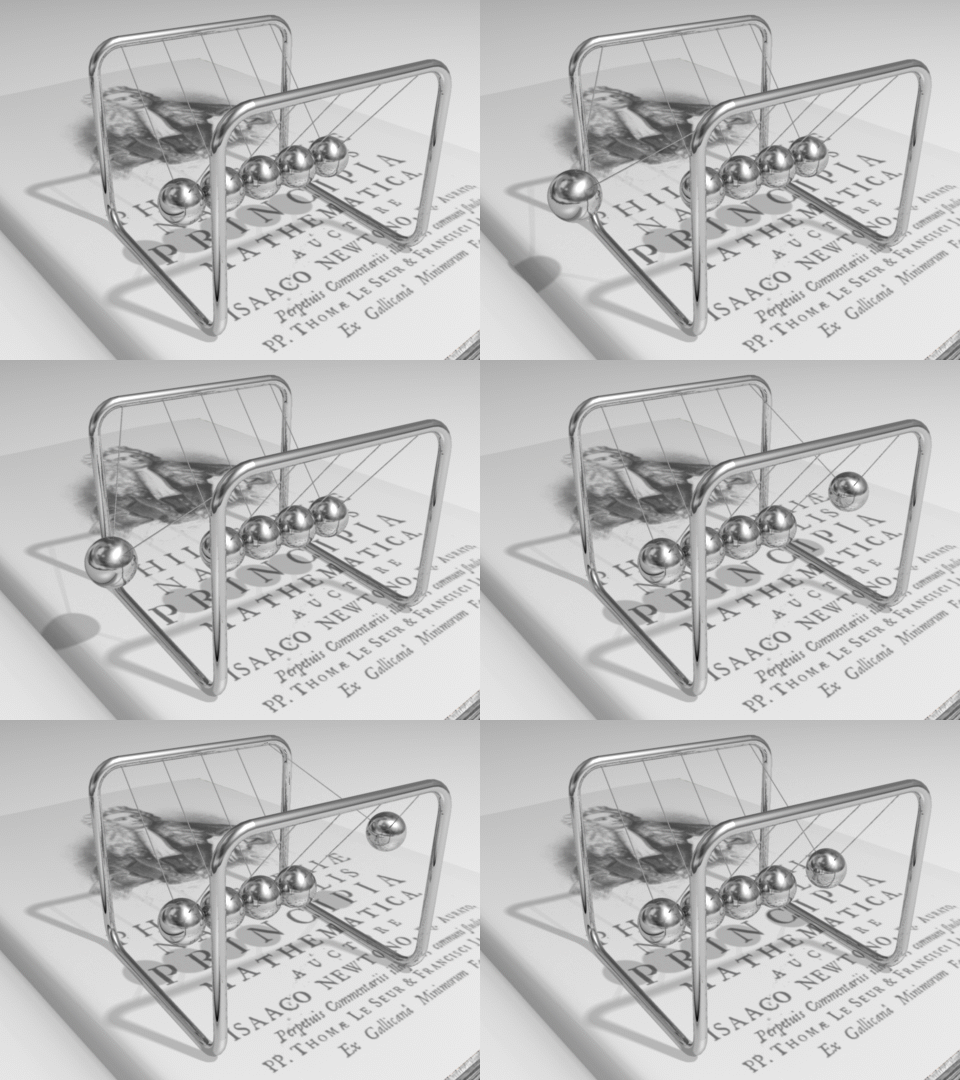
The operation of Newton’s Cradle is as simple as its structure. When a ball from one end is lifted and released, it strikes the subsequent stationary ball and transfers all its energy to it. Through a series of incredibly swift transfers, energy is transferred to the ball at the other terminal, forcing it to swing upwards. The terminal ball elevates to a height equal to the first ball before falling back down to hit the still stationary balls. The energy and thus the motion is now conducted in the reverse direction, eventually thrusting the first ball out again.
The following process continues until all energy imparted at the start is lost to friction from air resistance, to sound energy and from any heat generated between the swinging spheres.
Physics Behind Newton’s Cradle
As mentioned earlier, Newton’s Cradle demonstrates the laws of conservation of energy and momentum.
The law of conservation of energy states, ‘Energy can neither be created nor be destroyed, although it can be converted from one form to another’. On the other hand, the law of conservation of momentum asserts that the momentum of an isolated system is conserved/constant, i.e, when two objects collide, the momentum before and after the collision stays the same.
Coming back to Newton’s Cradle, at rest, the balls have zero potential energy, as they can’t move down any further (Potential Energy = mgh, at rest h = 0) and zero kinetic energy, since they aren’t moving (Kinetic Energy = 1/2 mv2, at rest v = 0). Similarly, the balls do not carry any momentum either (Momentum = mv, at rest v = 0).
However, when the first ball is lifted up and away, it gains gravitational potential energy with the increase in height, while kinetic energy remains the same, zero. Upon release, as the height of the sphere decreases, potential energy is converted into kinetic energy. All the potential energy is transformed into kinetic energy at the bottom position of the swing. Also, the ball gains momentum as it swings down and attains maximum momentum at the bottom position.
Upon impact with the next ball, the first one loses all its kinetic energy (and as a result, all its momentum) and comes to a dead stop. However, energy and momentum cannot be lost, so it must be transferred to the ball it strikes.
The force exerted by the first ball upon impact causes the second one to compress slightly. The compression is symbolic of energy being transferred in the form of potential energy. As the second ball tries to retain its original shape, the potential energy is converted into kinetic energy and is simultaneously transferred to the subsequent ball. The following chain of compression-decompression, and therefore the transfer of energy, continues until the final sphere.
The final sphere, as it decompresses, doesn’t find a subsequent ball to compress and transfer the energy to. Because transferring energy isn’t a viable option, the final ball pushes on the penultimate ball and gets propelled outwards in return. Every action has an equal and opposite reaction, right?
Since no energy is lost in the transferring process, the final ball shoots up with a speed equal to the dropping speed of the first ball, thus indicating that momentum has been conserved!
Also, the final ball rises to a level equal to the dropping height of the first one, signifying that all energy is also saved!
Which Law Does Newton’s Cradle Demonstrate?
If this has ever landed on your homework sheet, here is the honest answer: Newton’s cradle does not really showcase a single one of Newton’s three laws so much as it puts two conservation principles on display at the same time, the conservation of momentum and the conservation of energy. Both of these follow directly from Newton’s laws of motion, which is a big part of why the toy still carries his name.

Watch the chain closely and the mechanism becomes clear. When the raised ball swings down and strikes the row, it pushes on the ball next to it, and by Newton’s third law that ball pushes straight back with an equal and opposite force. That paired push is exactly what hands the momentum along the line without letting the total change, so the momentum of the whole row is conserved. And because the polished steel spheres collide almost perfectly elastically, very little kinetic energy is lost in the hand-off, so energy is conserved too. Virginia Tech’s physics outreach lab describes the cradle in precisely these terms: a way to see conservation of energy and conservation of momentum in a fairly elastic collision.
So the next time someone asks which law a Newton’s cradle demonstrates, you can give them the full picture. It is a live, tabletop proof that in a near-elastic collision, both momentum and kinetic energy are conserved at once.
Why Don’t Two Balls Swing Out At Half The Speed?
Here is the puzzle that trips up almost everyone. Lift one ball, let it go, and exactly one ball flies off the far end at the same speed. Lift two, and two fly off. You never see one ball leave at double the speed, and you never see two crawl out at half the speed. Why is the cradle so fussy about the count?
The surprise is that conservation of momentum on its own cannot explain it. Momentum is just mass times velocity, so a single ball leaving at speed v carries a momentum of mv, and two balls leaving at v/2 each would also add up to mv. As far as momentum is concerned, both outcomes are perfectly legal.
The tie-breaker is the conservation of energy. Kinetic energy depends on the square of the speed (½mv2), and that squaring changes everything. One ball leaving at speed v carries a kinetic energy of ½mv2, which matches the energy that went in. But two balls each moving at v/2 would carry only ¼mv2 between them, meaning half the energy has quietly vanished. A near-elastic collision does not permit that, so nature simply refuses the two-at-half-speed option. Only the same number of balls, leaving at the same speed, keeps both the momentum ledger and the energy ledger balanced at the same time.
One practical detail makes this run so cleanly: in a real cradle the spheres rest a hair apart rather than pressed together, so they collide one pair at a time. That tidy sequence of pairwise elastic collisions is what passes the momentum and energy down the line without smearing the motion across every ball at once.
Final Words
Although the working procedure and physics behind the cradle are quite straightforward, individuals often inquire: What if we dropped two balls instead of one? Why doesn’t the cradle blast two balls at half the speed? Or better yet, all the remaining ones at quarter speed? Once initiated, will the cradle ever stop?
First, each ball imparts enough energy to move one other ball (given that they are the same size), so the number of balls that get launched outwards will be equal to the number of balls dropped. Second, as we saw above, momentum on its own would even allow two balls to leave at half the speed; it is the conservation of kinetic energy in these near-elastic collisions that settles the matter, keeping the number of balls launched equal to the number dropped, each at the same speed. Third, the cradle does stop eventually due to energy losses.
In an ideal world, Newton’s Cradle would represent an elastic collision (kinetic energy before and after the collision remains the same), but, energy losses render the collisions inelastic.
Nevertheless, this nearly 60-year-old apparatus (the modern toy was named “Newton’s cradle” by English actor Simon Prebble in 1967) continues to prevail as a mesmerizing toy and an excellent educational tool!