X-rays penetrate a sheet of steel because they are uncharged, high-energy electromagnetic waves. With no electric charge, they aren’t deflected by the electrons and protons inside atoms, and their extremely short wavelength gives them enough energy to pass through several millimetres of metal.
X-rays are one of the most common forms of radiation that we come across in daily life. Whenever we break a bone or have to go to the dentist, we need to take an X-ray photograph in order to see the state of our bones. X-rays show even the smallest gaps in our bones because they pass through these gaps and our skin so easily.
What gives X-rays this special quality of high penetration? Why doesn’t it get blocked by solid objects like other forms of radiation? Well, to answer that question we first need to understand X-rays.
What Are X-rays?
X-rays are just a different form of the light that we know and see so well. Light is a common term for electromagnetic radiation. In simple words, if we consider an electromagnetic field, which is just the electric field paired with the magnetic field, since they always exist together, as linen, then the disturbances or the waves that would appear while shaking the linen would be the electromagnetic radiation, or as we like to call it, light.
Light or electromagnetic radiation is a wave (or a particle, depending on Schrödinger’s mood). Every kind of wave has a wavelength, which is the distance between two consecutive peaks or troughs.
If the peaks are packed closer, then the wave will have a small wavelength and if they are packed far apart, then the wave would have a long wavelength. Light is categorized in different forms, depending on the wavelength.
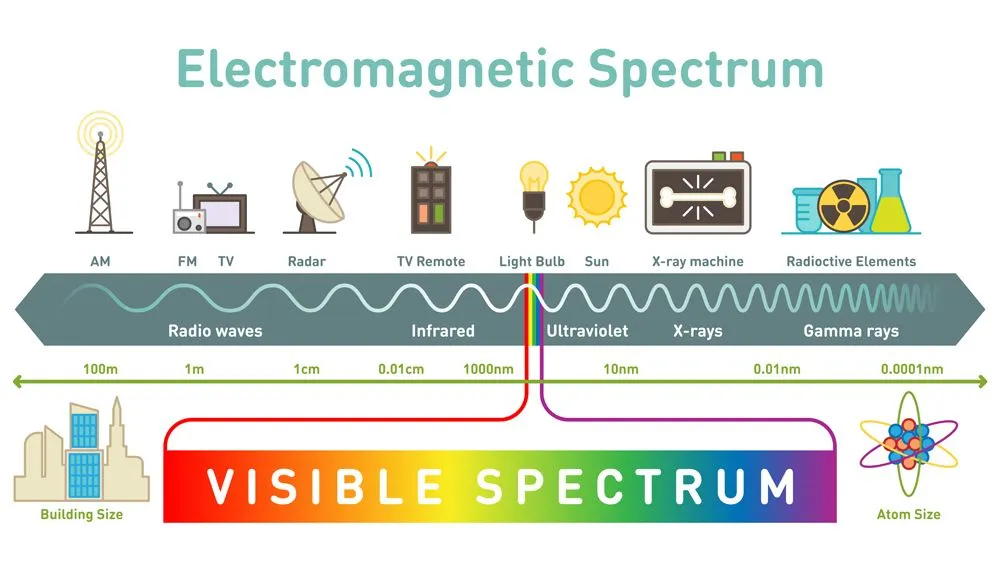
X-rays have extremely short wavelengths, only falling short of (no pun intended) gamma rays, with a wavelength range of roughly 10 to 0.001 nanometers. X-rays were discovered by Wilhelm Röntgen in 1895 and were named as such because of their mysterious nature at the time.
How Does Penetration Work?
All materials are made up of atoms, which are further made up of electrons and protons (charged particles). They are known as charged particles because they have charge values (electrons with a negative charge and protons with a positive charge).
When radiation interacts with matter, it interacts with these electrons and protons. The interactions between the radiation and the electrons and protons depend on the properties of the radiation.
If the radiation consists of charged particles like alpha particles or beta particles, then the interactions depend on the charge. Alpha radiation with a positive charge would get attracted to the electrons in the atoms and get deflected by the nuclei. It can be seen clearly that the more interactions the radiation has, the shorter distance it is able to cover.

Imagine two people traveling on a road, one in a car and the other on foot. When they get stuck in traffic, the person in the car has to wait for the car in front of him to move because he is interacting with vehicles. Meanwhile, the person who is walking disregards the traffic and cars and keeps on going, since he has no interactions with the vehicles. After 10 minutes in traffic, the person who is walking would’ve covered more distance than the person in the car.
This is similar to the penetration inside matter. Radiation with a charge has to interact with the atoms not only physically (by bumping into them), but also magnetically, due to the charge differences. This is why alpha and beta radiation have very small levels of penetration.
So, in technical terms, penetration is the distance at which the radiation can travel before its intensity drops to 1/eth of the original value (where e is Euler’s constant).
But What Makes The X-rays Penetrate More?
As mentioned earlier, X-rays are a form of electromagnetic radiation (light). Light has no charge, i.e., it is neutral. Thus, when X-rays interact with the atoms in a given material, they do not get deflected because of the charges on these subatomic particles (electrons and protons). But what about other forms of light, like visible light or infrared light? Why do the same rules not apply to them?
Well, they do. Light, no matter its wavelength, does not interact with the particles of a given material, but that is not the only property to consider. Taking the previous example again, the more energy the walking person has, the more distance he will be able to cover. A person who is already tired wouldn’t be able to go very far, even though he does not have to worry about the cars around him.

The same thing applies to light. Radiation that has higher energy levels would be able to penetrate the farthest. Now, the energy of any kind of wave depends on its wavelength. The smaller the wavelength, the higher the energy. Thus, infrared and radio waves have the lowest energy, while X-rays and gamma rays have the highest energy. This is why X-rays are able to penetrate much farther into matter than light at other (longer) wavelengths.
Which Type Of X-ray Penetrates Metal Best?
Not all X-rays are created equal. Physicists split them into two broad families: soft X-rays and hard X-rays. The difference comes down to energy, and therefore to wavelength. NASA draws the line at roughly 10 keV (kilo-electronvolts): X-rays with more energy than that are called hard, and the lower-energy ones are called soft.
Because energy climbs as wavelength shrinks, hard X-rays have the shortest wavelengths and the deepest reach. They are the ones that shrug their way through a weld, a suitcase, or a sheet of steel. Soft X-rays sit at the longer-wavelength end and give up their energy almost immediately; they are absorbed so readily that they barely make it through open air, let alone metal.
This is worth spelling out, because it trips a lot of people up: it is the short-wavelength X-rays that punch through metal, not the long-wavelength ones. If you ever see a claim that long-wavelength X-rays are the best at penetrating metals, it has the physics backwards. That is exactly why industrial radiography, the technique used to X-ray steel pipes and pressure vessels for hidden cracks, cranks the voltage up into the hard X-ray range rather than dialing it down.
Can An X-ray Be Deflected Or Bent?
This is one of the most common questions that follows the “how do they penetrate” one, and the answer is a satisfying “it depends on what you try to deflect them with.” Because an X-ray carries no electric charge, an electric or magnetic field does nothing to it. Alpha and beta particles, which are charged, can be steered by a magnet; X-rays sail straight through as if the field were not there. That neutrality is the same property that lets them ignore the charged electrons and protons inside steel.

Fire them at a crystal, though, and something elegant happens. The atoms in a crystal are stacked in neat, repeating planes, and when X-rays bounce off those planes the reflected waves interfere with one another. At certain angles they reinforce, producing a bright diffracted beam. This is captured by Bragg’s law, nλ = 2d sinθ, which links the X-ray wavelength to the spacing between the atomic planes. So an X-ray can very much be deflected, just not by fields; it is bent by the geometry of matter itself.
This bending is not a laboratory curiosity. X-ray diffraction is how scientists read the atomic architecture of crystals, and it is the technique that helped reveal the double-helix structure of DNA. X-rays can also change direction by scattering off individual electrons, which is one of the ways their intensity fades as they push through a thick block of metal.
How Do X-rays Rank Among The Most Penetrating Rays?
X-rays are impressive, but they are not the champions of penetration. If you line up the common types of radiation given off by radioactive materials, a clear pecking order appears, and it follows exactly the logic from earlier: the less a ray interacts with matter, the farther it travels.

Alpha particles come last. They are heavy, charged, and interact so strongly that a sheet of paper, or even the outer layer of your skin, stops them cold. Beta particles are lighter and more penetrating, but a thin sheet of aluminium or a layer of clothing brings them to a halt. X-rays and gamma rays sit at the top. Being uncharged and high in energy, they need something dense and thick to stop them, which is why hospitals and reactor halls shield them with lead and thick concrete.
Between the two heavyweights, gamma rays usually edge ahead. They tend to carry even more energy than X-rays and so, for a given material, they penetrate a little deeper. That is the honest answer to “what is the most penetrating ray”: among everyday radiation, gamma rays take the crown, with X-rays a very close second. It also explains why the same barrier behaves so differently for different rays; a wall that comfortably blocks alpha and beta radiation can still let a stubborn fraction of X-rays or gamma rays through.
Can X-rays Pass Through Earth’s Atmosphere?
Here is a lovely twist. X-rays can bore through millimetres of steel, yet they cannot get through the column of air above your head. The Sun, black holes and exploding stars all blaze in X-rays, but almost none of that radiation reaches the ground, because Earth’s atmosphere soaks it up.

It sounds contradictory until you count atoms. Air is thin, but the atmosphere is deep, and an X-ray photon travelling down through it runs into as many atoms as it would crossing a wall of concrete about 5 metres (16 feet) thick, according to NASA’s Chandra X-ray Center. Over a couple of millimetres of steel an X-ray can survive; over the whole depth of the sky, it does not stand a chance.
This is a headache for astronomers, and the reason X-ray astronomy only took off in the space age. To catch cosmic X-rays, telescopes such as Chandra have to be lifted above the atmosphere on rockets and satellites. The same shield that makes X-ray astronomy so difficult is, of course, the one that quietly protects us from a constant rain of high-energy radiation from space.
Conclusion
X-rays are a very energetic kind of electromagnetic radiation, so they can penetrate deep into materials. Although it depends on a few less important factors, due to their energetic and neutral nature, they can even penetrate small sheets of steel and other metals of similar density.
However, these vigorous little rays have their limitations too. How far they reach depends on the photon energy: a standard medical X-ray (around 100 kVp) easily passes through soft tissue but is stopped by a millimetre or two of lead, while industrial X-rays at 200–400 kVp are used to image through several centimetres of steel. For thicker steel or denser metals, your best bet may be gamma rays!
References (click to expand)
- Cervantes, G. A. (2016). The basics of x-rays. Technical Fundamentals of Radiology and CT. IOP Publishing.
- Liu, J., Saw, R. E., & Kiang, Y.-H. (2010, September). Calculation of Effective Penetration Depth in X-Ray Diffraction for Pharmaceutical Solids. Journal of Pharmaceutical Sciences. Elsevier BV.
- Hard X-Rays. NASA Goddard Space Flight Center (Hesperia).
- Bragg’s Law. HyperPhysics, Georgia State University.
- Radiation Basics. United States Environmental Protection Agency (EPA).
- X-Ray Absorption. Chandra X-ray Center (NASA).
- X-ray Astronomy. NASA Goddard, Imagine the Universe!