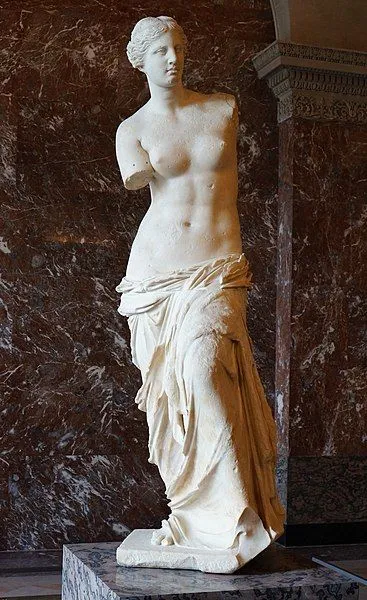
No one knows for certain how Venus de Milo lost her arms. The marble statue was already armless when it was unearthed on Milos in 1820, so the most likely culprits are the ravages of time, a skirmish between French and Turkish sailors as she was being shipped out, or simple mishandling. A separate hand holding an apple was found nearby.
Venus de Milo (literally, Venus, or Aphrodite, as some of you may know her, of Milos, a depiction of the goddess of love) is one of the most recognized relics from the Hellenistic period. It is an ancient Greek sculpture that is housed along with the Louvre’s other treasures (like the Mona Lisa) in Paris.
It was discovered on April 8, 1820, by a Greek farmer and his son (the farmer’s name was Yorgos Kentrotas), in a niche, buried in the ruins of the ancient city of Milos, on the present-day island of… MILOS!
You may have seen the statue or allusions to it in movies and television shows because of the infamous Venus de Milo comedic gag about how she lost her arms…
What We Know About The Statue
The Hellenistic period of art started with the conquests and end of Alexander the Great’s life and ended with the Roman conquest of the Greeks (though the Romans carried many of this period’s art styles to their own). It is during this time (most likely the late 2nd century BC, somewhere between 130 and 100 BC) that Alexandros of Antioch, the sculptor, gave us Venus de Milo. How do we know that? Well, along with the statue, there was an inscription found on the plinth that read:
‘Alexandros, son of Menides, citizen of Antioch of Maeander made the statue.’
They don’t display this inscription along with the statue. Perhaps that is because, while presenting it to Louis XVIII, by ditching the inscription that placed the statue in the Hellenistic period, more credibility could be given to it by speculating that the statue was the creation of a Classical (a more revered period for art historians) Greek sculptor Praxiteles. This reasoning, held by those in charge of the Louvre in 1821, carries on to this day.
She was gifted by Charles de Riffardeau, Marquis de Rivière to the French King Louis XVIII, who donated it to the Louvre.
What The Statue Tells Us
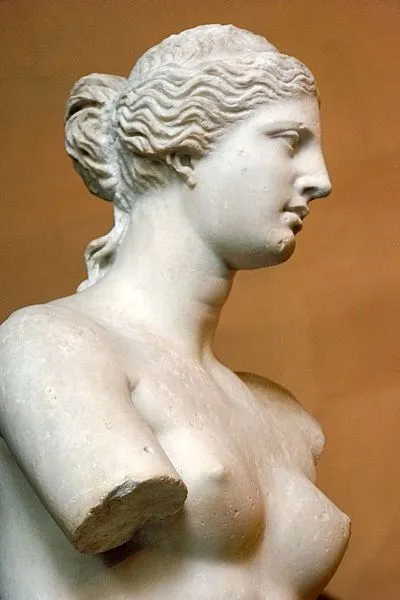
The statue deliberately echoes the features of an older, Classical style, a backward-looking nod that was itself a hallmark of the Hellenistic period. Venus de Milo’s figure and drapery point to it being seen and sculpted as something grand and noble. Standing just over 2 meters tall (about 6 ft 8 in), her figure is graceful in expression and her poise is reflected on her face.
She was built with two components joined at the hips, which is how she was found, with the upper body and draped legs in separate pieces. Venus de Milo would have been known as Aphrodite to those who built and first laid eyes upon her, but naming the statue Venus was just another way of Romanizing and laying claim to those artworks.
The Lost Arms
If you have some semblance of interest in Greek statuary, you’ll know that they were all made ‘whole’, with limbs and clothes and symbolic accoutrements chiseled from a single piece, often in white marble.
However, given that marble is prone to fracturing, many of the more intricate elements were lost to the ravages of time. This could be one reason why she is missing her arms.

Venus de Milo’s missing arms were broken long before the statue was unearthed for reasons that are largely unknown, despite a wide range of speculation by art historians.
However, a fragment of a marble hand clutching an apple was found alongside the statue, and modern scientific analysis supports the idea that it belonged to her left arm, though that arm was already detached from the body.
If that is true, it could help substantiate the claim that the woman is actually Venus (it is speculated, given the location, that it could be Amphitrite), given that in the myth of the Trojan War, Aphrodite/Venus was who received the golden apple from Paris, a Trojan prince.
The most popular reason for the arms being missing is a tussle between the French and the Turkish; around the time in the 1820s, there were bands of sailors from both sides fighting for control of it over the shores of Milos, which was under Ottoman control back then. The statue hit the rocks, and thus, lost her arms.
Venus De Milo’s Journey
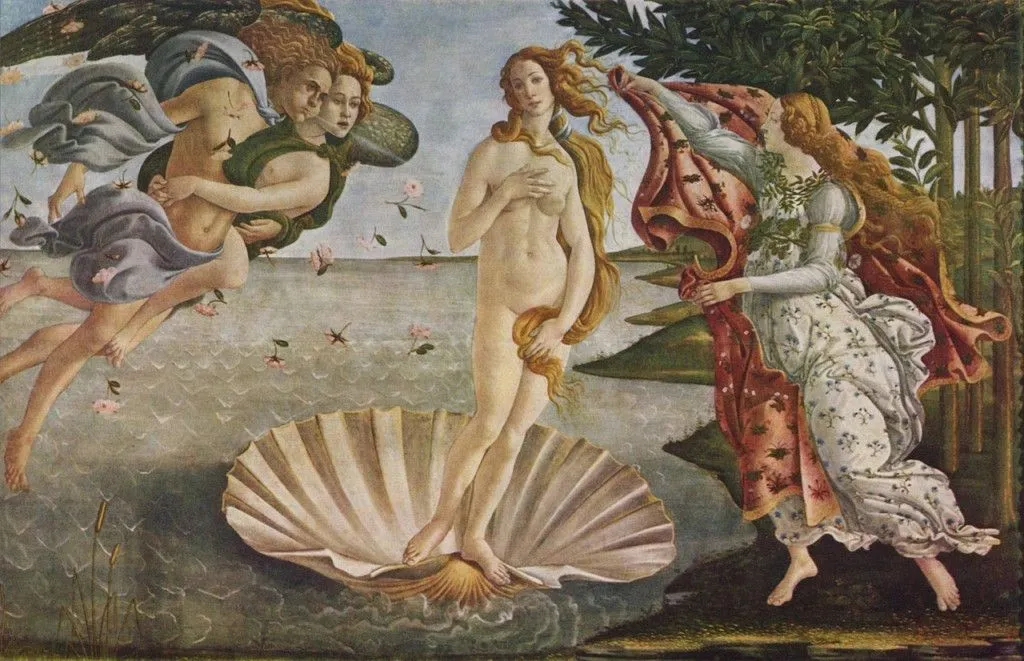
The fame of Venus de Milo was not always as obvious as it is now. Although it was considered important as an artistic finding from the Hellenistic period, it did not immediately attain its stature as one of the world’s most famous (albeit armless) statues. In the 19th century, when Napoleon Bonaparte lost power in France, in the aftermath of the Napoleonic looting, when France started returning the Louvre’s treasures to their countries of origin, Venus de Milo began gaining her fame.
This is because when Napoleon looted the Venus de Medici from Italy, and the French government returned it, to make up for the hole left behind by one Venus in the Louvre’s collection, they promoted Venus de Milo as a better, more refined replacement.
The propaganda was effective, and Venus de Milo earned the prime spot at the Louvre that she now holds in every visitor’s itinerary.
What Did Venus De Milo Look Like With Her Arms?
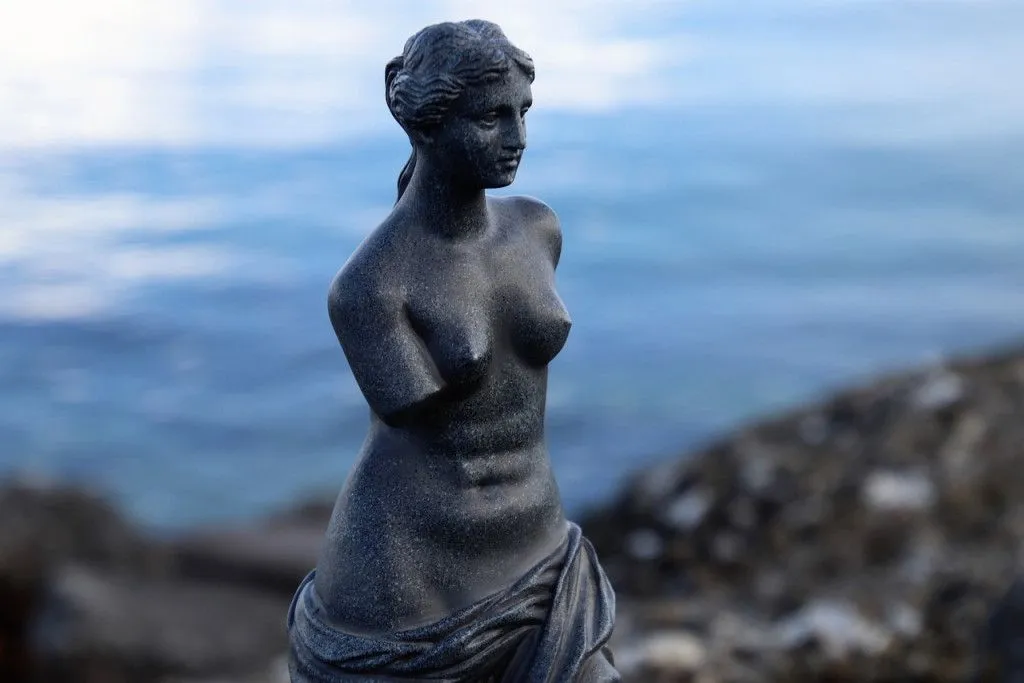
For two centuries, art historians have been trying to give Venus de Milo her arms back, at least on paper. Because no one ever recorded her intact, every reconstruction is educated guesswork, pieced together from the fragments found beside her and from comparisons with similar statues.

The most widely favored idea traces back to the German scholar Wilhelm Fröhner, who suggested in 1876 that her lowered right hand held the drapery slipping from her hips while her raised left hand held an apple. Adolf Furtwängler expanded on the theory, and his 1893 reconstruction shows her left elbow propped on a small pillar, apple in hand. The apple matters because of that marble hand clutching one that was found near the statue. When the Louvre restored Venus in 2010, scientific analysis supported the idea that the fragment genuinely belonged to her, which many scholars take as strong evidence for the apple pose (though, as with almost everything about this statue, not everyone is convinced).
Not everyone thinks she held fruit at all. Marianne Hamiaux, a Louvre curator, has argued that she originally held a shield polished enough to double as a mirror, echoing a famous Aphrodite worshipped on the heights of Corinth who was shown admiring her reflection in a burnished shield. Other scholars have imagined her adjusting her robe, spinning thread with a distaff, or holding a wreath, a dove, or a spear. There is no consensus, and because the arms themselves are lost, there may never be one. That open question is part of her enduring appeal, as everyone gets to picture their own Venus.
Why Are So Many Ancient Statues Missing Their Arms?
Venus de Milo is in surprisingly good company. Walk through any gallery of Greek and Roman antiquities and you will notice how many figures are missing an arm, a hand, a nose, or their head entirely. This is no coincidence, and it comes down to how the statues were made and what happens to marble over a couple of thousand years.
The arms are almost always the first to go, because they are the most exposed. An outstretched limb juts out from the protective bulk of the body and acts like a lever, so any knock or fall concentrates the stress right at the shoulder. On top of that, large Greek statues were usually not carved from a single block of marble: projecting parts such as the arms were often sculpted separately and then attached to the torso with dowels. That let sculptors attempt more ambitious, lifelike poses, but it also left natural weak points wherever two pieces met. Venus herself was assembled from more than one block of marble, and the celebrated hand-and-apple fragment came from an arm that had already broken away from her body. Give those joints enough centuries of burial, rough handling, transport, and the occasional scuffle between rival sailors, and the slender parts snap off long before the solid torso does.

She is not even the only famous armless statue in her own museum. A short walk away in the Louvre stands the Winged Victory of Samothrace, a Hellenistic figure of Nike, the goddess of victory, carved in white Parian marble around 200 to 190 BC. She is missing not only both arms but her head as well, and stands about 2.75 meters (roughly 9 feet) tall on the prow of a stone warship. Two of the most beloved sculptures in one of the world's most visited museums, and neither of them has a pair of arms.
Conclusion
Venus de Milo may have lost her arms, but her charms live on, very literally for her viewers, but also as a metaphor for love and beauty. That’s why AC/DC, in their song “Touch Too Much,” gave us the line: “She had the face of an angel, smilin’ with sin. The body of Venus with arms.”
References (click to expand)
- Kousser, R. (2005, April 1). Creating the Past: The Vénus de Milo and the Hellenistic Reception of Classical Greece. American Journal of Archaeology. University of Chicago Press.
- Arenas, A. (2002). Broken: The Venus de Milo. Arion: A Journal of Humanities and the Classics, 9(3), 35–45.
- Lethaby, W. R. (1919, November). The Venus de Milo and the Apollo of Cyrene. The Journal of Hellenic Studies. Cambridge University Press (CUP).
- Venus de Milo. Wikipedia.
- Cartwright, M. Greek Sculpture. World History Encyclopedia.
- Winged Victory of Samothrace. Wikipedia.