Table of Contents (click to expand)
Badminton uses three shuttlecock types. A feathered shuttlecock (also called a birdie or shuttle) has 16 overlapping goose or duck feathers on a cork base and is used in tournament play. A synthetic shuttlecock uses a plastic skirt and is more durable. A hybrid mixes the two. They all have a high open skirt that produces enormous drag, which is why a shuttlecock decelerates rapidly after a hit.
Who remembers playing badminton on Sunday mornings or after school? A light breeze could never stop the game, remember? And the type of shuttlecock we used didn’t matter either; any playable shuttlecock was enough to keep the game going. Until the scorching sun burnt our foreheads, of course.
In badminton lingo, a shuttlecock (also called a bird, birdie or shuttle) is a small cork with feathers or plastic attached to it. In the game, it is struck with badminton rackets and volleyed across the net by the players.
Different Types Of Shuttlecocks
There are three different types of shuttlecocks:
Feather Shuttlecocks

A shuttlecock consists of around sixteen goose or duck feathers that overlap and are put into a spherical base made of cork. Players of an intermediate or higher level and those who play badminton professionally typically use these shuttles. These are far simpler to use than nylon shuttles. With the proper knowledge, abilities, and approach, it is possible to produce both net spin (an offensive technique) and slicing (a method to alter the angle of return of the shuttlecock).
When compared to nylon shuttles, feather shuttles have a shorter lifespan than their synthetic counterparts. Because of this, feather shuttles are not suggested for beginners, as using an improper technique can damage the feathers of the shuttlecock and render it useless. It is recommended that the shuttlecocks be stored in an atmosphere that is normally humid so the feathers do not become brittle and dry, which would more rapidly lead to damage.
Feather shuttles have a steeper trajectory (a curved path in which objects move) than nylon shuttles. In recent years, activists for animal rights have asserted that it is inhumane to pluck feathers from the wings of a living goose or duck in order to sell them for recreational purposes.
Nylon Shuttlecocks

The head of this badminton shuttlecock is constructed from a single piece of solid cork. In contrast, the body is constructed out of high-quality nylon, which gives it a reputation for being able to move rapidly, and is praised for being stable and long-lasting.
The nylon shuttlecock is most well known for its flying ability and durability. Because they are not particularly expensive and also last for a very long time, often up to 100 games, before wearing out, these shuttles are primarily utilized by novices and recreational players. The shuttles lose their speed more slowly than feather shuttles, which usually results in a game that moves at a quicker pace and features less control and touch play.
Hybrid Shuttlecocks
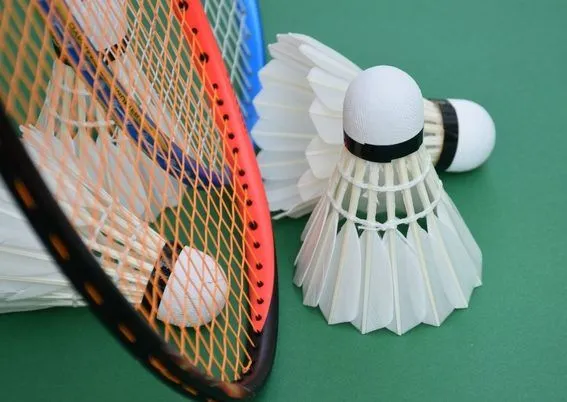
These shuttlecocks are made of a combination of plastic and feathers. These shuttles were very recently developed, and their availability is primarily accessible to the United Kingdom. The end feathers of these shuttles are duck or goose feathers, and the shuttle’s frame is made of synthetic material.
These shuttles have higher durability than conventional feather shuttles and higher control than traditional nylon shuttles. Hybrid shuttles are cheaper than most full-feather shuttlecocks, due to the use of cheaper materials and low manufacturing costs.
Now, let’s move on to the concept that allows shuttlecocks to fly, aerodynamics.

The study of how things behave when moving through the air is known as aerodynamics. The branch of science known as aerodynamics is responsible for explaining how an airplane can move through the air.
Everything that moves through the air, from a rocket lifting off to a kite flying in the sky, is impacted by aerodynamics in some way. Even automobiles are subject to the principles of aerodynamics, since air surrounds them. Similar principles apply to the shuttlecocks, allowing them to cut through the wind and rise in the air before gravity finally acts on them.
Aerodynamics Of Shuttlecocks
The shuttlecocks used in badminton can go faster than the balls used in other sports. At the same time, because they have more drag, they slow down much more quickly. The drag force on a shuttlecock significantly affects where it goes. It should be in a range where a skilled player can keep the shuttlecock within the boundaries of the court.

So that the skirt of a synthetic shuttlecock has the same aerodynamic effect as overlapping feathers on a feather shuttlecock, the holes in the net are not all in the same place. We know that feather shuttlecocks and synthetic shuttlecocks are made differently. Because of the differences in how they are made, their aerodynamics and paths are also different.
Both kinds of shuttlecocks (feathered and nylon) have different trajectories of movement. The diagram below can depict this more clearly.

Much more weight lies in the cork than in the skirt, so all shuttlecocks tend to line up with the direction of movement, cork-first. In flight, the shuttlecock is most stable and powerful when it is at a zero angle of attack and aligned with the direction of flow.
A zero angle of attack can be visualized in the diagram given below.
Various studies have concluded that the gaps in the skirt of a shuttlecock lead to an increase in drag. It was also concluded that a synthetic shuttlecock bends more than a feathered shuttlecock when moving at high speeds. Because of this effect, there is less aerodynamic drag.
What Is The Ball In Badminton Called?
Here is a small surprise: badminton has no ball at all. The thing players whack back and forth is the shuttlecock, and depending on where you grew up you might know it as a birdie, a bird, or simply a shuttle. In many places, especially North America, “birdie” is the everyday word, while “shuttle” is the shorthand you will hear around most courts.

Whatever you call it, it is the same little object: a rounded cork base with a flared skirt of feathers or plastic on top. According to Encyclopaedia Britannica, the classic feathered version is a small cork hemisphere fitted with 16 goose feathers and weighs only about 5 grams (0.17 ounces).
So why the odd name “shuttlecock”? It stitches together two much older words. The “shuttle” part comes from weaving, because a loom’s shuttle darts back and forth across the threads exactly the way the birdie flies from one player to the other. The “cock” part points to a rooster, since the ring of feathers resembles the plume of tail feathers on a male bird. The word has been around since the early 1500s, long before the modern sport existed, back when the pastime was called battledore and shuttlecock.
Is Badminton The Same As A Shuttlecock?
People often use the two words as if they mean the same thing, but they do not. Badminton is the sport, the whole game of two or four players rallying over a net. The shuttlecock is just the object you hit. The mix-up is easy to understand, because “shuttle” is such common shorthand that plenty of players casually say they are going for a game of shuttle when they really mean badminton.

The sport got its curious name from a place, not from the birdie. Per Encyclopaedia Britannica, the game we know today was played around 1873 at Badminton House, the Gloucestershire estate of Henry Somerset, the 9th Duke of Beaufort, and it took its name from that estate. Before it reached England it had traveled from India, where it was first known as “poona,” after the city of Poona (modern Pune). Further back still, it grew out of the old street pastime of battledore and shuttlecock.
So here is the tidy way to remember it: one word names the game you play, and the other names the little feathered thing you send flying over the net. Badminton is one of only a handful of sports built around a shuttlecock rather than a ball.
After knowing more about the intricacies of this enjoyable sport, it will be much easier for all of us to understand and play badminton even better!
References (click to expand)
- J McLachlan —. Aerodynamics of a Badminton Shuttlecock. worldbadminton.com
- [PDF] A study of badminton shuttlecock aerodynamics. Semantic Scholar
- AERODYNAMIC PROPERTIES OF BADMINTON .... Semantic Scholar
- A Study of Shuttlecock's Trajectory in Badminton (2009). PMC, NCBI.
- What Is Aerodynamics? - NASA. The National Aeronautics and Space Administration
- Badminton | History, Olympics, Rules, Equipment, and Champions. Encyclopaedia Britannica
- Shuttlecock | badminton. Encyclopaedia Britannica
- shuttlecock (etymology). Wiktionary