We’ve seen many times that sharks are attracted to blood, so the animals must be able to detect it using their senses: sight, taste, or smell. But can sharks actually distinguish between human blood and other blood?
Movies such as Jaws and the ludicrous Sharknado have ingrained in our minds that sharks are attracted to human blood. These bloodthirsty swimmers of the sea never pass on a chance to eat a human, at least according to Hollywood. But does this happen in real life? Or is it just a “reel life” phenomenon?
Frequency Of Shark Attacks On Humans
Media attention to shark attacks makes it seem like they happen a lot, but the frequency of shark attacks on humans is exceptionally low. Per the International Shark Attack File at the Florida Museum of Natural History, there were 47 unprovoked shark bites worldwide in 2024, a 28-year low, with only 4 fatalities. The 10-year average is about 70 unprovoked bites and 5-10 deaths per year worldwide.

Out of five hundred species of sharks, it was found that three sharks (the great white shark, the bull shark, and the tiger shark) were responsible for most of the attacks. They cause over 60% of all reported shark bites and 80% of the shark bites, resulting in casualties.
In contrast, a 2.8 mm (0.11 inches) mosquito kills approximately 700,000 people each year, and man’s best friend, the dog, kills over 50,000 people each year by spreading rabies.
Can Sharks Smell Human Blood?
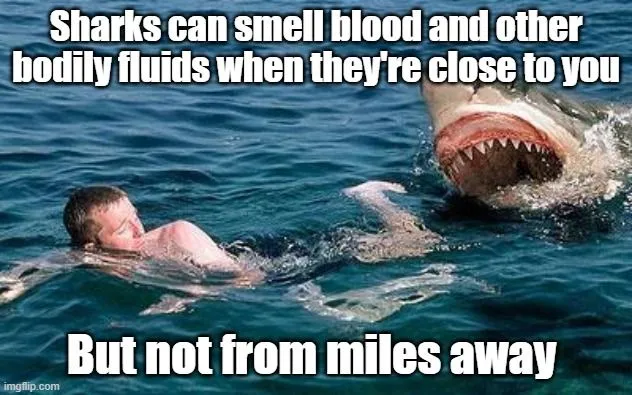
Contrary to what Jaws might say, sharks are not attracted to human blood. However, they can’t sniff out one drop of blood from miles away. Blood and factors like disturbances in the water can be a possible pull for sharks. This is how sharks detect fish or marine mammals.
The chances of sharks being attracted to human blood or any other body fluid are much lower.
An Experiment By ex-NASA Engineer
In 2019, Mark Rober, an ex-NASA engineer turned science YouTuber, ran an experiment in the Bahamas to test whether sharks prefer human blood or fish blood. He attached pumping devices filled with either cow blood (which mimics human blood), fish blood (tuna fish), or seawater to three surfboards and then released them into the ocean. The pumping devices would release the fluid into the water as they moved. Over an hour, with the help of a drone, they observed the number of shark visits to each surfboard.
They witnessed 0 shark visits to the surfboard with seawater, eight shark visits to the one pumping out cow blood, and a monumental 134 visits to the surfboard with fish blood. However, this can only be taken as an anecdotal academic reference and is not a complete analysis.

A study published in 1963 found similar results. In a test pond, they exposed sharks to fish blood, fresh and decomposing human blood, and human sweat and urine. The sharks swarmed around the fish blood, especially tuna blood. The sharks in the study were attracted to human blood, but inconsistently and less strongly than fish blood, and were outright repulsed by old decomposing blood. As for sweat and urine, these substances did little to attract the shark.
However, for a shark to detect these from miles away, the fluid must be strong enough to not be diluted by the enormous amount of water around it. One drop of blood in flowing water would be diluted from 10-6 to 10-21 in the space of one kilometer. That’s as good as the drop never having existed.
Some sharks have reportedly swum past other people to seek out a particular individual or a group of swimmers or divers. That one swimmer might have a stronger body odor than others. But, for this, the concentration of odor molecules in the water must be very high.
A more plausible explanation is that sharks are more attracted to one person’s activities, like thrashing about in the water, than their body odors.
What About Menstrual Blood?
So, if any body fluid in a large enough amount and concentration might attract a shark, what about when a person is menstruating? Is that any different?
There is no positive evidence of menstrual blood leading to shark attacks. The chances of menstrual blood releasing in the water are low, as the pressure of the water while swimming or diving will temporarily stop one’s menstrual blood flow.
Sharks also do not have any preference for males over females or vice versa. Previous data might suggest that more men are attacked, but that was only because more men were present in water activities than women.
Are Sharks Attracted To Urine?
You have probably heard the warning never to pee in the ocean because it will summon a shark. It is one of the most stubborn pieces of beach folklore, so is there anything to it?

Sharks certainly have the equipment to notice urine. According to the Florida Museum's International Shark Attack File, any bodily fluid released into the water is likely detectable by a shark's keen sense of smell. Detecting a substance, though, is very different from being drawn to it, and there is no positive evidence that urine is a factor in shark bites.
The clearest direct test remains the same 1963 pond study mentioned above. When the researcher A.L. Tester exposed sharks to human sweat and urine, these fluids did little to attract them, a stark contrast to the frenzy set off by tuna blood. So the popular idea that sharks find urine more tempting than blood, or that a quick pee turns you into a target, simply does not hold up. Like a stray drop of blood, urine is diluted into near-nothingness within a short distance, and even undiluted it barely registers with a shark.
Do Sharks Bleed, And What Color Is Their Blood?
This whole discussion has asked whether human blood interests a shark, but it is worth flipping the question around. Do sharks themselves bleed, and if so, what color is their blood?

Sharks do bleed, and their blood is red, just like ours. Sharks are fish, and like other vertebrates they ferry oxygen around their bodies using hemoglobin, the iron-rich pigment that turns blood red. Researchers who have isolated the hemoglobin of species such as the Greenland shark confirm that it binds and carries oxygen much as hemoglobin does in other animals.
Where sharks get genuinely strange is in how they make that blood. A shark's skeleton is built from cartilage rather than bone, so it has no bone marrow, the tissue that manufactures blood cells in humans and most other animals. Instead, sharks produce their blood cells in other organs, including the spleen and a special structure called the epigonal organ that sits alongside their reproductive organs. So sharks are far from bloodless. They simply keep their blood factory in some unexpected places.
Can Sound Attract A Shark?
We have seen how smell can attract sharks, but does sound have any role to play?
Sound is the main cue for a shark to move into an area. However, once a sound is registered and it starts moving towards the source, a shark will rely more on sight than sound.
Sharks are attracted to low-level frequency sounds, especially in the range of 10-50Hz. This is the frequency that a struggling or injured fish also releases. Tests have concluded that sharks are most sensitive to 40 Hz and 800 Hz frequencies. They use their lateral line sense organ and inner ears to locate their prey from 250 meters away or more.

What Colors Are Sharks Attracted To?
Smell and sound are only part of the story. Divers ask constantly whether the color of a swimsuit or a piece of gear matters, and here the science is genuinely useful. The old joke among divers is "yum yum yellow", the notion that the bright yellow of life jackets and rafts practically rings the dinner bell.

According to the International Shark Attack File, there is a grain of truth in the joke, but not the part you would expect. Most sharks are effectively colorblind, so a shark is not craving the color yellow itself. What sharks see extremely well is contrast. Anything that stands out sharply against the water, a flash of bright color, a pale limb, or a glinting watch, is highly visible to a shark. The museum even notes that the glint of light off metal jewelry can mimic the flash of light off fish scales, a shark's normal food.
That is why seasoned divers tend to wear dark, muted wetsuits and tuck their watches out of sight. You cannot make yourself invisible underwater, but you can avoid looking like a high-contrast target. It is the same sharp visual world in which some sharks can change color to blend into the seabed.
A Final Word
As mentioned above, only a handful of shark species are involved in attacks on humans. Sharks evolved millions of years before humans appeared. Their usual prey includes marine animals, such as fish or seals. Humans are not part of a shark’s diet, so it seems logical that they don’t have much of a taste for us.
If you’re ever out in the ocean, swimming or diving, there is a minuscule chance of you being attacked by a shark and dying unless you’re already bleeding. Meanwhile, you can learn more about what makes shark eggs different than other eggs by clicking here!
References (click to expand)
- Fun Facts About Shocking Sharks | NOAA Fisheries.
- Do sharks hunt people? - NOAA's National Ocean Service.
- Menstruation and Sharks – International Shark Attack File.
- Shark Attack Theories.
- Simpfendorfer, C. A., Heupel, M. R., & Kendal, D. (2021, July 23). Complex Human-Shark Conflicts Confound Conservation Action. Frontiers in Conservation Science. Frontiers Media SA.
- Tester AL. 1963. The role of olfaction in shark predation. Pac Sci 17(2): 145-170.
- Color of Apparel – International Shark Attack File.
- Sharks & Rays - Anatomy & Physiology - SeaWorld.
- Russo R. et al. (2017). The Greenland shark Somniosus microcephalus - Hemoglobins and ligand-binding properties. PLOS ONE.