Table of Contents (click to expand)
You are much safer inside a hard-topped, metal-framed car during a lightning storm than out in the open, but the rubber tires have almost nothing to do with it. The car’s metal shell acts as a Faraday cage, routing the lightning current around the outside of the vehicle and into the ground. Convertibles, fiberglass-bodied cars, golf carts and open vehicles do not provide this protection.
Numerous claims about the effects of lightning exist, confusing the public about what is factual.
We have previously dispelled several misconceptions about lightning, such as the notion that metal piercings attract lightning, the belief that staying indoors during a lightning strike puts you in harm’s way, and the idea that glass is always formed when lightning strikes sand.
Now, we will examine another claim related to lightning, which suggests that you are entirely safe inside a car during a lightning strike, and that the rubber tires are what provide the insulation. As we’ll see, only one half of that statement is roughly true.
Are You Completely Safe Inside A Car During A Lightning Storm?
No.
It is commonly believed that being inside a car can protect you from lightning strikes due to the rubber tires. However, this is not true.
While rubber is a great insulator, it cannot necessarily withstand the enormous electric current of a lightning strike. Although rubber may prevent electricity from passing through, it cannot guarantee 100% protection against one of nature’s most powerful forces.
Why Can’t Rubber Tires Do Much To Protect You?
Did you know that a bolt of lightning carries an enormous amount of electric current? It’s so strong that it can increase the temperature of the air around it by several thousand degrees. As it travels to the ground, it passes through thousands of feet of air, which offers some resistance to the electric current.
Due to this resistance, the electric current encounters net resistance from the many layers of air it has traversed, which is much higher than the resistance posed by the few inches of rubber in your car’s tires.
Hence, it’s unlikely that a bolt of lightning, which has already traveled several kilometers through the air, will be stopped entirely by your car’s tires.
What Actually Happens When Lightning Strikes Your Car?
Lightning can hit a car, and its occupants can survive unharmed. However, the tires do not provide much protection against a lightning bolt. Instead, it is the metallic frame of the car that offers some degree of safety.
When lightning strikes a car with a metallic roof, the electricity flows around the outside of the car, and most of it runs into the ground. This is known as grounding (or earthing). Essentially, the car acts as a Faraday cage, protecting the people inside from the effects of the lightning strike.
A Car Acts As A Faraday Cage
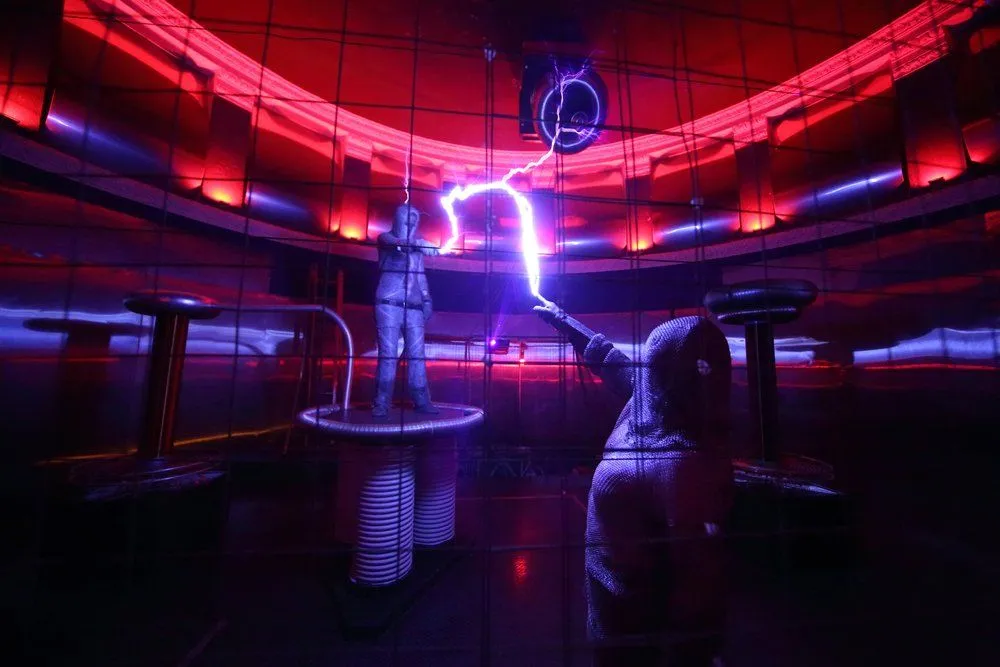
A Faraday cage, or a Faraday shield, is a container made of conductive material or mesh. It can prevent external electrostatic and electromagnetic influences from entering the enclosure. If a powerful electric current strikes the cage, it conducts electricity along the outer surface and channels it to the ground, leaving the interior largely shielded from the discharge (though not perfectly so).
If a strong electricity bolt hits this cage, the cage acts like a lightning rod. It makes sure that the electric charge travels around the outside of the cage and down into the ground – similar to how a water slide directs water from top to bottom. So, everything inside the Faraday cage, like a person or a device, stays safe and unharmed, even if a strong electrical shock hits the cage itself.
Although a car struck by lightning is a mobile Faraday cage, in theory, some factors can affect its effectiveness. For instance, if the metal used in the car’s frame is substandard, it can compromise the cage’s ability to protect the passengers. Convertibles are also a concern because they lack a metal roof.

To guarantee 100% safety against a lightning strike, you can do… well, nothing. No magic trick can ‘guarantee’ your safety. However, it’s not as if everyone is killed as soon as they are struck by lightning; there are umpteen cases of people’s miraculous escapes from certain lightning-induced deaths! Electric vehicles, by the way, are no exception: so long as they have a solid metal body, the EV’s battery and electronics may take a beating in a direct strike, but the cage effect still protects the occupants.
Your best bet is to stay indoors, take a few wise precautions, and pray that lightning does not strike when you’re taking a stroll through an empty cornfield.
What Should You Do If Lightning Strikes Your Car?

If a storm catches you on the road, the safest move is the boring one: pull over somewhere sensible, keep the engine off, and wait it out with the windows fully up. The US National Weather Service is blunt about how the protection actually works, and it has nothing to do with your tires. The metal shell does the job only if you are not handing the current an easy path to your body, so the advice is to avoid contact with any conducting paths that lead to the outside of the car, things like the radio, a CB unit, the ignition, and other metal fittings, while the storm is overhead.
It is worth repeating which vehicles do not count. A convertible offers no real protection even with the top up, and open-cab vehicles such as golf carts, tractors and construction equipment leave you exposed. Only a fully enclosed, hard-topped, metal-bodied car gives you the Faraday-cage effect.
And if your car actually takes a hit? Every strike is different, but the National Weather Service notes that damage to the antenna, electrical system, rear windshield and tires is common. The antenna can partially melt, part of the discharge can fry electronic components and leave the car inoperable, the current running through the heating wires in the rear window can shatter the glass, and it routinely blows out one or more tires as it punches through the steel belts on its way to the ground. In rare cases it can even start a fire. So even if everyone walks away unhurt, do not assume the car is fine: have it checked by a qualified mechanic before driving it again, and photograph the damage for your insurer.
How Often Do Cars Actually Get Struck By Lightning?

Rarely enough that you should not lose sleep over it. To put the everyday risk in perspective, the US National Weather Service estimates the odds of any one person being struck by lightning in a given year at roughly 1 in 1,222,000, and about 1 in 15,300 over an 80-year lifetime. Over the 30 years from 1989 to 2018, lightning killed an average of 43 people a year in the United States, a figure that drops to around 27 a year when you look only at the most recent decade in that span.
A car is a tall-ish metal object that often sits out in the open on a highway, so it is a more plausible target than, say, a person crouched in a field, but direct strikes on moving vehicles are still uncommon. And when they do happen, the outcome is usually a wrecked antenna and a hefty repair bill rather than a tragedy: across all lightning strikes on people, only about 10% are fatal, leaving the roughly 90% of survivors to deal with injuries that range from minor to lasting. The enclosed metal body is the reason a car ranks among the safer places to be caught in a storm, second only to a substantial building. If you want the full survival playbook, see our guide on the best way to survive a lightning strike.
Last Updated By: Ashish Tiwari
References (click to expand)
- RSHQ Lightning Strike Hazard in Mining Report.
- A Faraday Cage Exploration:.
- Lightning Safety in a Thunderstorm | Physics Van | UIUC.
- Alkhteeb, S. A. M., Oho, S., Nagashima, Y., Nishimura, S., & Shimizu, H. (2017, March 28). Risks of Lightning to Automotive Occupants and Electrical/Electronic Systems. SAE Technical Paper Series. SAE International.
- Kuan, T. H., & Chew, K. W. (2019, November). Analysis of Lightning and Surge Protection for Float Ground System. 2019 1st International Conference on Electrical, Control and Instrumentation Engineering (ICECIE). IEEE.
- Lightning and Cars. National Weather Service, NOAA.
- NWS JetStream – Lightning Safety. National Weather Service, NOAA.
- How Dangerous is Lightning? National Weather Service, NOAA.