
Diamonds are so hard because every carbon atom is locked to four others by strong covalent bonds in a rigid three-dimensional network. This tightly packed lattice, forged under extreme heat and pressure deep in Earth's mantle, leaves no weak direction, earning diamond a perfect 10 on the Mohs hardness scale.
Diamonds are often associated with luxury and grandeur, but have you ever wondered where the first diamond was found?
It was in India!
The first diamond was discovered around the 4th century BC. Up until the 18th century, it was widely believed that India was the only place where diamonds could be found. When the diamond mines in India were no longer productive, however, the search for alternative supply sources began. A small deposit was discovered in Brazil in the early 18th century.
Even so, there was not enough supply to meet the demands of the world market. The mesmerizing fact to remember is that these deposits had already been in place for around 990 million years.
Good things indeed take time!
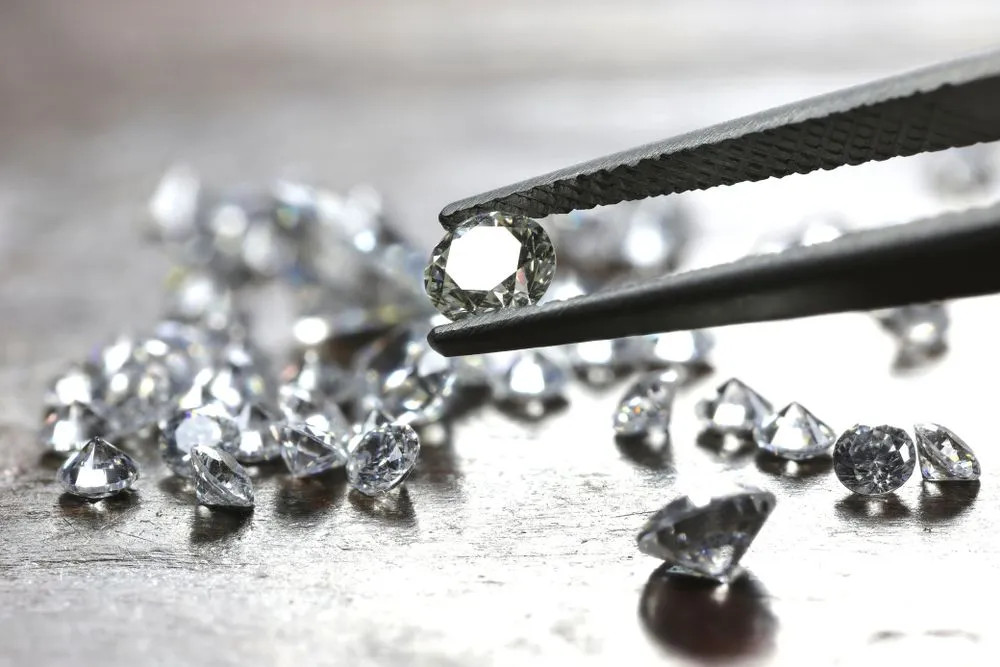
Diamonds were highly valued soon after they were discovered due to their brilliance, extreme hardness, and the fact that they could shape metal and bend light. People began wearing diamonds as jewelry, using them as instruments for cutting, wearing them as talismans to ward off evil, and utilizing them to protect themselves in combat. People in the Dark Ages also believed that eating a diamond would make them immune to disease and help them recover from wounds faster!
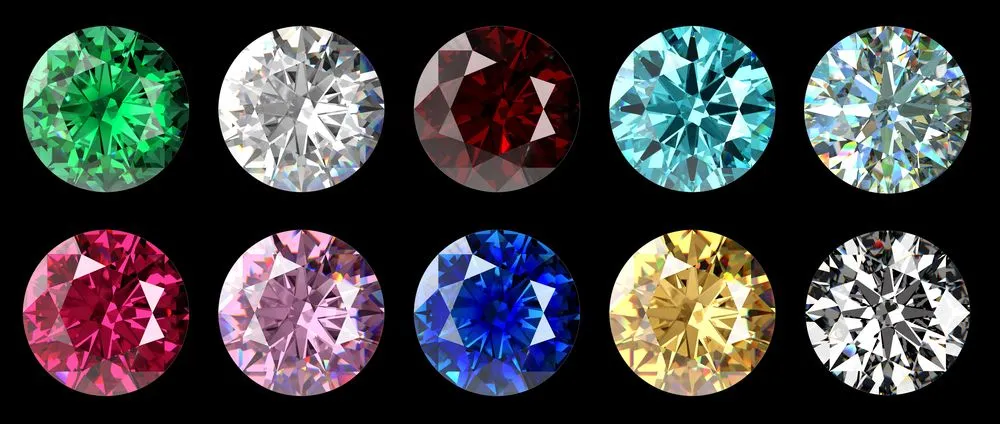
You might assume that diamonds are colorless gemstones, but that’s not true!
Diamonds may be found in every color of the rainbow (the familiar ROYGBIV spread), and the look of each color tone is distinctively different. The most difficult colors to find are blue, green, orange, and red diamonds.
Rare and beautiful things have always captivated people’s attention. Diamonds maintain their reputation as the most expensive and gorgeous piece of jewelry that one can purchase.
However, the value of diamonds is based on much more than just their aesthetic appeal.
They are valued more than any other gem due to their one-of-a-kind characteristics. Some of these characteristics lead to the use of diamonds in a wide range of industries.
Industries? Aren’t diamonds famous for being delicate and sophisticated?
Well, believe it or not, diamonds are one of the hardest substances on Earth, and are used for many different purposes in the modern world, aside from just being a unique stone. From their use as a tool to remove cataracts from the human eye to their use by beauticians to give you wrinkle-free skin, diamonds do it all. Diamonds are also used in the automobile industry to polish glass and sharpen drill bits.

Diamonds are a natural substance that have been proven to have the highest level of hardness. On the Mohs scale, diamonds get a perfect 10 out of 10. In 1812, the German mineralogist Friedrich Mohs developed this scale to rank minerals by their scratch hardness, with each mineral able to scratch every one below it. Because of their incredible hardness, only another diamond is capable of scratching a diamond.
The fact that diamonds are made of pure carbon (the same element as coal) is perhaps the most amusing fact about them. One is so expensive that wars have been fought over it, while the other is merely appreciated if we think about it in monetary and energy production terms.
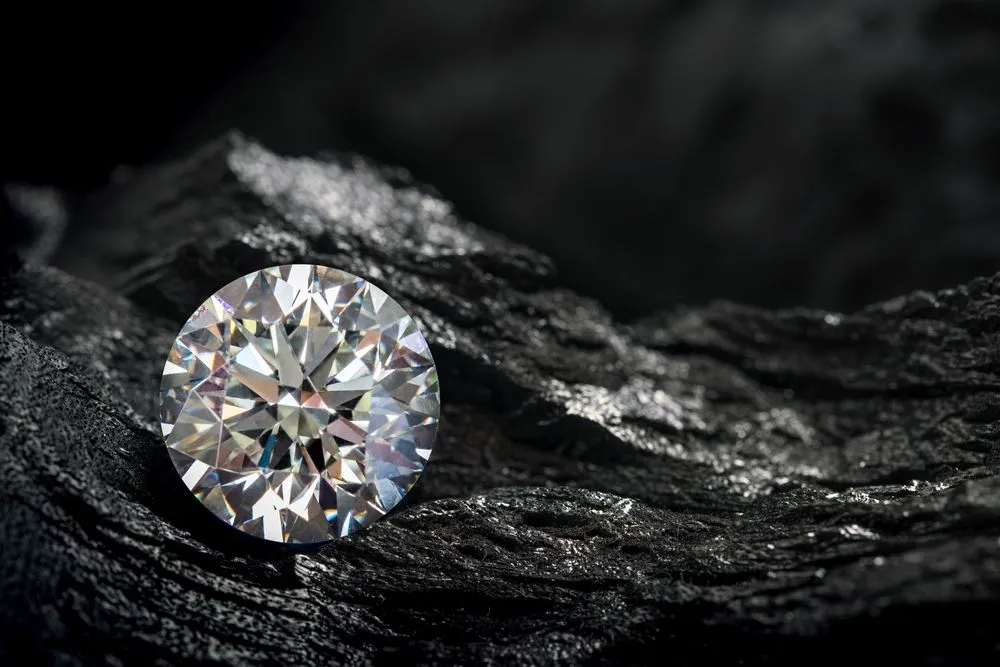
Why Did Mohs Declare The Diamond To Be A Perfect 10?
Quite simply, the density and arrangement of the carbon atoms. The main reason why diamonds are so hard is the carbon density in the diamonds.
Diamonds pack their atoms more tightly than any other solid. Diamond holds about 1.76 × 10²³ carbon atoms per cubic centimeter, the highest atomic density of any material on Earth.
A diamond that is roughly one one-thousandth of a cubic centimeter in size contains around two sextillion carbon atoms. This figure corresponds to the number of sand grains on all the world’s beaches. No other material has atoms in such close bonding with one another. One can deduce how tightly packed this substance truly is.
Furthermore, carbon is subjected to tremendous heat and pressure for a very long period before transforming into diamonds. This carbon requires a depth of about 150 to 200 kilometers (roughly 90 to 125 miles), deep in the Earth’s mantle, where temperatures reach 900 to 1,300 °C (1,650 to 2,370 °F), to transform into a precious stone one day. However, that “one day” can take 1 to 3.3 billion years to arrive!
Extreme heat and pressure lock each carbon atom to four neighbors in a rigid framework that leaves them no room to shift; this is covalent bonding. Because the atoms are packed so close to one another and bonded equally in every direction, the bonds are exceptionally strong, which is what gives a diamond its resilience.
Moreover, a diamond is a naturally occurring mineral almost entirely composed of crystalline forms of the element carbon. It has a cubic structure per the isometric system. An isometric crystal structure refers to the fact that the carbon atoms in a diamond are connected in approximately the same way, regardless of the direction from which the crystal is viewed.
The hardness of this substance is the reason it is so extensively used in the industrial sector. A substance so hard, yet the epitome of delicacy… nature is indeed miraculous.
Is A Diamond Brittle? Why The Hardest Thing On Earth Can Still Shatter
Here is the part that surprises most people: the hardest natural material on the planet can be smashed with a hammer. Hardness and toughness sound like the same thing, but in materials science they are not. Hardness is a mineral's resistance to being scratched. Toughness is its resistance to breaking or chipping when something strikes it. Diamond wins the first contest outright, yet its toughness is only rated fair to good.

The reason lies in the same tidy lattice that makes diamond so hard. That rigid, evenly bonded framework has four built-in weak directions known as octahedral cleavage planes, which run parallel to the faces of a diamond's natural octahedron. Along those planes the carbon atoms are held by fewer bonds, so a sharp, well-aimed knock can split the crystal cleanly.
Put a number on it and the gap is stark. The fracture toughness of natural diamond has been measured at about 2 MPa·m1/2, which is respectable for a gemstone but poor next to everyday engineering metals. Common steels are several times tougher. That is why a diamond will shatter if you strike it with an ordinary hammer, even though nothing short of another diamond can leave a scratch on it.
Rather than fight this weakness, diamond cutters learned to use it. For centuries, long before the age of lasers, a skilled cleaver would study a rough stone, line a blade up along one of its cleavage planes, and split it with a single tap. Get the angle right and the diamond parts along a mirror-smooth face. Get it wrong and a small fortune can turn to gravel.
How Hard Is A Diamond Compared To Everything Else?
A perfect 10 on the Mohs scale sounds neat and final, but the scale actually hides just how far ahead diamond really sits. The Mohs scale is an ordinal ranking: it only tells you which mineral scratches which, not by how much. The steps between the numbers are wildly uneven.

Corundum, the mineral behind rubies and sapphires, sits at 9, just one rung below diamond. Yet measured on an absolute hardness scale, diamond is roughly four times as hard as corundum despite that single-number gap. The leap from 9 to 10 is the largest single step on the whole scale. In fact, the difference in absolute hardness between a sapphire and a diamond is greater than the entire spread from talc, the softest mineral at 1, all the way up to sapphire.
Laboratory measurements tell the same story. On the Vickers hardness scale used by engineers, diamond comes in at roughly 70 to 150 GPa, comfortably making it the hardest known material on Earth. So while a Mohs 10 and a Mohs 9 look like close neighbors on paper, in reality nothing else in the natural world comes remotely close to a diamond's ability to resist a scratch.
References (click to expand)
- History of the Hope Diamond | Smithsonian Institution. The Smithsonian Institution
- Mohs hardness | Definition, Table, Examples, & Facts. Encyclopaedia Britannica
- Diamond History and Lore - GIA. The Gemological Institute of America
- Australian gems | Geoscience Australia. Geoscience Australia
- HDLD Form —. How Do Diamonds Form in the Deep Earth? | Gems & Gemology. The Gemological Institute of America
- Formation of Diamonds - The Ohio State University. The Ohio State University
- How Are Diamonds Made? - Ask An Earth and Space Scientist |. Arizona State University
- How Are Diamonds Made? - Ask An Earth and Space Scientist |. Arizona State University
- Why Are Diamonds So Hard? - GIA 4Cs. The Gemological Institute of America
- How Diamonds Are Formed. The University of North Carolina at Charlotte
- Material properties of diamond - Wikipedia
- Diamond - Wikipedia
- Mohs scale - Wikipedia
- Superhard material - Wikipedia


