Table of Contents (click to expand)
An eraser works mainly through adhesion: graphite sticks more strongly to rubber than to paper, so rubbing lifts the flakes off and carries them away on the crumbs that roll up. The first rubber eraser was sold in 1770 by London instrument-maker Edward Nairne. Pencil “lead” is actually graphite (a form of carbon), and a pencil’s grade (soft B to hard H) is set by its graphite-to-clay ratio.
In our digital age of social media, everything seems closely monitored. As they say, the Internet never forgets. Once it’s on the Internet, it will remain there forever.
The Internet also doesn’t forgive. Ask any celebrity who has committed an unfortunate typo or posted something contentious on their page. Trolls on the Internet are just waiting to pounce on any such gaffe and make a big issue of it. They’ll bookmark it, screenshot it, archive it and do everything to make sure that miswritten content remains on the internet in some form or another. Therefore, even if an individual deletes a tweet/post/comment, the content is preserved in some form, which can then be used later, if necessary.

Basically, you need to be very careful about what you type on the Internet to avoid such embarrassing encounters.
All of this makes me want to return to my childhood, when life was so much simpler, when making a mistake wasn’t a crime. When we were not constantly mocked and hounded about our tiniest errors.
Back then, any error could simply be erased, thanks to our trusted pencils, the writing tool for most children growing up.
However, with the advent of digital devices like tablets, smartphones and smart screens, the pencil and eraser are becoming less popular. For millennials, boomers, and earlier generations, however, the sight of a pencil and eraser triggers undeniable nostalgia, even if you don’t fully understand the production or function of these rudimentary tools.
Pencil
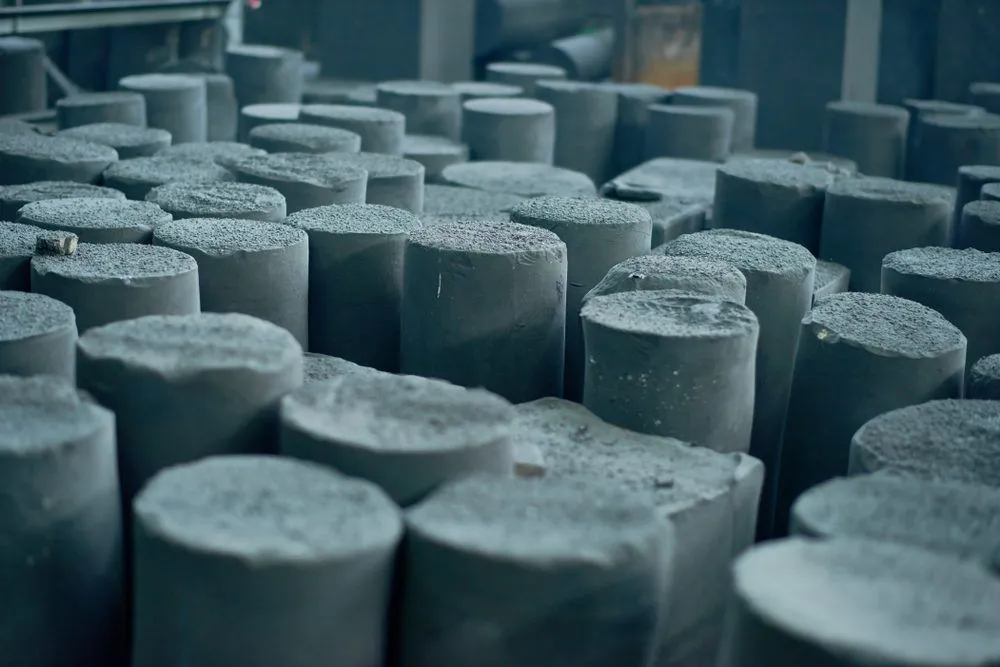
Most people believe that pencils are made from lead, but this isn’t quite right. Although we call the black stuff with which we write “pencil lead”, pencils are actually made of a mineral called graphite, which is composed of carbon.
Interesting History Behind The Discovery Of Pencils
The story of the discovery of graphite for use as a pencil is quite interesting. In the mid-1500s, near Borrowdale, in the Lake District of northern England, a storm is said to have uprooted some trees, and locals spotted a strange dark substance clinging to the roots underneath. They started fiddling with it and discovered that this lump of dark solid material tended to leave marks behind. This strange material was graphite, one of the purest deposits ever found.
One of the group members had the idea that this dark solid substance could be used to tag sheep so owners could record and track their herd. This discovery by those curious locals paved the way for the modern pencils still in use today!
How Does A Pencil Work?
Isn’t it strange for something solid, like graphite, to leave its color behind? The answer to this lies in the physical property of graphite. As mentioned earlier, graphite is made of sheets of carbon layers. These layers nicely stack over each other, and are held together by a weak atomic bond. When we use it as a pencil, the sheet of carbon from the cylindrical pencil rubs off and gets deposited onto the fibers of the paper on which you are writing. These deposited flakes cling to the fibers of the paper and firmly remain there, if left undisturbed.
Evolution Of The Pencil
After people started using graphite for marking things, they realized that it’s a bit messy to deal with graphite directly. Using raw graphite would stain one’s clothes and make your hands dirty. Subsequently, they came up with the idea of sharpening one end of the graphite block and wrapping the rest of it in string or cloth, so that only the tip was left uncovered.
In 1795, a French army officer and inventor named Nicolas-Jacques Conté came up with a more advanced design for the wooden pencils we see today. He fired a mixture of clay and powdered graphite in a kiln at roughly 1040 oC (about 1900 oF), then let it cool. He encased the resulting rod in a long cylindrical wooden covering. This is how the modern wooden pencil came into being! The different grades of pencils (9B through HB to 9H) that we see today come from tweaking this graphite-to-clay ratio. For example, when you increase the quantity of clay, the pencil writes lighter and harder (the H grades), whereas if you increase the proportion of graphite, the mark comes out darker and softer (the B grades).
Eraser
A single pencil holds a surprising amount of writing in it: by one popular estimate, an average pencil can write roughly 45,000 words before it runs out (people who have actually tried it have squeezed out even more). If you set out to test that by writing a 45,000-word story with a single pencil, chances are good that you will make quite a few mistakes along the way. To err is human, so it’s a good thing that you can correct your mistakes without leaving any proof of your error behind, provided that you have an eraser, of course!
How Does An Eraser Work?
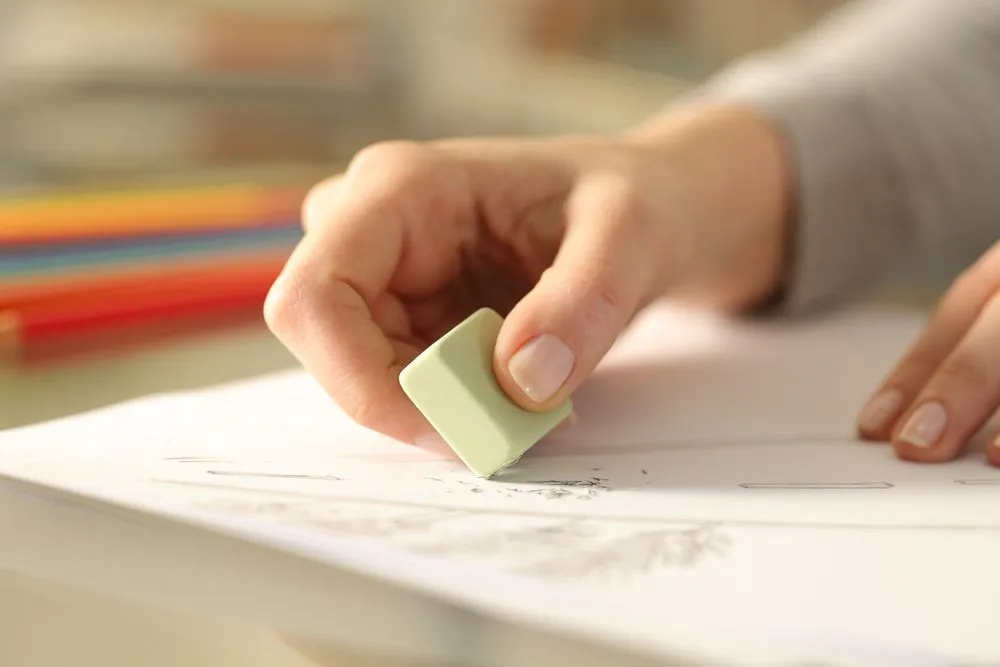
The real secret of an eraser is a property called adhesion, with a helping hand from friction. Remember that pencil marks are just loose graphite flakes clinging weakly to the paper fibers. As it turns out, those flakes stick far more strongly to soft rubber than they do to the paper. So when you rub an eraser across your mistake, the graphite is grabbed by the rubber and pulled off the page, the way a lint roller lifts hair off a sweater. Friction does its part too: the rubbing action abrades the surface and dislodges the flakes so the rubber can grab them. As the eraser drags along, its surface keeps breaking up into those little crumbs you brush away, and each crumb carries away graphite with it, which is why a fresh patch of rubber keeps doing the work. (The old idea that friction heats the rubber until it turns sticky is mostly a myth: the marks are lifted by adhesion, not melted off by heat.)
A Brief History Of Erasers
Erasers, like those used on the backs of pencils, have an interesting story behind their invention. When earlier humans used pencil in the form of cloth-covered graphite, they also discovered that moist bread could erase pencil marks. Thus, a slightly moistened and balled up piece of bread could be readily used as an eraser. This all changed around 1770, after an accidental discovery by British scientific-instrument maker Edward Nairne. As the story goes, Nairne inadvertently picked up a piece of rubber instead of breadcrumbs, and to his pleasant surprise, the rubber eliminated the pencil imprint! He was smart enough to realize the business potential of using a rubber eraser, as erasing using bread was really a “crummy” process. He began selling small natural rubber cubes for three shillings apiece, which was a very high price at that time. This natural rubber eraser was made from latex, a substance released by certain trees as a chemical to dissuade insects from eating plants.
Although natural rubber erasers worked well, they were expensive to produce. Moreover, many people developed allergies to these natural rubber erasers. Gradually, cheaper synthetic petroleum-based rubber was used to make erasers. Most of the rubber erasers you see today are made from synthetic rubber.
What Are Erasers Made Of?
Reach into a pencil case and you will usually find more than one kind of eraser, and they are not all made of the same material. The classic pink block, and the little cap on the end of a pencil, is typically synthetic styrene-butadiene rubber rather than the natural latex that Nairne once sold. To help it bite into stubborn marks, this type is blended with mineral fillers and a mild abrasive such as pumice, plus a plasticizer like vegetable oil to keep it flexible. That gritty abrasive is exactly why an old-school pink eraser can rough up thin paper if you press too hard.

The soft white erasers you find on drafting pencils and in art kits are a different animal. Most are vinyl, made from plasticized polyvinyl chloride (PVC). Because they are non-abrasive, they lift graphite cleanly without scuffing the page, and they tend to last a long time. Art gum erasers, traditionally tan or brown, are softer still and deliberately crumbly: they were originally made from corn oil vulcanized with sulfur dichloride, and they wear away quickly so that fresh, clean rubber is always meeting the paper. Then there is the artist’s favorite, the kneaded eraser, a soft putty you can stretch and mold to a fine point. Instead of shedding crumbs, it lifts graphite by dabbing it up, which makes it ideal for gently lightening a shaded sketch. So while every eraser relies on the same adhesion trick, what it is made of decides how gently (or how aggressively) it treats your paper.
Who Put The Eraser On The End Of A Pencil?
We tend to think of the pencil with a little rubber tip on top as a single object, but the two were originally sold as separate things. So who first married them together? That credit usually goes to Hymen L. Lipman, an American stationer from Philadelphia, who was granted a patent on 30 March 1858 for a pencil with a strip of rubber fixed into a groove at one end. The idea was simple but genuinely useful: your writing tool and your correcting tool now lived in the same hand, so you never had to go hunting for a stray eraser again.

The story then took a strange legal turn. Lipman sold his patent to a businessman named Joseph Reckendorfer, who went on to sue the famous pencil manufacturer Faber for making pencils with erasers attached. The dispute climbed all the way to the U.S. Supreme Court, and in Reckendorfer v. Faber (1875) the justices threw the patent out. Their reasoning is a neat little lesson in what actually counts as an invention: fixing an eraser onto a pencil did not create anything new, because each part simply kept doing its own separate job. As the Court put it, “each continues to perform its own duty, and nothing else.” A pencil still wrote and an eraser still erased, so joining them produced no new combined result. In the eyes of the law, then, the everyday object in your pencil case was never truly “invented” at all.
Why Is An Eraser Considered A Solid?
Here is a question that trips up more students than you might expect: an eraser is obviously a solid, but why, exactly? The answer comes down to two defining features that every solid shares. First, a solid has a definite shape of its own. Leave an eraser on your desk, drop it in a bag, or hold it in your palm, and it keeps the same blocky shape instead of flowing to fit its container the way water or air would. Second, a solid has a definite volume, meaning it takes up a fixed amount of space and cannot be squashed down into something noticeably smaller.
Both of those properties trace back to what is happening at the level of the eraser’s particles. In a solid, the particles are packed tightly together and locked into fixed positions, held there by strong forces between them. There simply isn’t enough thermal energy for them to break free and move around, so instead they just vibrate gently in place. That rigid, closely packed arrangement is exactly what gives the eraser (and every other solid) its steady shape and volume. In a liquid the particles can slip past one another, and in a gas they fly apart to fill whatever space they are in, which is why only a solid holds its form the way your eraser does.

That’s the science and history behind the discovery of two popular stationery items: pencils and erasers. One thing that this perfect pair teaches is that we shouldn’t be afraid to make mistakes. Instead, we should learn from them, and shouldn’t hesitate to correct them when required!
References (click to expand)
- The Secret Science of Pencils & Erasers. The American Chemical Society
- 20 Things You Didn't Know About Pencils. Discover Magazine
- The future of the pencil. The Economist
- How do erasers actually work? Popular Science
- Eraser. Wikipedia
- Reckendorfer v. Faber, 92 U.S. 347 (1875). Legal Information Institute, Cornell Law School
- Classifying Matter According to Its State. Chemistry LibreTexts