No, Asgard is not a real place. It began as the home of the gods in Norse mythology and appears in Marvel as Thor's flat, disc-shaped planet. A planet that flat would need to spin so fast, and be so absurdly dense, that it could not hold together or support life, so a real Asgard breaks the laws of physics.
In its journey to date, which now comprises more than 35 feature films, the Marvel Cinematic Universe has taken us to faraway galaxies and wondrous destinations. Although the stories mostly revolved around Earth, audiences were also introduced to numerous planets and celestial bodies that seemed unreal.
Each of these places was unique and looked like something that we had never seen before, which brings us to our question: can these Marvel planets exist in reality?
Many of the MCU planets seen in the movies were habitable and hosted various species. Much of this, however, depends on whether these planets satisfy the laws of planetary physics or not. In this article, we will review the planet Asgard, but before digging into our Marvel fact file, let’s take a look at the true origins of Asgard.
Asgard From Norse Mythology
The world was not always as we see it today. There was a time when there was no science or national boundaries; the only distinct groups that formed were based on one’s location and beliefs. One such group of people in early Scandinavia and neighboring regions were called the Norse; their line of thought, as found in various pieces of their literature, is called Norse Mythology.
The Nordic mythological world mostly talked about Gods and other out-worldly creatures. However, the most interesting belief that the Nordic people shared was about The Nine Worlds, which were home to the nine different types of beings they believed existed in the pre-Christian era.
One of these nine worlds was called Asgard, which translates to the home of Aesir or “the Gods”. Asgard was the seat of King Odin and his son Thor (yes, our beloved Thor was originally a Norse mythological character).
Asgard is described as a highly civilized society that is law-abiding and boasts a proper political structure (Norse Mythology). It is situated somewhere in the sky and is connected to the land of humans (Midgard) by a rainbow-like bridge. Asgard is said to be invisible to most common beings, and only an Aesir can access the bridge. This means that to enter the land of Gods, one would need a god of their own by his side.
The Nine Realms And The World Tree Yggdrasil
Asgard was never meant to stand on its own. In Norse belief it is one of nine worlds bound together by Yggdrasil, an enormous ash tree whose roots and branches hold the entire cosmos in place. Picture Yggdrasil as the axis of the universe, with each world resting somewhere among its branches or beneath its roots (Norse Mythology).

The nine worlds are Asgard (home of the Aesir gods), Midgard (our world of humans), Vanaheim (home of the Vanir gods), Jotunheim (land of the giants), Alfheim (the elves), Nidavellir or Svartalfheim (the dwarves), Niflheim (primordial ice), Muspelheim (primordial fire) and Hel (the realm of the dead). Together they gave the Norse a complete map of existence, stretching from the fires of creation to the cold home of the dead.
One point is worth being honest about: no surviving Norse text spells out exactly where each world sits in relation to the others. The neat diagrams you often see, with the realms stacked tidily around the tree, are modern reconstructions rather than anything the myths actually describe. When Marvel calls Asgard part of “the Nine Realms”, it is borrowing this ancient framework, even though the films rearrange the details to suit the story.
Where Is Asgard, And How Far Is It From Earth?
This is one of the questions readers ask most often, and the honest answer is that Asgard has no address you could ever feed into a spacecraft. In the myths it sits “in the sky”, but the old sources treat that as a spiritual location rather than a physical one. The Poetic Edda poem Grímnismál places the halls of the gods high in the heavens, yet it never offers anything you could measure the way we measure the distance to a star (Norse Mythology).

What links Asgard to Midgard, our human world, is not a stretch of empty space but the Bifröst, the burning rainbow bridge watched over by the god Heimdall. The gods ride across it; ordinary humans cannot. Distance in the everyday sense never really enters the picture, because you reach Asgard by crossing the bridge, not by covering a measured gap.
Marvel keeps this idea intact. In the films, travel between Asgard and Earth happens through the Bifrost, opened by Heimdall, rather than by flying a set number of light-years. So if you have ever wondered whether Asgard is on Earth, circling a nearby star, or a fixed distance away, the answer in both the myth and the movies is the same: it is a realm you reach by the bridge, not a planet you could point to in the night sky.
Asgard According To The Marvel Cinematic Universe
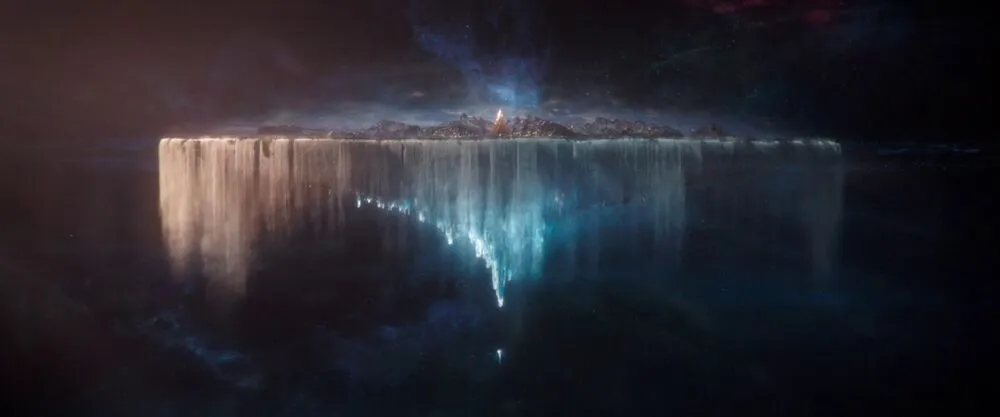
Asgard has been depicted as a separate planet in the Marvel movies. It is the planet of the peacekeepers and a part of the nine realms. It is the home of the mighty Thor and his fellow Asgardians. Frankly speaking, it is the coolest planet shown by the MCU. The towering skyscrapers, hovering structures of unique architecture, and all the other technology provide proof of its superiority and greatness.
What strikes me the most is Asgard’s similarities to the United States. Think about it… a technologically advanced nation that proclaims to solve all intergalactic problems and deploys forces wherever military tension exists.
Can A Planet Be Flat?
In the movies, Asgard has been shown as a flat planet, a description that matches to some extent the one given by the ancient Nordic books and myths. The flatness in planetary terms implies that Asgard’s equatorial diameter is far greater than its polar diameter.
To understand this better, consider the axial rotation of our own planet. Earth is also not a perfect sphere. It is slightly bulged at the Equator, as compared to the poles (Earth’s equatorial diameter is about 43 km, or 27 mi, larger than its polar diameter). The reason behind this unevenness is the axial rotation of the planet.
At the Equator, Earth's surface rotates at about 1,670 km/h (1,040 mph), and the centrifugal force generated by this motion forces it to flatten minutely. However, for a planet to be as flat as Asgard, it would have to rotate at extremely high speeds. As a result of such high rotational speeds, as well as the Coriolis and other effects that follow it, the surface of such a planet would experience extreme turbulence. It would make the planet’s crust extremely uneven and not ideal for supporting any kind of life.
The Problem Of Heavy Mass
Let’s consider for a second that the problem of surface turbulence was solved. Even so, one issue would continue to haunt us. Planets rotate due to their inertia acting in the wide vacuum of space. When a spherical body is hit by an object at its surface (say an asteroid or meteor from space), it starts axial rotation.
If no external force acts on such a body, it keeps spinning because of a property called inertia, which is tied to the planet’s mass. Mass alone doesn’t set the spin rate, though. A planet’s rotation comes from the angular momentum it inherited as it formed, and the most massive planets tend to have swept up the most spinning material. That is why the giant planets spin so much faster than the small rocky ones: Jupiter’s equator whips around at roughly 45,300 km/h (28,100 mph), compared to Mars’ 868 km/h (539 mph). For a planet to have as high a rotational speed as a flat Asgard would require, it would need an enormous store of mass and angular momentum.
Such a planet would either be extremely large to incorporate all the mass, or it would be made up of unimaginably dense material. A body that massive and that fast-spinning would store a tremendous amount of rotational kinetic energy. Stirring that much electrically charged material at high speed tends to generate powerful magnetic fields (the same dynamo process that drives Jupiter's enormous magnetosphere and its violent auroras), and those fields would whip the surface and atmosphere into ferocious, planet-wide turbulence.
It would also attract smaller celestial bodies towards it, which would constantly hit it, reducing its size and thus slowing it down. This is why we only see planets under a certain size limit. For the latter case to occur, such a dense element would have to exist, which would itself be nearly impossible, given our knowledge at present. Atoms with a high number of protons and neutrons in the nucleus are extremely unstable; in fact, the final few elements in our periodic table have only existed for a few seconds in highly controlled laboratory settings!
A Final Word
Again, on a planet spinning fast enough to flatten into a disc, the outward centrifugal effect at the equator would overwhelm gravity, effectively flinging loose objects (and anyone standing there) off the surface rather than holding them down. All in all, there seem to be a lot of problems with the possibility of Asgard truly existing.
As such, with the knowledge we currently possess, we can safely rule out the prospect of finding such a celestial body. However, Early Man once believed that Earth was the center of the Universe, and that clearly didn’t end up being correct. Perhaps our present knowledge and beliefs will one day be looked back upon and be seen as equally rudimentary and ignorant…. only time will tell!
References (click to expand)
- Asgard | Marvel Cinematic Universe Wiki - Fandom. Fandom
- Roche Limit. University of Oregon
- Marvel.com | The Official Site for Marvel Movies, Characters. marvel.com
- Asgard - Norse Mythology for Smart People. norse-mythology.org
- Jupiter Fact Sheet. NASA NSSDCA
- Why Does Jupiter Spin So Fast? The Planetary Society
- The Nine Worlds - Norse Mythology for Smart People. norse-mythology.org