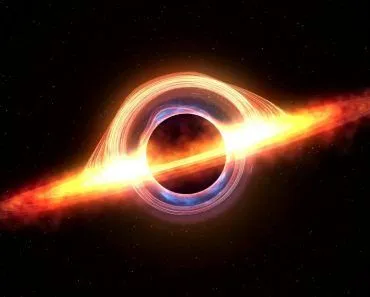
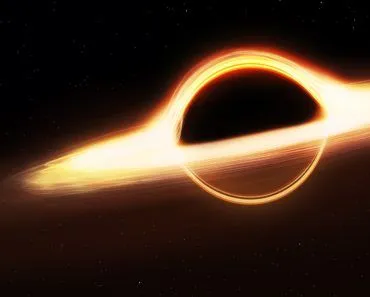
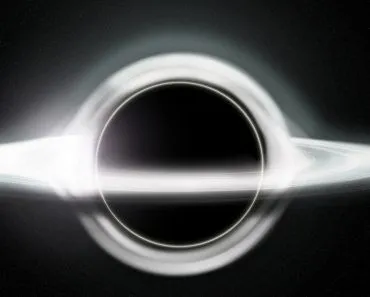
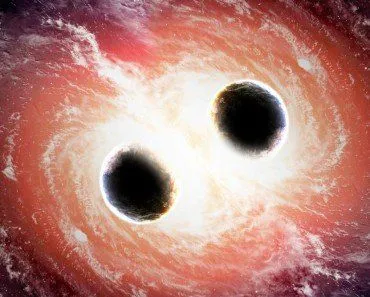
Cooper's plunge into Gargantua in Interstellar dramatizes a real physics problem: general relativity (which governs gravity at large scales) and quantum mechanics (which governs everything else) break down inside a black hole. The singularity at a black hole's center is the one place in the universe where quantum gravity is expected to dominate, so it's where data (if you could ever survive long enough to send it back) would matter most.
If you’re among the many people who have seen the movie Interstellar, you surely remember the spectacular and mind-boggling part where Cooper saves the day by jumping into the black hole.

If you remember, the plot of the story revolved around the fact that gravity was giving up on Earth and mankind had to find another way to survive. Either on Earth or elsewhere. A team was tasked with finding a suitable planet for mankind outside of our solar system.
An amazing adventure later, they see the clock running out on Earth, with only one planet left to check, but no one had figured out the gravity completely.
So what does the protagonist Cooper do to solve the problem? He jumps into the black hole.
Believe it or not, given what we know about gravitational force, the idea actually makes sense!
Now, you may be surprised at my saying this, but the fact is that gravitational force is the most controversial one in the family of forces.
Rather, it is the only one barred from the family of fundamental particles (called the Standard Model), which groups elementary particles and forces running the universe.
What is the reason behind this uncharacteristic treatment of gravity? Why is the most prominent force treated so differently? And why does falling into the black hole (literally!) make sense in such a cinematic scenario?
For that, we first need to understand the forces running our universe.
What Are The Fundamental Forces Of Nature?
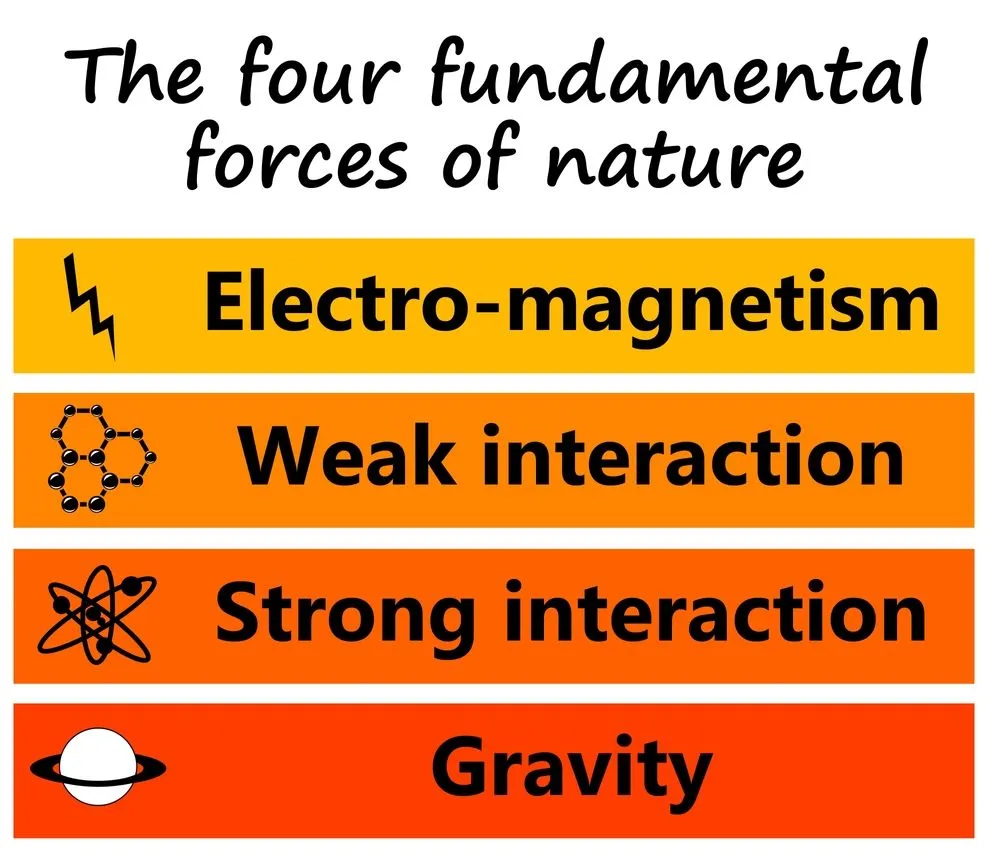
Today, we know most of the fundamental particles that make up the universe (at least, the visible universe). We also know all about the fundamental forces that run it. These fundamental forces are electromagnetism, strong and weak nuclear forces, and gravitational force.
To give you an example of how each force exists behind the running of the universe, take a look around you. We see examples of electromagnetic force in the electronic gadgets in our hands.
The strong nuclear force is what powers the Sun and other stars: it binds the atomic nucleus together and releases energy when light nuclei fuse together. Inside that same nucleus, the strong force also confines the quarks inside each proton and neutron, while the weak nuclear force handles certain particle decays (like beta decay) that play a supporting role in fusion chains. Finally, there is gravitational force, the very reason why we are sitting on our chairs and able to walk around this beautiful planet.
The Standard Model has been the go-to piece of science that has helped us house the particles we have discovered. It can be seen as a house for the family of elementary particles, but the family is a rather complex and controversial one. And like any other complex family, this one also has a black sheep, gravitational force.
Strange that the most obvious of all these forces is the one that is not acknowledged at the family table of fundamental building blocks of the universe!
What Is The Grudge Against Gravitational Force?
The answer was quite literally given in Interstellar. If you remember, in the movie, Professor Brand and his daughter (and later Murph too) were absolutely frustrated trying to complete this stubbornly incomplete theory of gravity. It seemed that the only way to understand the force entirely was to get a full mathematical picture of it. However, even after years of trying, on his death bed, Professor Brand tells Murph that there is no way to complete the equation.

I know, it may be a little confusing… why is an incomplete equation responsible for such a snub from the Standard Model? Moreover, don’t we already have a very successful theory of gravity, given by Albert Einstein, called the general theory of relativity? So, what is the reason for the exclusion of this famous force?
The simple answer is that even though we do have an equation, it is for the world on a massive scale: the stars, the moon, the planets, a baseball, a marble, etc.
However, when we start talking about particles on a quantum level, the equation is insufficient. The icing on top is the fact that all the other forces can be expressed using quantum physics. On the other hand, when talking about gravity on a quantum level (quantum gravity), for example, inside a black hole, the general theory of relativity fails us!
Now do you understand why we are still unable to understand the interiors of black holes?
The Solution Given By Interstellar
Now, here comes the most bizarre, but frankly, legitimate idea Cooper came up with, falling into a black hole. Regardless of how strange it seems, it is the best option. Provided we somehow build a spaceship to withstand the extremely high gravity and temperature, slather SPF 1000000000000 on our bodies, and hope the black hole doesn’t obliterate us. Semantics, right?
Truthfully, though, it is a good idea, because we have postulated many theories to unite gravity with quantum physics. Unfortunately, all of them have fallen short. Moreover, how are we to experimentally observe quantum gravity when the only place in the universe it exists is a singularity? A point where the force of gravity is the highest in the universe, i.e., inside a black hole.
Interstellar scene of falling into the blackhole
And that is why, when Cooper maneuvered his spacecraft and entered the black hole, there was an ahhh! moment, not just for the story, but the science too. He could successfully take observations of quantum gravity, and by using that information, Murph could finally complete the equation of gravitational force and save the day on Earth!
So, the next time you’re watching Interstellar, remember how many facts its fiction is built on, and enjoy!
Why Did Cooper Jump Into The Black Hole?
In the film, Cooper doesn't dive into Gargantua on a whim. By the time the Endurance reaches the black hole, the crew is almost out of fuel, and the only way to fling Amelia Brand's lander onward to Edmunds' planet is to make the ship lighter. So Cooper and the robot TARS detach their own modules and let Gargantua's enormous gravity whip the rest of the craft forward. That is a real maneuver called a gravitational slingshot, the same gravity-assist trick NASA uses to hurl probes across the solar system.

Cooper's sacrifice does double duty. Shedding that mass gives Brand the boost she needs, and it sends Cooper on a one-way trip past the point of no return. That is exactly where the science above comes back in. The singularity inside a black hole is the one place in the universe where quantum gravity should reveal itself, so if Cooper could somehow record what happens in there, humanity would finally have the missing piece for the gravity equation. He isn't only giving up his life; he is gambling that the inside of a black hole holds the answer.
How Did Cooper Survive Falling Into Gargantua?
Here is the part that surprises people: crossing the edge of a black hole this big would not instantly shred you. The real danger is the tidal force, the difference in gravity between your head and your feet. Around a small stellar-mass black hole that difference is brutal, stretching anything that falls in into a thin strand, a fate physicists cheerfully call spaghettification. But Gargantua is a supermassive black hole of roughly 100 million times the Sun's mass, and the bigger the black hole, the gentler the tidal gradient at its event horizon. As NASA astrophysicist Jeremy Schnittman puts it, "If you have the choice, you want to fall into a supermassive black hole," because you can slip across the horizon without feeling a thing.

That buys Cooper some time, but not survival. The tidal forces still climb viciously as he plunges toward the center, and no known physics lets a human body endure the singularity. This is the moment Interstellar hands the wheel to science fiction. Just before Cooper is destroyed, he is caught by a tesseract. In pure geometry a tesseract is a four-dimensional cube, but in the film the structure is used as a doorway into higher-dimensional space, one that lets Cooper treat time itself as a direction he can move along. It is built by advanced beings whom Cooper realizes are not aliens but our own descendants from the far future, humans who have evolved to perceive extra dimensions the way we look around a room. To his eyes, the tesseract appears as an endless lattice folded out of every moment behind his daughter Murph's bookshelf.
How Did Cooper Escape The Black Hole And Get Home?
From inside the tesseract, Cooper can reach across space and time using gravity, the one force thought to leak beyond our familiar four dimensions. TARS, which fell in alongside him, had measured the quantum data from inside the horizon and encoded it in Morse code. Cooper passes that code to Murph by nudging the second hand of the wristwatch he gave her years earlier, a faint gravitational signal ticking out the numbers she needs. Armed with it, the grown-up Murph finally solves the gravity equation, unlocks controllable gravity, and gives humanity a way off a dying Earth.

Once the message is delivered, the tesseract closes and lets Cooper go. He is found drifting near Saturn, close to the wormhole that began the journey, and picked up by a space station orbiting the ringed planet roughly a century after he first left home. Relativity has kept him young, while Murph is now an old woman on her deathbed. It is a gorgeous ending, and it rests on real ideas, but it is worth being clear about the science: in reality, nothing, not even information, can climb back out of a black hole's event horizon. Cooper's return leans entirely on the film's invented higher-dimensional physics, not on anything we can currently test. The real magic of Interstellar is how much genuine science it stacks beneath that single leap of imagination.
References (click to expand)
- The Standard Model | Institute of Physics. iop.org
- Is Gravity Quantum? - Scientific American. Scientific American
- New NASA Black Hole Visualization Takes Viewers Beyond the Brink. NASA Science
- The Warped Science of Interstellar (Jean-Pierre Luminet). Futura-Sciences
- Explaining the Interstellar Ending. Den of Geek