Table of Contents (click to expand)
- Does A Data Center Use A Lot Of Electricity, And Where Does It Go?
- Why Does Evaporating Water Carry Away So Much Heat?
- What Does A Data Center Cooling Tower Actually Do?
- Why Not Just Blow Outside Air Over The Servers?
- How Much Water Do Data Centers Really Use, And Does ChatGPT Waste Water?
- So, Why Do Data Centers Use So Much Water, And Can They Stop?
Data centers use so much water because the cheapest way to dump the heat from thousands of servers is to let water evaporate in a rooftop cooling tower, and every kilogram that turns to vapor carries away about 58 times more heat than warming it by ten degrees would. In the United States, data centers evaporated about 66 billion liters (17 billion gallons) this way in 2023, but roughly 800 billion liters more were evaporated at the power plants making their electricity. Dry coolers and closed loops can cut the on-site water to almost nothing, but they burn extra electricity, and that electricity costs water somewhere else.
Every new data center seems to arrive with one headline number. It is how many million gallons a day the place will “drink”. You see water pumped through racks of computers like coolant through an engine. It vanishes into the chips.
That picture is wrong in a way that matters. The servers never get wet. If they did, this would be a different and much shorter article. Water at a data center lives in pipes, and most of it leaves through the roof as vapor. On a cold morning you can watch it go: a white plume over the building that people mistake for smoke.
So the question is not where the water goes. It is why anyone would throw clean freshwater into the sky on purpose. The answer is a piece of physics your own body uses every time you sweat.
Does A Data Center Use A Lot Of Electricity, And Where Does It Go?
Yes. US data centers now use more than four percent of the country's electricity. Nearly every joule of it ends up as heat. A chip does not store energy or turn it into motion. It flips billions of tiny switches, and every flip warms the silicon a little.
That heat has to leave the building, or the servers cook. Getting it out happens in two stages. First, heat moves from the chips into air or liquid inside the server hall. Then the facility pushes that heat outdoors. Stage one is a closed loop. The same water (or air) goes round and round, and nothing is lost. Stage two is where the water bill starts. The most common way to get heat out of a building is a cooling tower, and a cooling tower works by evaporation.

Why Does Evaporating Water Carry Away So Much Heat?
Go for a run on a warm day and your skin gets wet. The sweat is not there to make you damp. It is there to evaporate, and evaporating pulls a surprising amount of heat out of your skin.
Warming water just makes its molecules jiggle faster. Evaporating water means ripping molecules away from their neighbors. They fly off into the air as gas, and that costs far more energy. The energy needed to turn a liquid into a gas without changing its temperature is called latent heat.
The numbers are lopsided. Warming one kilogram of water by 10 °C takes about 42 kilojoules. Evaporating that same kilogram at a comfortable 30 °C (86 °F) takes about 2,430 kilojoules. Evaporation soaks up roughly 58 times more heat per kilogram. It is why a cooling tower evaporates water instead of warming it and sending it back to the river.

Now run that through a data center. One kilowatt-hour of electricity is 3,600 kilojoules. Almost all of it becomes heat the tower must remove. Each evaporating kilogram carries off 2,430 kilojoules. Divide, and you get about 1.5 kilograms, or 1.5 liters (a little under half a gallon). If every joule of server heat left as vapor, the tower would evaporate a liter and a half per kilowatt-hour. Warming water instead of evaporating it would take nearly sixty times as much water.
What Does A Data Center Cooling Tower Actually Do?
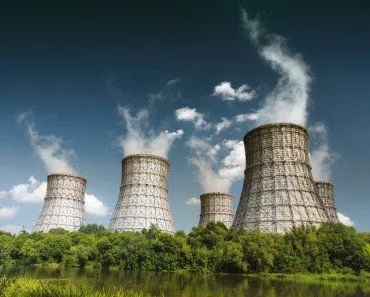
A data center tower is not the giant concrete chimney at a power station (those are natural-draft towers, a different beast). It is a boxy unit with big fans on top, sitting on the roof or in a yard beside the building.
Inside, warm water from the server loop is sprayed over a honeycomb of plastic sheets. The fans pull outside air through it. A small fraction evaporates into that air, and in doing so chills the rest. The cooled water goes back for more server heat. The vapor goes up and out as the plume you see on a cold day.
The tower loses water three ways, and the fresh water it needs is the sum of all three:
Make-up = Evaporation + Blowdown + Drift
Evaporation is the big one, and the reason the tower exists. Drift is a few stray droplets carried out by the fans. Blowdown is the sneaky one. When water evaporates, its dissolved minerals stay behind. It is the salt left in a pasta pot you have boiled nearly dry. Left alone, that salt would crust the pipes with scale. The tower drains off some of its concentrated water now and then and replaces it with fresh. Most towers reuse each batch of water only a handful of times before it is too salty to keep.
That leaves two different “water use” numbers. People argue about them without noticing they differ. Withdrawal is everything the site takes in. Consumption is only the part that evaporates. With decent water quality, about 80 percent of what is withdrawn is consumed. The rest goes down the drain as blowdown.

How does the theory check out against real towers? Reported figures sit on both sides of the worked example. One large cloud operator reports about 1 liter per kilowatt-hour across its fleet. Many of its sites spend part of the year cooling on outside air alone. One large commercial site in an Arizona summer hit about 9 liters per kilowatt-hour. Hot, dry air makes a tower work harder.

Why Not Just Blow Outside Air Over The Servers?
Plenty of data centers do, when the weather allows. The catch is a number called the wet-bulb temperature.
Take an ordinary thermometer, wrap its bulb in a wet cloth and fan it. The reading drops, because the cloth is evaporating and the evaporation steals heat. The temperature it settles at is the wet-bulb temperature. It is the lowest temperature that evaporation can cool anything to in that air. On a dry day it sits well below the air temperature. When the air is already saturated with moisture, the two are equal. Evaporation stops helping.
A cooling tower can chill water down toward the wet-bulb temperature. A dry cooler, which is a radiator and a fan with no water at all, can only get down toward the air temperature. On a hot afternoon that gap decides whether the water is cool enough to use. That is why even “free air” data centers switch on evaporative help once the outside air climbs past about 29 °C (85 °F).
The old alternative is to make cold with a machine, the way an air conditioner does. It works in any weather and uses no water on site. But it uses far more electricity, and electricity is itself made with water.

How Much Water Do Data Centers Really Use, And Does ChatGPT Waste Water?
The industry's yardstick is water usage effectiveness, or WUE: liters consumed on site per kilowatt-hour of server energy. Averaged across the whole United States, data centers run at just over a third of a liter per kilowatt-hour. The gap from the worked example comes from the many sites that use outside air for much of the year.
Add it all up and US data centers evaporated about 66 billion liters in 2023, about three times what they used a decade earlier. The big cloud operators account for most of it, and their own reports show it climbing fast. One of them reported a 17 percent rise in a single year.
Now the part that changes the debate. The water evaporated at the data center is the small half. Electricity has to come from somewhere, and most power plants are also giant kettles. They boil water into steam to spin a turbine, then evaporate yet more water in their own cooling towers to condense it. Count that, and the indirect water footprint of US data centers comes to nearly 800 billion liters. The power plants evaporate roughly twelve times what the data centers do.

That also answers whether a chatbot “wastes water”. One widely cited estimate looked at an older model, GPT-3. It found that a half-liter bottle covers between ten and fifty medium-length answers. The exact number depends on where and when the servers run. The striking part is the split. On an average US grid, only about two milliliters of that was evaporated at the data center. Around fifteen milliliters was evaporated at the power plant. A chatbot's thirst is mostly its electricity bill wearing a disguise.
So, Why Do Data Centers Use So Much Water, And Can They Stop?
Data centers use so much water because they make so much heat, and evaporation is the cheapest way physics offers to get rid of heat. One kilogram of water leaving as vapor takes 58 times more heat with it than the same kilogram merely warmed. The thirstiest option is also the one that needs the least electricity and the fewest machines. Engineers did not pick water because they are careless with it. They picked it because the alternative is a bigger power bill.
Can they stop? Partly, and the trade-off never goes away. Microsoft says its newest data center designs use no water for cooling. They cool the chips with liquid in a closed loop, and the first sites are due online in late 2027. The cost, in the company's own words, is a nominal rise in energy use. Dry coolers manage the same in any climate, with the same energy penalty. Liquid cooling at the chip does not by itself solve anything. The heat still has to leave the building, by a tower or by a radiator.
The gentler fixes do not fight physics. They feed the tower something other than drinking water. Treated wastewater, industrial water and seawater all evaporate just as well. Others put the servers somewhere naturally cold, or pipe the waste heat into homes.
Every one of those choices moves the cost around rather than deleting it. You pay in water on site, or in electricity and the water hidden inside it, or in a long cable to a cold place. The right answer for a data center in Finland is the wrong answer for one in Arizona. The plume over the roof is only the part of the bill you can see.
References (click to expand)
- 2024 United States Data Center Energy Usage Report — Lawrence Berkeley National Laboratory (LBNL-2001637)
- Making AI Less “Thirsty”: Uncovering and Addressing the Secret Water Footprint of AI Models — Communications of the ACM (2025)
- Making AI Less “Thirsty” — arXiv 2304.03271 (open-access version, v5)
- Thermophysical Properties of Fluid Systems: Water, saturation properties — NIST Chemistry WebBook
- Best Management Practice #10: Cooling Tower Management — U.S. Department of Energy, Federal Energy Management Program
- What is the wet-bulb temperature? | The Weather Guys (University of Wisconsin–Madison, SSEC)
- What are wet bulb temperatures and what are they used for? — Met Office
- 2024 Environmental Report — Google
- Sustainable by design: Next-generation datacenters consume zero water for cooling — Microsoft Cloud Blog, Dec 9, 2024