Table of Contents (click to expand)
Bulletproof glass is layered glass laminated with polycarbonate. The plastic layer absorbs and spreads the bullet's energy so the glass cracks but does not shatter or pass the bullet through.
Assume you are in the midst of a deadly encounter, ducking bullets fired by the enemy. You are in dire need of help. You cannot keep dodging a sniper’s bullets for long. The safest way to save yourself in this dire situation would be to place a transparent but tough barrier between you and the gunfire. Something tough enough to take the bullets without spalling, by dissipating their energy outwards. That is the basic premise of "bulletproof" glass. In this article, we will demystify the science behind the coveted bulletproof glass.
Not Really “Bulletproof”
If you are an ardent action movie buff, you might have spotted bulletproof glass on several occasions in the movie. This bulletproof glass is mostly depicted to be indestructible. Irrespective of the gun used and the quantity of bullets fired, bulletproof glass remains to be invincible and intact in the action-packed movie scenes.
That’s a wishful science but reality isn’t really the same. We have made very strong "bullet-resistant" glass, but it is not truly "bulletproof" from a scientific perspective, because no glass is fully impenetrable. Bullet-resistant glass slows and absorbs incoming bullets, and it usually takes several shots to shatter. So what you see in high-security applications is technically bullet-resistant glass; marketers tend to call it "bulletproof" anyway, since the ballistic-glass industry is worth several billion dollars.
History Of Bulletproof Glass
Popular histories sometimes credit the 17th-century Prince Rupert of the Rhine, who accidentally dripped molten glass into cold water and discovered tear-shaped beads (now called Prince Rupert's drops) that could withstand a hammer blow on the bulbous end. But Prince Rupert's drops are a glass curiosity, not actual bullet-resistant glass: snap the tail off and the whole bead explodes into powder. The real ancestor of modern bullet-resistant glass came in 1903, when the French chemist Édouard Bénédictus accidentally dropped a glass flask coated on the inside with dried cellulose nitrate (a celluloid plastic) and noticed it cracked but did not shatter. He patented his "Triplex" laminated safety glass in 1909, sandwiching a layer of celluloid between two sheets of glass. That sandwich construction is essentially what bulletproof glass still is today, just with stronger plastics. Popular Science magazine envisaged the possible use of “bulletproof glass” in armored police vehicles in 1937.
How Bulletproof Glass Works?
If you have ever played cricket you know that it’s challenging to catch a fast-moving ball; especially if the batsman has timed it well. You might be aware that the trick to catch a fast-moving ball is move your hands back i.e., in the direction of the balls’ trajectory, in a bid to stop the ball more gradually. This method minimizes the force which you feel on hand and thus catching would be a less painful experience. To explain it from the physics perspective, the force exerted by the ball on your hand is proportional to the rate of change in the ball’s momentum. Simply put, the force you can feel due to the ball hitting your hand can be reduced if you change the momentum of traveling ball slowly or gradually. Let’s understand it with an example.
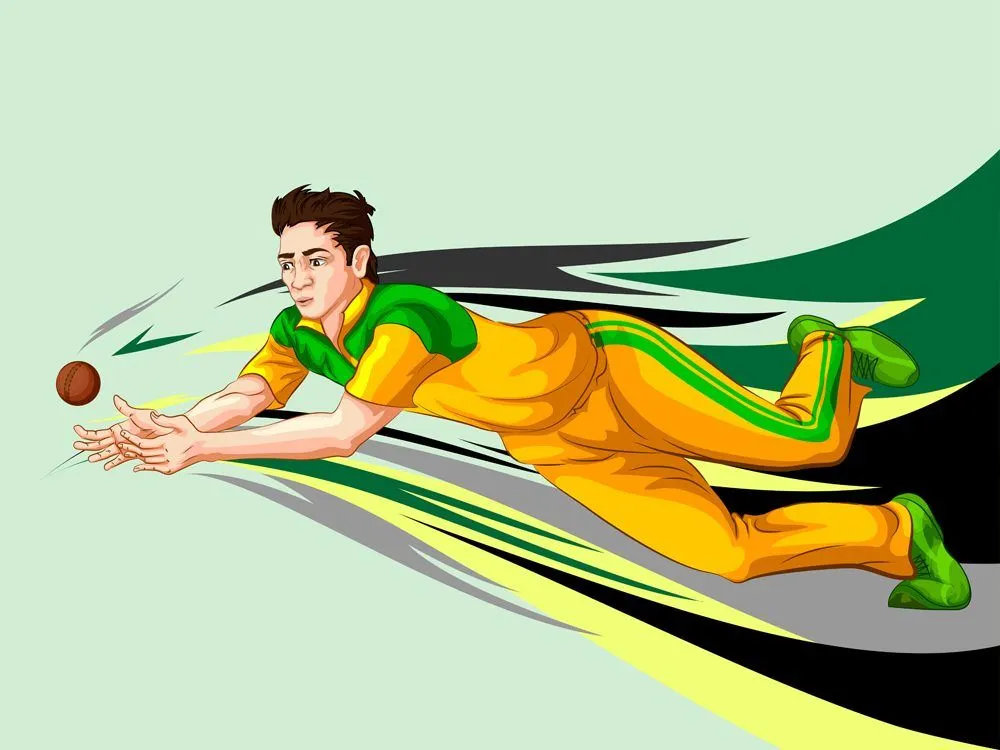
Suppose you try to catch a ball by abruptly stopping it upfront say in just half a second. You would feel a thwack on hand. Now suppose you could replay the same moment again—this time you catch the ball gradually—taking two seconds to complete the catch. Now as you took 4x more time to bring the ball in motion to rest, force feels on your hand would be quarter than what you felt when you did it abruptly in 0.5 seconds.
Coming back to the glass, unlike your hand, a pane of glass cannot move. It offers very little protection against the ramming object. So, if a person fires a bullet on a normal glass sheet, glass cannot bend and absorb the energy gradually. Instead, an incoming bullet fractures the glass with force and shatters it into countless shards. Many of those shards are sharp and pointed, which adds another dimension of danger: the flying glass might injure you even if the bullet does not. This is why ordinary glass offers next to no protection against bullets. It fails miserably to slow them down.
Bullet-resistant glass is different from ordinary glass, although it looks much the same from the outside. Its internal composition is what sets it apart, and it can withstand a few bullets depending on the glass's thickness and the caliber of the rounds being fired.
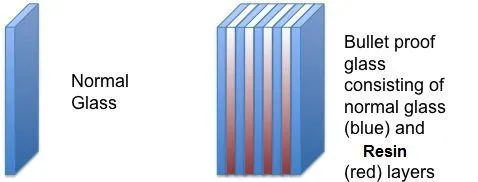
Bullet resistant material is basically made by inserting a layer of polycarbonate material between layers of ordinary glass. The process is commonly called lamination. The polycarbonate material imparts a general toughness and flexibility to the glass. It can be up to 10 times thicker than ordinary window glass, and is therefore quite heavy.
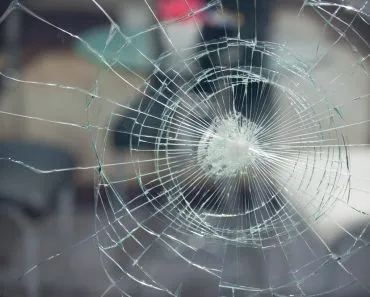
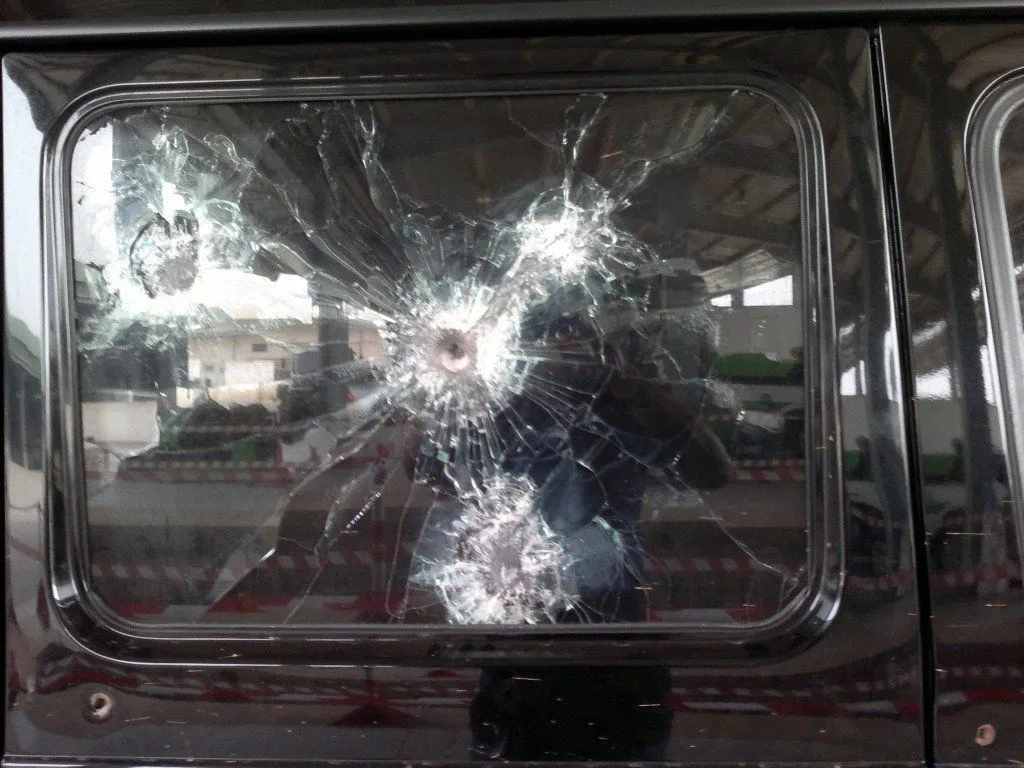
When a bullet strikes bullet-resistant glass, the bullet's energy spreads sideways through the layers. The multi-layered arrangement divides the energy between the glass plies and the polycarbonate, which absorbs it without spalling. The bullet meets so much resistance that it does not have enough energy left to punch through. If several rounds hit the same spot, the glass eventually does break; but thanks to the interlayered plastic, it does not shatter into a cloud of flying shards. Think of bullet-resistant glass as "energy-absorbing" glass and you have a fair idea of how it works.
How Is Bullet-Resistant Glass Made?
If the trick to stopping a bullet is a plastic filling, then making bullet-resistant glass is really an exercise in careful sandwich-building. A manufacturer begins by cutting sheets of ordinary glass and clear plastic to the exact size of the finished panel. The plastic arrives in two roles: thick, load-bearing sheets of polycarbonate, the tough, flexible plastic that soaks up much of the bullet's energy, and much thinner bonding films of polyvinyl butyral (PVB) or thermoplastic polyurethane, each only a few thousandths of an inch thick. Those thin interlayers are the glue that will eventually hold the whole stack together.

The layers are cleaned and stacked in a strict order, typically glass, interlayer, polycarbonate, interlayer, glass, inside a dust-free room, because a single trapped speck of dust would show up as a permanent blemish once the panel is bonded. The stack is then de-aired: rollers or a vacuum bag squeeze out every pocket of air caught between the sheets, and the edges are sealed so no air can creep back in. Skip this step and the finished glass sets with a milky haze of trapped bubbles.
The sealed sandwich then goes into an autoclave, a large oven-like pressure vessel. There it is baked at roughly 135 to 145 degrees Celsius (275 to 290 degrees Fahrenheit) under about 10 to 15 times atmospheric pressure, held anywhere from half an hour to several hours. The heat softens the interlayers until they turn optically clear and flow into intimate contact with the glass and polycarbonate, while the pressure crushes out the last traces of air. When the panel cools, the separate sheets have fused into a single monolithic slab that looks like one thick pane of glass but behaves more like body armor.
Thickness And Cost Of Bulletproof Glass
It must be noted that thickness plays an important role in the durability of the bullet-resistant glass. These glasses are usually designed to shield from a bullet fire or a round of bullet fires. Based on the force exerted by the ramming bullet and the type of gun used, a thicker piece of bullet resistant glass is required to abort the bullet coming with more force. For example, a gunshot from a sniper rifle is more powerful than one from a typical pistol, so more thickness is needed to stop a rifle round than a pistol round. The thickness of bullet-resistant glass generally ranges from about 0.75 inches (19 mm) up to 3.5 inches (89 mm), and the industry rates each thickness against a UL 752 or NIJ ballistic level (Level 1 stops a 9 mm pistol, Level 8 stops 7.62 mm rifle rounds, and so on). Prices typically run from about $25 per square foot for entry-level laminated panels to several hundred dollars per square foot for the thickest, highest-rated configurations.
Advancements In The Bulletproof Glass
When a bullet is fired at bullet-resistant glass, its outside layer is pierced, but the polycarbonate layer present inside absorbs the bullet’s energy and distributes its impact considerably. Thus, the bullet is unable to exit the final layer, i.e., break through the glass to strike a target.
Interestingly few companies have recently developed “one-way” bullet-resistant glass, which is designed to stop incoming bullets, while simultaneously allowing the person at the receiving end to shoot back.
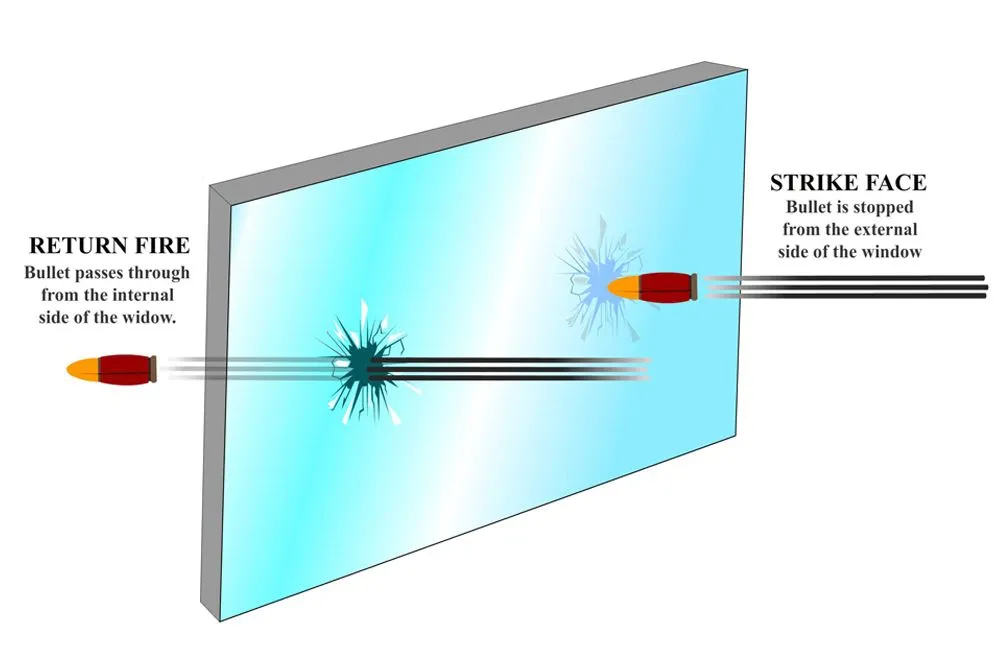
This glass works by reinforcing a brittle glass layer, and again, utilizes a tough polymer layer. The brittle layer faces outwards and shatters if a bullet is fired at it, thus spreading the force of the bullet over a large area, which is then absorbed by the tough (polycarbonate) layer behind it. A bullet fired from the other side, however, can puncture the polymer layer easily before breaking the glass, only slowing the bullet slightly.
The bigger leap in recent years has not been a new sandwich recipe but a new material altogether: aluminum oxynitride, or ALON, a transparent ceramic so hard it sits at 9 on the Mohs scale (the same as sapphire) and roughly four times as hard as fused silica glass. The US military has tested ALON-based transparent armor that stops a .50 BMG round at roughly 1.6 inches (40 mm) of thickness, compared to about 3.7 inches (94 mm) for conventional glass/polymer laminate, a 2.3x reduction in thickness and a significant cut in weight per square foot. ALON is still expensive to manufacture and is mostly used in armored vehicles and aircraft cockpits, but it represents the most credible path past the thickness-versus-clarity ceiling that pure-glass laminates have run into.
Applications Of Bulletproof Glass
Businesses that keep a large amount of cash and precious items like jewellery stores, banks, liquor shops often fear they could be the target of an assault by a gunman and may need something like bullet resistant glass to protect themselves and other precious items. Similarly, administrative departments in the US including local police stations and court houses are also using bullet resistant glasses in the areas which are susceptible to gun crimes. Bullet resistant windows used in the White House is much more robust than the ones used to protect cashier in a bank or executive in a bullet resistant glass cubicle. They are specially designed to withstand gunshots even from high-velocity rifles. Demand for bullet-resistant glass has continued to rise in regions experiencing armed conflict or elevated gun violence, from Ukraine and the Middle East to high-crime metro areas in the United States and Latin America.
Can You Break Bullet-Resistant Glass?
Yes, and understanding how is the whole reason the industry rates its products so precisely. Because no glass is genuinely bulletproof, every panel is certified to stop a specific threat for a specific number of hits, and anything beyond that rating will eventually get through. In the United States the benchmark is the UL 752 standard, which sorts glazing into levels by the caliber of the round and the number of shots it must survive.

At the lower end, Levels 1 to 3 must stop a three-shot cluster from a handgun: Level 1 is tested against a 9 mm pistol, Level 2 against a .357 Magnum, and Level 3 against a .44 Magnum. Levels 4 and 5 step up to a single high-powered rifle round, such as a .30-06 or a 7.62 mm military cartridge. The top tier, Levels 6 to 8, must absorb five shots each: Level 6 is rated for a 9 mm submachine gun, Level 7 for a 5.56 mm AR-15, and Level 8 for five rounds of 7.62 mm rifle fire. Bring something bigger than the rated threat and the panel loses.
The most reliable way to defeat any panel, though, is simply to keep hitting the same spot. Each round cracks and weakens the glass locally, so a tight group of shots on one point chews through far faster than the same rounds spread across the pane, which is why some of the higher UL levels are specifically tested for repeated impacts in one area. Bullets are not the only threat, either. A ballistic rating says nothing about how the glass holds up against a determined attacker with a sledgehammer or pry bar, which is why a newer standard, ASTM F3561, tests panels for forced entry after a ballistic attack, striking the shot-weakened glass with a heavy pendulum to mimic an active shooter trying to break through. The takeaway is that bullet-resistant glass buys time and stops the threats it is rated for; it does not make a barrier truly indestructible.
Limitations Of A Bulletproof Glass
Besides not being truly bulletproof as mentioned earlier, another problem with bullet resistant glasses is their heavy weight. Their thick and heavy composition is not really an issue for fixed windows or interior cubicles, but it makes them awkward to use in vehicles. Not only do thickness and weight pose engineering constraints in automobile design, they also introduce a trade-off between robustness and clarity. The tougher the glass is, the lesser transparency it offers. This makes them impossible to use as front car glasses as it could affect the visibility of the driver while driving.
But despite limitations, we need to acknowledge efforts behind the scientists and researchers working to make bullet-resistant glass more and more robust. It’s surely an important innovation that has saved the lives of thousands of people, from the military to the highest echelons of church and state.
References (click to expand)
- Édouard Bénédictus. Encyclopedia Britannica.
- UL 752 Standard for Bullet-Resisting Equipment. Underwriters Laboratories.
- Ballistic Resistance of Body Armor NIJ Standard-0101.06. National Institute of Justice.
- Aluminium oxynitride (ALON) overview. Wikipedia.
- Zhu, J., & Tian, Y. Y. (2011). Applications of Advanced Composite Materials in Bullet-Proof Fields and their Study. Advanced Materials Research.
- How is Bulletproof Glass Made? Total Security Solutions.
- Moeyersons, L. Autoclaving. Glass on Web.
- Laminated glass. Wikipedia.
- Bullet Resistant Glass Levels and Ballistic Ratings (UL 752). US Bulletproofing.
- ASTM F3561: Forced-Entry-Resistance of Fenestration Systems After Simulated Active Shooter Attack. Intertek.