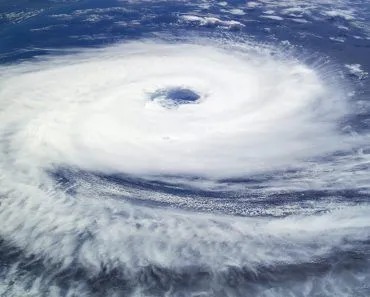
Palm trees survive hurricanes and cyclones because they bend instead of break. Their fibrous, ring-free trunks can flex 40 to 50 degrees, they carry few branches and fold their leaves to cut wind resistance, and a shallow mat of roots grips the soil. Hardy palms can withstand winds near 145 mph (230 km/h).
A friend of mine lives near a beach that was recently hit by a cyclone. After the storm subsided and normality returned, she sent me some pictures of the beach and the surrounding area. Fortunately, the cyclone did not claim any lives in the area; it uprooted some trees and destroyed some huts on the beach.
What struck me, however, was that while the storm wreaked havoc on the beach, the palm trees that lined the beach looked more or less… intact.
You can look it up on the Internet and confirm that palm trees usually survive cyclones and other violent storms, while most other trees do not. Why is that?
Palm Trees Are Not “Woody”
Palm trees are monocots. Commonly known as monocotyledons, monocots are composed of grasses and grass-like flowering plants. Their seeds generally consist of only one cotyledon, which means that the seed produces one leaf when it germinates.
Simply put, this means that palm trees are not as woody as ‘regular’ trees; they are more like grass or have more in common with grass than with trees, like oaks.
The trunk of an oak is built from concentric growth rings of dense secondary wood, which is why it can support the enormous weight of its branches but cannot bend much. A palm trunk has no growth rings at all. Instead, it’s packed with bundles of tough, fibrous vascular tissue scattered throughout, more like the strands inside a cable than the rings inside a log. That arrangement is strong enough to hold the tree up, yet springy enough to bend and snap back.
The result is striking: some palm species can bend 40 to 50 degrees before their trunks tear or snap. Hardy palms such as the sabal palmetto have been known to survive winds of around 145 mph (about 230 km/h), which is well into Category 4 hurricane territory.
This makes them a perfect candidate to withstand strong wind gusts and even tropical storms, such as hurricanes.
Lack Of Branches In Palm Trees
Have you ever noticed that palm trees have no branches? Botanically speaking, palms don’t produce woody branches at all. They grow from a single point at the very top called the apical meristem, sprouting a crown of large leaves called fronds. Compare a palm with any other tree species that you would normally see in a coastal area, and you’ll see the difference immediately.
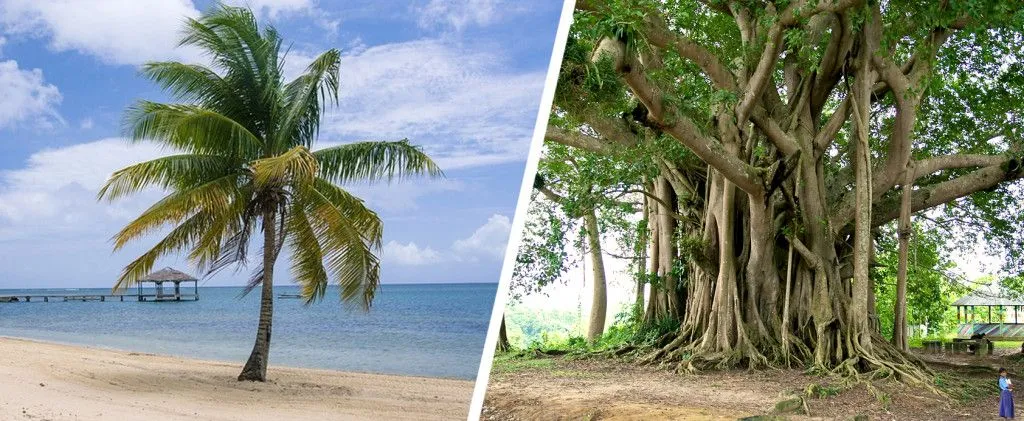
As a palm grows, its older lower fronds die and drop away, so the only foliage left is the cluster of fronds at the very top. There’s no spreading network of heavy limbs anywhere along the trunk.
The absence of branches means that a palm tree does not carry as much weight along its trunk. It also reduces the tree’s “sail area,” the surface that catches the wind. With all of its foliage gathered close to the treetop, a palm doesn’t sway back and forth as severely as a sprawling, branchy tree does in a violent storm.
Leaves Of Palm Trees
While other trees have a dense network of branches and leaves that help maximize the absorption of sunlight for photosynthesis, palms have fewer leaves, but they are huge and quite unique.
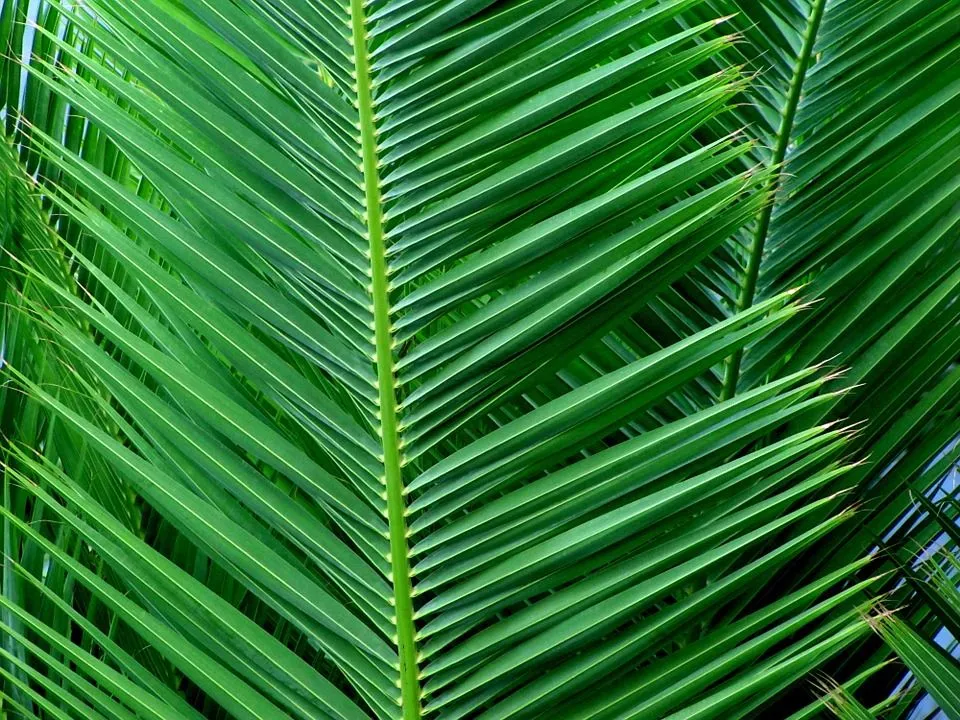
In fine weather, these leaves expand and form a beautiful, full canopy at the top of the tree; the region of a palm tree in which its leaves are located is called the “canopy.”
Palm leaves vary by species, but most palm leaves consist of three types: pinnate, palmate, or costapalmate. These leaves can fold from the middle, thus reducing their surface area, significantly reducing the air resistance of the palm to strong winds.
Trees with “regular” leaves, however, do not fold and close in this way, and therefore offer greater resistance to strong winds.
Think of it this way: during a violent storm, would you rather wrap your arms around your chest and stick your head down, or stand with your arms outstretched in the middle of a street facing the full force of the storm?
Although the answer varies depending on how adventurous you feel at that moment, it would be safest to choose the first option, because this posture would reduce your body’s resistance to strong winds, which is exactly what a palm tree does.
Palm Trees Have An Unconventional Root System
Oaks and other large trees generally have some very strong roots that extend a few meters underground, but palm trees have a different kind of root system.
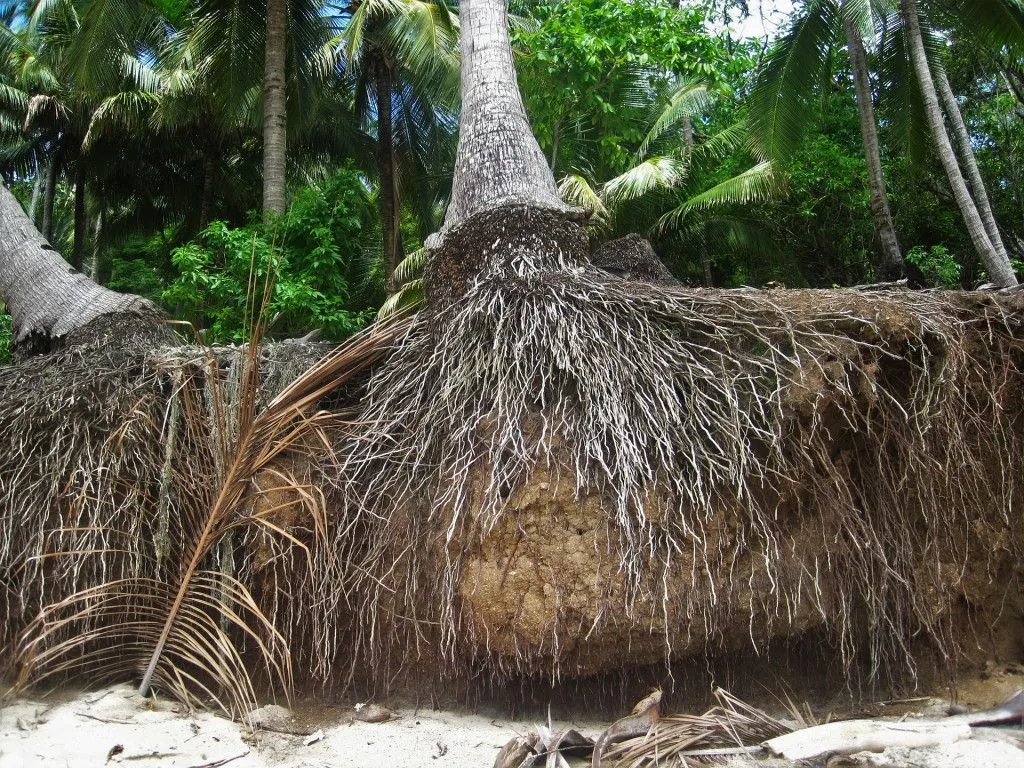
They have many short roots that spread over the top layers of the soil, which helps the tree secure a lot of soil in its “grip”.
If the root system of a tree has a large number of small roots spread laterally under the surface of the ground, then the force that strong winds and cyclones exert on the tree and its trunk is transferred down to the roots, where it spreads out in multiple directions under the ground.
This prevents the mechanical failure of a tree and prevents it from toppling or getting uprooted.
Here’s a simple way to visualize this: put your fist on the ground and pour soil on it until you cannot move your hand at all. Now, pull it up. Repeat the same activity, but this time keep your palm open, fingers outstretched, facing towards the ground. Then, pull your hand up.
You’ll notice that it’s much more difficult to pull up your hand if your palm is open and the fingers are outstretched. This is how the root system of a palm tree protects itself against uprooting during hurricanes.
You can read about how root systems prevent trees from toppling here.
This type of root system is another reason why palms can “weather” hurricanes and other violent storms.
How Do Palm Trees Not Fall Over?
Storms aside, a palm poses an everyday puzzle: how does such a tall, top-heavy and seemingly flimsy tree stay upright at all? Part of the answer lies in the way a palm is built. Because it has no vascular cambium, a palm cannot keep thickening year after year the way an oak does, and it never forms the concentric growth rings you would count on a cut stump. Instead, a young palm first fattens up close to the ground, and only once its stem has reached its full, mature diameter does it begin shooting upward. By the time you see a towering coconut palm, its trunk is essentially a single uniform column that was built to its final thickness before it ever gained any height.

The anchoring is just as unusual. A palm never grows a deep taproot or the thick, woody roots you would find beneath an oak. Every root is adventitious, sprouting from a band at the base of the trunk called the root initiation zone, and each root emerges at its maximum diameter and never thickens further. The result is a dense mat of thousands of similar, slender roots that grips a broad plug of soil and spreads the load, rather than depending on one large anchor.
Even so, palms can and do topple. When the ground turns to slurry after days of heavy rain, that shallow root mat can lose its hold. A lethal fungus called Ganoderma butt rot can also hollow out the base of the trunk from the inside, and because a palm cannot wall off or repair the decay, the tree may collapse without much warning. The telltale sign is a shelf-like conk near the soil line, and once it appears, the palm is almost always beyond saving.
How Much Wind Can A Palm Tree Withstand?
There is no single wind speed at which every palm gives up, because so much depends on the species, the height of the tree and the health of its trunk. Field surveys after real hurricanes do give us a useful range, though. When University of Florida researchers walked through storm-hit Florida neighborhoods and tallied thousands of trees, they found that palms as a group came through better than almost anything else around them. In Hurricane Charley, whose winds reached about 233 km/h (145 mph), 88% of palms survived, compared with 77% of all other trees. In Hurricane Jeanne, with winds near 193 km/h (120 mph), 86% of palms survived, against 76% of other trees.

Not every palm is equally tough. The native sabal palm (Sabal palmetto), Florida’s state tree, survived both of those storms at a rate of 92%, and smaller species did even better, with pygmy date palms coming through at close to 100%. At the other end of the scale, experts rate the queen palm as having the lowest wind resistance of the common species, and the coconut palm fared badly in the fiercest storms, with only 41% surviving Hurricane Andrew. Height matters as well: the same Washington palm that survived Charley at 92% managed only 80% in Jeanne, where the trees happened to be far taller on average.
The real secret to a palm’s wind tolerance is where it keeps its single growing point. Every new leaf a palm ever makes sprouts from one bud, the apical meristem, tucked at the very top of the trunk. A palm can be stripped of every last frond and still recover, as long as that bud survives; a royal palm may shed most of its leaves in a gale while a sabal loses only a few. Recovery is slow, however. It can take six months or more before a battered palm reveals whether it will pull through, and its first new leaves often emerge ragged before later ones fill back in as normal.
Thus, a combination of several factors, including its root system, leaves and fewer branches, makes the palm tree a perfect candidate to withstand strong winds and violent storms that occur in coastal regions around the globe!
References (click to expand)
- Broschat, T. K. (2013, July 31). Palm Morphology and Anatomy. Edis. University of Florida George A Smathers Libraries.
- Monocotyledon. Encyclopaedia Britannica.
- Palm Leaf Structure - UF/IFAS Gardening Solutions. The University of Florida Institute of Food and Agricultural Sciences
- Selecting Tropical and Subtropical Tree Species for Wind Resistance. FOR120/FR175, UF/IFAS EDIS.
- Hurricane-Damaged Palms in the Landscape: Care after the Storm. ENH1204/EP465, UF/IFAS EDIS.
- Elliott, M. L., & Broschat, T. K. Ganoderma Butt Rot of Palms. PP54/PP100, UF/IFAS EDIS.