The largest thing in the Universe is the Hercules-Corona Borealis Great Wall, a supercluster that is so humungous that it defies the laws of inflation.
The speed of light was believed to be infinite until the 17Th century when Ole Roemer, while observing the moons of Jupiter, discovered that the light reflected by them takes a longer time to reach us when the Earth is farther from Jupiter in its orbit. Roemer had just discovered that the speed of light is finite. It was in the year 1975, after lots of precise measurements, scientists determined the magnitude to be an exorbitant 299,792,458 m/s.
This implied that the Sun’s light didn’t reach us instantaneously. Situated almost 150 million kilometers away, even something as fast as light would take some time to travel this distance, albeit not much. A quick calculation would tell you that it takes light around 500 seconds or 8 minutes to reach Earth. Similarly, light emanated from Proxima Centauri, the closest star to us other than the Sun, takes 4.24 years to reach Earth!
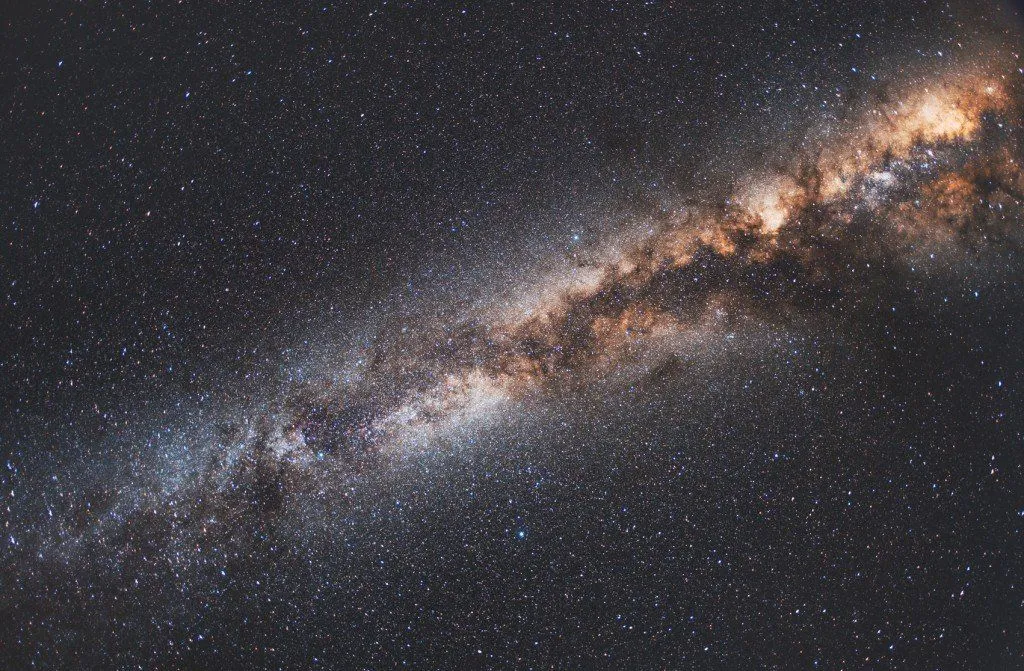
A light-year, the distance that light travels in a year (9 trillion kilometers) was eventually recognized as a standardized unit to measure astronomical distances. If you think a distance spanning 4.4 light-years is unfathomable, the Milky Way galaxy is 100,000 light-years wide. However, the Milky Way’s width is merely 0.001% of the width of the biggest thing in the Universe.
Now that is truly unfathomable.
A Structure So Big That It Shouldn’t Exist!
The largest thing in the Universe is so gigantic that it doesn’t transcend just our perception of size, but violates the very laws of physics! Cosmologists have always been baffled by the uniformity or homogeneity of the Universe. The leftover heat from the Big Bang is astonishingly uniform in every direction we look. And because these early temperature fluctuations subsequently led to density fluctuations, one can also say the same thing about the matter in the Universe.
If matter in the Universe wasn’t so smooth and uniformly distributed, large clumps would have attracted smaller clumps of matter and the Universe wouldn’t have expanded, but rather contracted under its own gravity. However, even though it is homogeneous on a very large scale, the Universe, due to slight initial irregularities, is locally heterogeneous. The heterogeneity can be observed in dense populations of stars, galaxies, clusters – a collection of galaxies — and superclusters – a collection of clusters.
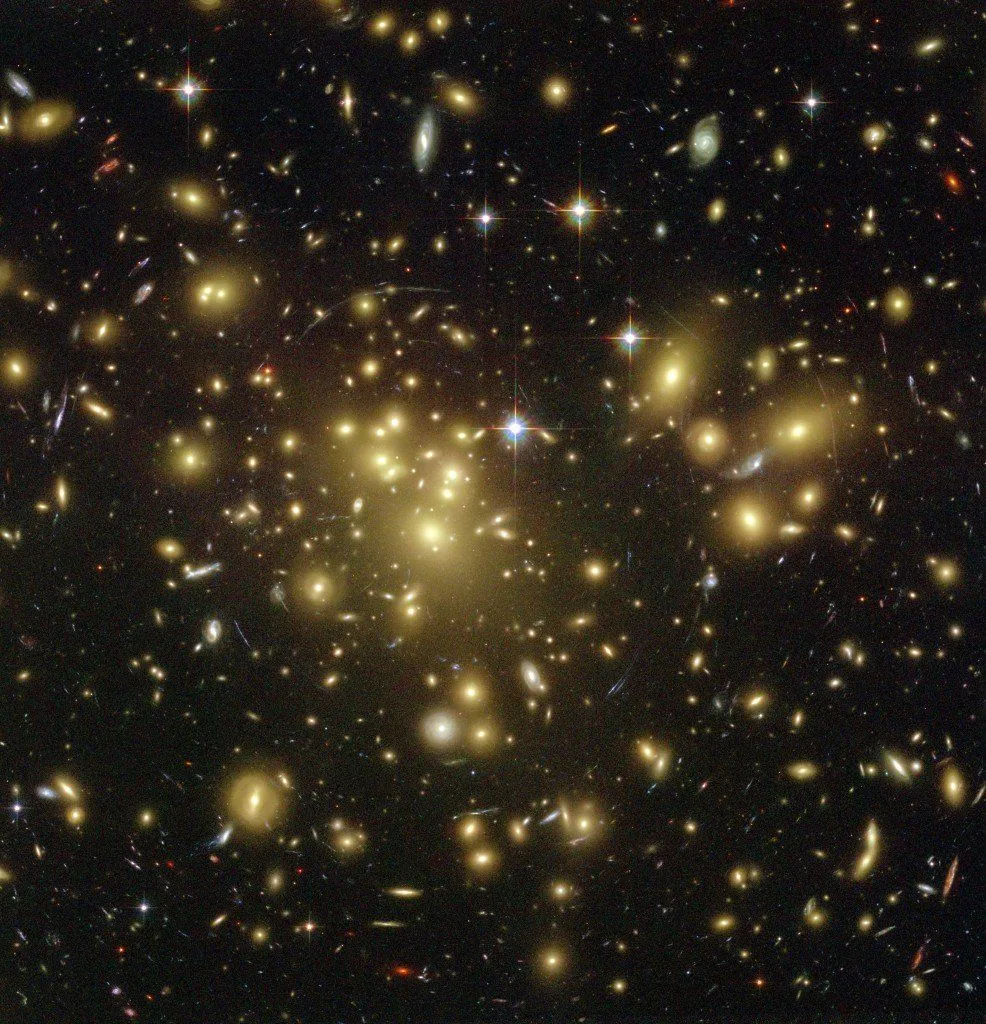
The homogeneity was explained by the theory of inflation, a highly crucial aspect of the Big Bang model of the Universe, a model that is currently believed to be the most convincing explanation of the birth of our Universe. However, the Hercules-Corona Borealis Great Wall is a supercluster that represents such an immense irregularity or non-uniformity that it defies the laws of inflation. The supercluster is so humungous that it exceeds the maximum structural size allowed by the inflationary model of the Universe!
The Hercules-Corona Borealis Great Wall
The structure was discovered in 2013 by a team of astronomers led by I. Horváth, J. Hakkila and Zs. Bagoly while looking for Gamma Ray Bursts (GRB). For this reason, the structure is often called the Great GRB Wall. Gamma rays are the most powerful type of radiation in the entire electromagnetic spectrum. Such super high-frequency radiation is emanated only in a handful of stellar events, such as supernovae — the explosive death of a star, collisions of neutron stars, or by matter spun around violently by a black hole. The energy released during a supernova is so colossal that the Sun is incapable of producing the same amount during its entire lifetime!
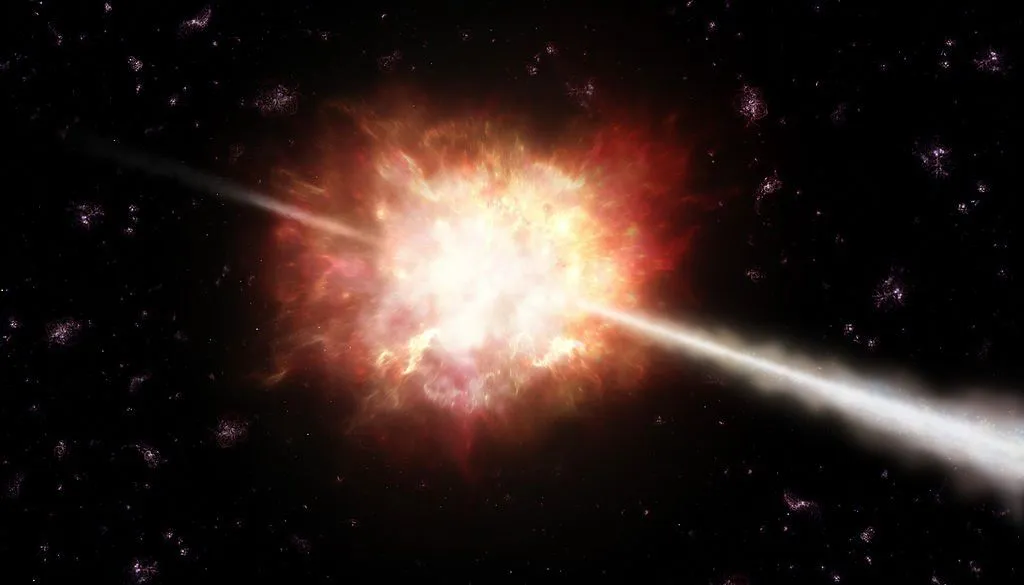
Astronomers study these bursts because they enable us to locate massive structures in the Universe. Massive stars can only form around a dense surplus of mass because that is what they feed on. Also, planetary systems like our Solar System are fundamentally congregated debris dispersed during the explosive deaths of these very same stars, from supernovae, so studying these structures allows us to glimpse both the childhood and the grand history of our Universe.
The researchers recorded an unusually high volume of gamma-ray bursts concentrated about 10 billion light-years away in the direction of the Hercules and Corona Borealis constellations. The angle this volume spanned in space translated to a width of 10 billion light-years. Yes, the Great GRB Wall is 10 billion light-years wide. For perspective, that is 10% of the diameter of the observable Universe!
The researchers themselves were incredulous about their discovery. Co-author Jon Hakkila highlighted his disbelief in a press conference in 2014 when he remarked: “I would have thought this structure was too big to exist.” However, they calculated that the chances of the gamma-ray shower springing up randomly in that location are very slim — far less than 1 in 100. This brought them solace and convinced Hakkila to “believe that the structure exists.”
In fact, there are other structures that appear to violate the inflationary model, such as the Sloan Great Wall and the Huge Large Quasar Group. The list has kept growing. In 2024, astronomer Alexia Lopez and colleagues reported the Big Ring, a ring-shaped arrangement of galaxies about 1.3 billion light-years across, and in early 2025 a team led by Hans Böhringer announced Quipu, a galaxy supercluster system roughly 1.3 billion light-years long containing some 200 quadrillion solar masses, possibly the largest mass concentration ever identified (though still much smaller than the Hercules-Corona Borealis Great Wall in extent). Each new discovery sharpens the tension between observation and the cosmological principle. Hakkila himself is adamant that his fame is ephemeral; he speculates the existence of even larger structures as he recognizes that “the danger of finding the biggest, or most distant, or the oldest things in the universe is always that, sooner or later, someone is likely to come along and find something bigger, more distant, or older than the thing you found.”
What Does The Hercules-Corona Borealis Great Wall Actually Look Like?
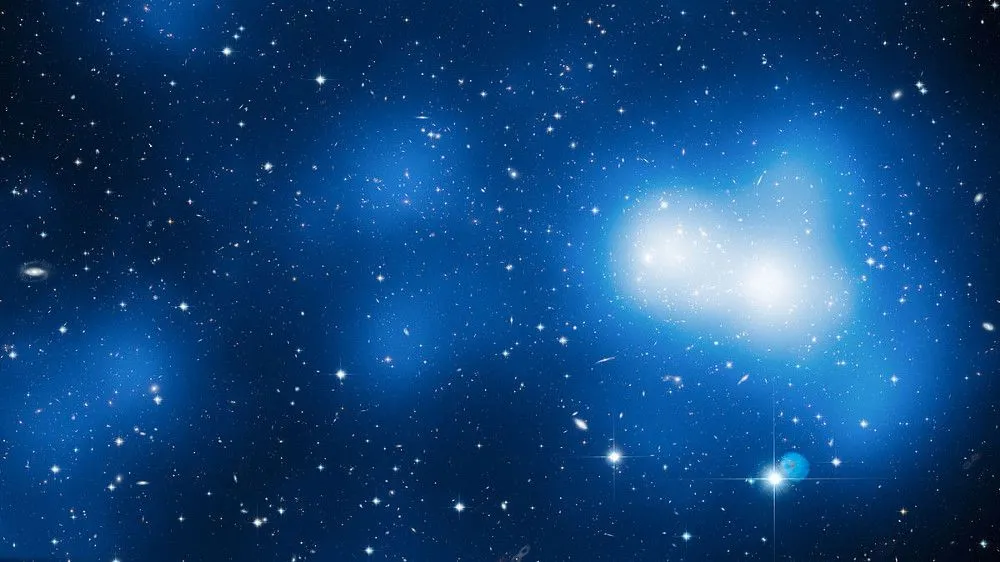
Here is the strange part: there is no glossy, full-colour photograph of the biggest thing in the Universe, and there never will be one. Unlike a galaxy or a nebula, the Great Wall is not a single glowing object that you can aim a telescope at and snap. It is a pattern — a statistically improbable crowd of gamma-ray bursts scattered across a colossal patch of sky, all sitting at roughly the same staggering distance.

What you actually see in the discovery papers is a map, not a picture. Each dot marks the spot where a distant star died in a gamma-ray burst, and the wall reveals itself as an obvious clump of those dots in the direction of the Hercules and Corona Borealis constellations. Every one of those dots is billions of light-years away, so the “wall” is really the shape traced out by the crowd, in much the same way a swarm of fireflies can outline a hedge you cannot see in the dark. Any dramatic, richly textured “real image” of the Great Wall you come across online is therefore an artist’s impression, not a telescope photograph. The structure is simply too vast, too distant, and too diffuse for any camera to ever frame it in a single shot.
How Big Is It, Where Is It, And Could You Ever See It?
The numbers are almost comically large. The Great Wall stretches roughly 10 billion light-years (about 3 gigaparsecs) along its longest axis and around 7 billion light-years across its shorter one. Ten billion light-years works out to nearly 95 sextillion kilometers (a 95 followed by 21 zeros), or a little under 11% of the length of the entire observable Universe.

On the sky, the structure sprawls across about 125 degrees, covering some 15,000 square degrees, which is more than a third of the whole celestial sphere. It is centered near the border of the constellations Draco and Hercules and reaches all the way from Boötes to Gemini, spanning five constellations in total. Distance-wise, its redshift of 1.6 to 2.1 places it between roughly 9.6 and 10.5 billion light-years away in light-travel time.
So could you ever see it? No, not with your eyes, and not through any telescope ever built. The wall gives off no light of its own as a structure; it is a statistical arrangement rather than a luminous body, and even its individual member galaxies are far too faint and far too distant to pick out. And no, the Milky Way is not tucked away somewhere inside it either. We sit roughly 10 billion light-years outside the Great Wall, gazing at it across most of cosmic history.
Is The Hercules-Corona Borealis Great Wall Even Real?
For all its fame, the Great Wall comes with an awkward asterisk: not every astronomer is convinced it is actually there. Remember that nobody ever photographed it. The whole structure is a statistical bump, a crowd of gamma-ray bursts that looks too tightly packed to be a coincidence. And whenever a discovery rests on a scatter of dots and a probability argument, other scientists are right to prod at it.
The trouble starts with the sample. Only a couple of dozen gamma-ray bursts trace out the wall itself, and the wider catalogue of bursts with reliably measured distances runs to just a few hundred. Worse, our satellites do not sweep the sky evenly. They linger over some patches longer than others and miss bursts hidden behind the dust of our own galaxy. Critics have argued that these lopsided viewing conditions, rather than a genuine wall of matter, could be what piles the dots up in one direction. In 2020, astronomer Sam Christian re-ran the original analysis with updated data and Monte Carlo simulations of a perfectly smooth, structureless universe. Such a random universe, he found, could reproduce the supposed clustering surprisingly often, and he concluded that the Great Wall’s existence should be “treated as doubtful at best.”
The discoverers have not backed down. In their own 2020 follow-up, I. Horváth, Jon Hakkila and their colleagues worked through the bias objections in detail, reported that the clustering still surfaces in the most reliable data available, and argued the Wall “may indeed be the largest structure in the Universe.” Their honest caveat, though, was that today’s patchy burst catalogue simply cannot settle the argument. To know for sure, they wrote, we will need a dedicated future mission such as the proposed THESEUS space telescope, which would map gamma-ray bursts uniformly across the whole sky. Until then, the biggest thing in the Universe sits in a curious limbo: too striking to ignore, yet not quite proven, a reminder that at these scales even “the largest object ever found” still carries a question mark.
References (click to expand)
- What is the biggest thing in the universe? - Space.com. Space.com
- Hercules–Corona Borealis Great Wall - Wikipedia. Wikipedia
- Horvath, I., Bagoly, Z., Hakkila, J., & Toth, L. V. (2015). New data support the existence of the Hercules-Corona Borealis Great Wall (Version 1). Arxiv.
- Horvath, I., Hakkila, J., & Bagoly, Z. (2014). Possible structure in the GRB sky distribution at redshift two. Astronomy & Astrophysics.
- Christian, S. (2020). Re-examining the evidence of the Hercules-Corona Borealis Great Wall. Monthly Notices of the Royal Astronomical Society, 495(4), 4291-4296.
- Horvath, I., Szecsi, D., Hakkila, J., et al. (2020). The clustering of gamma-ray bursts in the Hercules-Corona Borealis Great Wall: the largest structure in the Universe? Monthly Notices of the Royal Astronomical Society, 498(2), 2544-2553.