
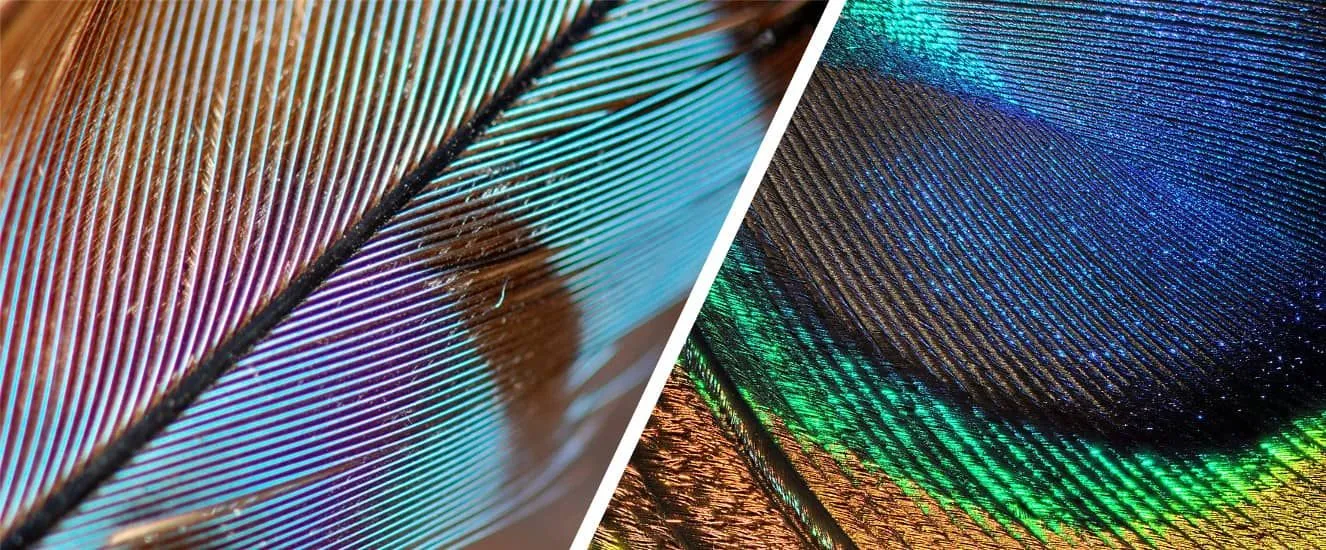
True blue is rare in nature because the chemistry of pigments that absorb light in just the right wavelengths is hard for biology to evolve. Almost every blue you see in animals (blue jays, peacocks, blue Morpho butterflies, blue eyes) is structural color: microscopic ridges, beads, or layers that scatter or interfere with light to bounce only the blue wavelengths back at you. Blue flowers use chemistry, but cleverly: they tweak the red pigment anthocyanin with metals and pH shifts to make it look blue.
Have you ever seen a blue-colored bird? Or a blue-colored frog? Or even a blue-winged butterfly? They are strikingly beautiful, aren’t they? However, if you think about it, we don’t come across many of these. In fact, there is a good chance that you haven’t seen more than two or three birds with entirely or partially blue wings in your whole life. What do you think the reason behind this could be?
Most color pigments are not made in our body. Animals consume various things in their diet that help in making those pigments. In the case of flamingoes, which are born grey, the diet they consume consists of blue-green algae and brine shrimp, which helps them turn pink! Crustaceans have pigments called carotenoids, which are used by the birds. However, among animals a true blue pigment is very much the exception rather than the rule. Butterflies are the great holdouts here: the Obrina Olivewing (Nessaea obrinus) really does lay down a genuinely blue pigment called pterobilin, and so do a number of swallowtails. So how do birds, peacocks, blue-eyed humans, and Morpho butterflies manage it? The answer will probably ‘blue’ your mind!
What’s The Explanation For These Mysterious Blues?
In the case of birds, there is no one principle mechanism. Different birds follow a variety of mechanisms, from microscopic bead design to maintaining a uniform crystal structure. The bluejay feather consists of the bead design, which is quite messy in nature. These beads scatter light in such a manner that only blue light is able to escape, whereas peacock feathers have microscopic lamellae that cause the interference. Also, if you have blue eyes, that blue is also based on the structure – not any pigments!
How Does It Work?
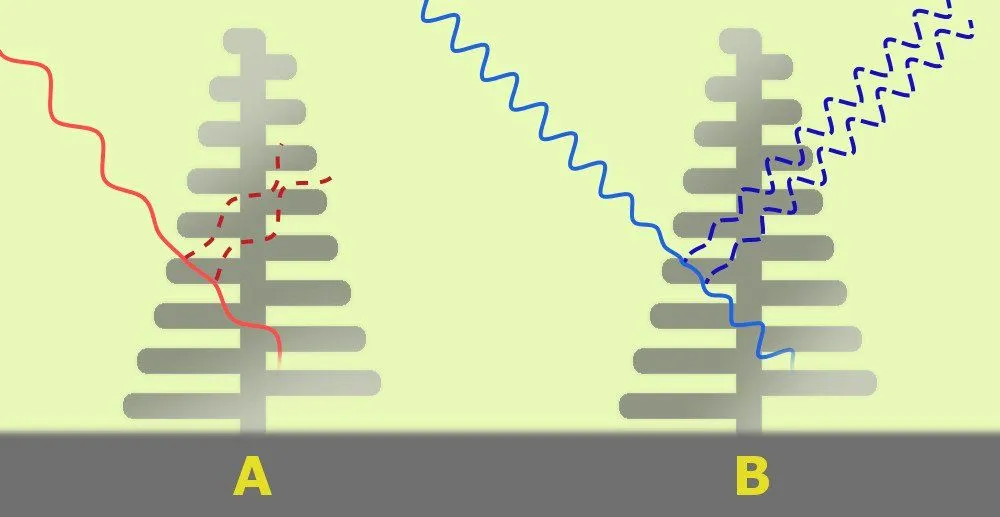
Before we look at how butterflies to do it, we need to understand a bit of physics. Now, this appearance of the color blue is due to the microscopic structure of the scales and a concept called interference of light.
Interference of light takes place when two rays of light collide. This results in either a ray of light with higher intensity (Constructive Interference CI) or no light at all (Destructive interference DI). Light is basically a wave, and as such, it has crests and troughs. When the two rays collide and the crests or troughs overlap one another, CI takes place and the waves are said to be ‘in phase’. However, if a crest overlaps a trough, then DI takes place and the waves are said to be ‘out of phase’.
Thus, when we zoom into the structure of the scale, we can observe ridge-like structures that are parallel to one another. When light hits the ridges and its branches, some of the light will reflect off the top layer, while the rest enters the branch. A part of the light that passes through the branch is reflected off the bottom layer of the same branch. This gives us two rays of light with equal wavelength and intensity. For most colors, the reflected light rays will be ‘out of phase’, so we don’t see those colors. However, in the case of the color blue, the two light rays that reflect off the ridge are perfectly ‘in phase’, meaning that they do not cancel each other out, allowing us to see the blue color. The light rays passing through are also bending at the correct angle, which helps cause the blue color.
The Olivewing, though, is not quite the lone wolf it is often made out to be. Its blue comes from pterobilin, a bile pigment (chemically, biliverdin IXγ) that absorbs strongly in both the ultraviolet and the red, leaving blue-cyan light to reach your eye. Far from being a one-off, pterobilin turns up right across the papilionid, nymphalid, and pierid butterfly families, in Graphium swallowtails and Charaxes among others, and butterflies mix it with yellow pigments to conjure greens as well. So blue chemistry is not impossible for biology. It is just that hardly anything outside the butterflies bothered to invent it.
Can They Lose Their Blue Color?
What if we change the refractive index of the wings, i.e., change the angle at which the light bends while passing through the ridges; won’t that put the rays “out of phase”? If that happens, we won’t be able to see the blue color. The question is, how can we change the refractive index? By simply filling the space in the ridges with some other material instead of air! Every material has its own refractive index, as they bend light at different angles, which means that even water can change the angle. If that’s the case, these butterflies will lose their color as soon as it rains, right? The answer is “No”. Thanks to evolution, the wings are made of a material that is naturally water resistant! The Morpho wing scales are chitin coated with hydrophobic waxes, so water beads up and rolls off before it can sit in the ridges long enough to disrupt the interference.
What About Plants?
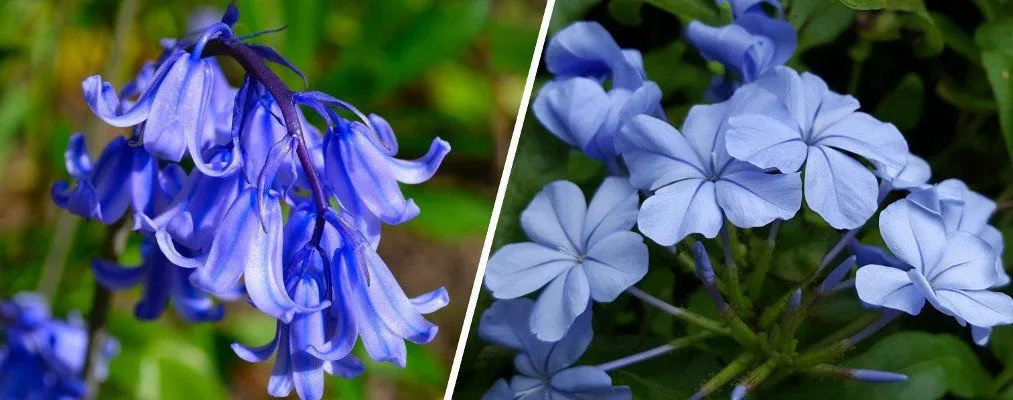
The lack of blue as a pigment is also seen throughout the plant world. Plants use a red pigment called anthocyanin for their blue color. Yes, you read that correctly. Plants tweak the anthocyanin by mixing it with other pigments or molecules to produce the color blue. Sometimes they use pH shifts to change the color as well. Scientists are trying to understand the genetics behind the process in order to replicate it with other flowering plants.
Why Are There No Blue, Green, Or Red Mammals?
Here’s a question that catches almost everyone out. Birds, fish, and frogs turn up in every color you can name, so where are the blue mammals? Or the green ones? Come to think of it, where are the genuinely red ones? Out of thousands of mammal species, not one of them pigments its fur blue, green, or truly red.

The problem is a shortage of tools. Fish, amphibians, and reptiles build their colors with an entire toolkit of pigment cells called chromatophores: melanophores for black and brown, xanthophores for yellow, erythrophores for red, and iridophores that reflect light structurally. Mammals inherited exactly one of them. As a review of pigment cell development in vertebrates puts it, the pigment pattern in a mouse or a chick is produced exclusively by melanocytes, whereas a zebrafish mixes melanophores, xanthophores, and iridophores to paint its stripes.
And that lone cell type makes just one substance: melanin. Melanin comes in two flavors, and only two. Eumelanin runs from black to brown, and pheomelanin runs from yellow to reddish. That is the whole mammalian paint box. The black of a panther, the tawny gold of a lion, the rust of a fox: all of it is mixed from those two pigments, plus the option of making no pigment at all.
So a fox isn’t “red” the way a strawberry is red. It’s pheomelanin turned up to maximum, and pheomelanin tops out somewhere around orange-rust. There is simply no rung on that ladder that reaches blue or green.
Now, you might reasonably object: birds only have melanocytes too, and they manage a blue jay just fine! True. But as we saw earlier, birds don’t use pigment for that blue, they use nanostructure built into the feather. Feathers evolved into extraordinary optical devices. Hair, for the most part, simply never did.
But What About Blue Mandrills And Green Sloths?
Every good rule attracts exceptions, and this one has a few famous ones. The fun part is that none of them actually break the rule. Each one finds a way around it.

The mandrill is the poster child. Those electric blue ridges on its face and rump are undeniably blue, but notice where they are: on bare skin, not on hair. When Richard Prum and Rodolfo Torres put mandrill skin under an electron microscope, they found no blue pigment at all. The color comes from coherent scattering by quasi-ordered arrays of parallel collagen fibers in the dermis, and the spacing of those fibers sets the shade. It is the same structural principle as a Morpho wing, just built out of collagen and relocated to the skin. Their work also overturned a century-old assumption that this blue was ordinary Rayleigh scattering.
The green sloth is cheating even harder, because the green isn’t the sloth’s at all. Sloth hair is strange stuff: two-toed sloths have deep grooves running the length of every hair, while three-toed sloths have irregular transverse cracks that grow more numerous with age. Green algae move into those crevices, chiefly a species called Trichophilus welckeri, which has never been found anywhere except sloth fur and appears to pass directly from mother to offspring. The sloth isn’t green. The sloth is a well-tended garden.
What about a “blue” Doberman, or a gray cat? Sorry to disappoint, but that is neither blue pigment nor structural color. It is ordinary black eumelanin, diluted. Changes in the melanophilin (MLPH) gene make pigment granules clump together instead of spreading evenly through the growing hair shaft, and clumped pigment reads to our eyes as a smoky blue-gray. Cats pull off the same trick through a mutation in the very same gene, which is why a “blue” cat is really just a black cat turned down to gray. The mechanism is different, but the moral is the one this article keeps running into: fur can show you a color it does not actually contain, which is also why a polar bear’s fur looks white without holding any white pigment at all.
The closest any mammal gets to genuine structural color in hair is the golden mole. Its hairs are flattened, with heavily reduced cuticular scales that form smooth multiple layers of alternating thickness, producing color by thin-film interference in much the same way an iridescent beetle’s wing cases do. Before you picture a shimmering blue mole, though, the measured sheens run from purple to green, and are (in the researchers’ own words) weak and variable. A blind burrowing animal has little use for a paint job. Even nature’s best attempt at a structurally colored mammal is, frankly, a bit of a letdown.
Evolution wasn’t able to develop a process for blue pigment production for every organism, but at least it provided a way to replicate the effect. The biological issue was taken care of by simple physics! We will have to wait and see if we ever come across an animal that can make blue pigment – or perhaps our scientists can unlock the mechanisms of plant genetics to simply create blue pigments!
References (click to expand)
- Giraldo, M. A., & Stavenga, D. G. (2016, April 12). Brilliant iridescence of Morpho butterfly wing scales is due to both a thin film lower lamina and a multilayered upper lamina. Journal of Comparative Physiology A. Springer Science and Business Media LLC.
- Why Aren't There More Blue Flowers? - Treehugger. TreeHugger
- Why are peacock feathers colored? (interference) - Webexhibits. WebExhibits
- What color is a bluejay? -- Wisconsin Natural Resources magazine -- February 2003 - dnr.wi.gov
- Kelsh, R. N., Harris, M. L., Colanesi, S., & Erickson, C. A. (2009). Stripes and belly-spots - a review of pigment cell morphogenesis in vertebrates. Seminars in Cell & Developmental Biology, 20(1), 90-104.
- Ito, S., & Wakamatsu, K. (2003). Quantitative analysis of eumelanin and pheomelanin in humans, mice, and other animals: a comparative review. Pigment Cell Research, 16(5), 523-531.
- Prum, R. O., & Torres, R. H. (2004). Structural colouration of mammalian skin: convergent evolution of coherently scattering dermal collagen arrays. Journal of Experimental Biology, 207(12), 2157-2172.
- Suutari, M., et al. (2010). Molecular evidence for a diverse green algal community growing in the hair of sloths and a specific association with Trichophilus welckeri (Chlorophyta, Ulvophyceae). BMC Evolutionary Biology, 10, 86.
- Philipp, U., Hamann, H., Mecklenburg, L., Nishino, S., Mignot, E., Guenzel-Apel, A.-R., Schmutz, S. M., & Leeb, T. (2005). Polymorphisms within the canine MLPH gene are associated with dilute coat color in dogs. BMC Genetics, 6, 34.
- Snyder, H. K., Maia, R., D'Alba, L., Shultz, A. J., Rowe, K. M. C., Rowe, K. C., & Shawkey, M. D. (2012). Iridescent colour production in hairs of blind golden moles (Chrysochloridae). Biology Letters, 8(3), 393-396.
- Ishida, Y., David, V. A., Eizirik, E., Schaeffer, A. A., Neelam, B. A., Roelke, M. E., Hannah, S. S., O'Brien, S. J., & Menotti-Raymond, M. (2006). A homozygous single-base deletion in MLPH causes the dilute coat color phenotype in the domestic cat. Genomics, 88(6), 698-705.
- Stavenga, D. G. (2023). Butterfly blues and greens caused by subtractive colour mixing of carotenoids and bile pigments. Journal of Comparative Physiology A, 210(3), 371-380.


