Table of Contents (click to expand)
Mountains do not sink into the ground because of isostasy. The Earth’s crust is far less dense than the mantle beneath it, so it floats much like a block of wood on water. A mountain has a deep, lightweight “root” pushing down into the mantle that buoys up its weight, keeping the whole range in balance.
Have you ever seen an iceberg floating in the Arctic Ocean? Or more commonly, ice cubes floating in a glass of soda? You probably know that this happens because liquid water has greater density than solid ice. However, you may have also observed that the thicker chunks rise higher above the water than the thin ones. This is buoyancy putting an upward force on any object immersed in a liquid. Buoyancy is the opposing force sensed by a body that is partially or completely submerged in a fluid.
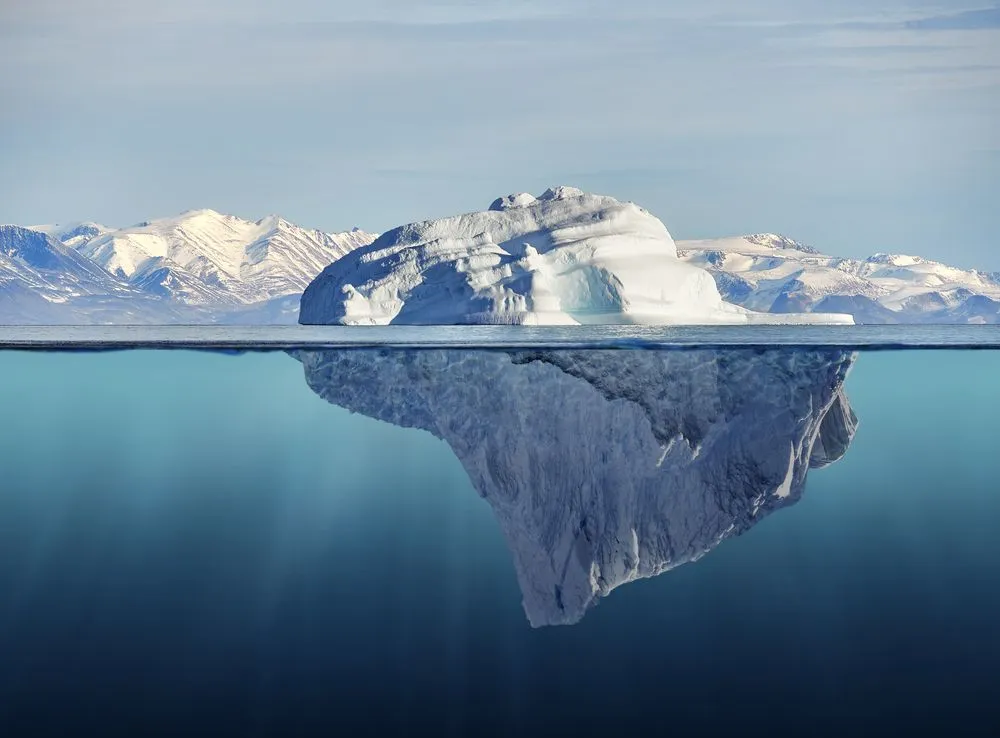
The different layers of the earth act in a similar way. The uppermost mantle is linked to the crust to create the lithosphere. The asthenosphere is the region of the mantle underneath the lithosphere, upon which the lithosphere somewhat floats. The asthenosphere is plastic and may move like a fluid. Just as a wooden block floats on water, varying thicknesses of the lithosphere will displace different quantities of the asthenosphere and “float”.
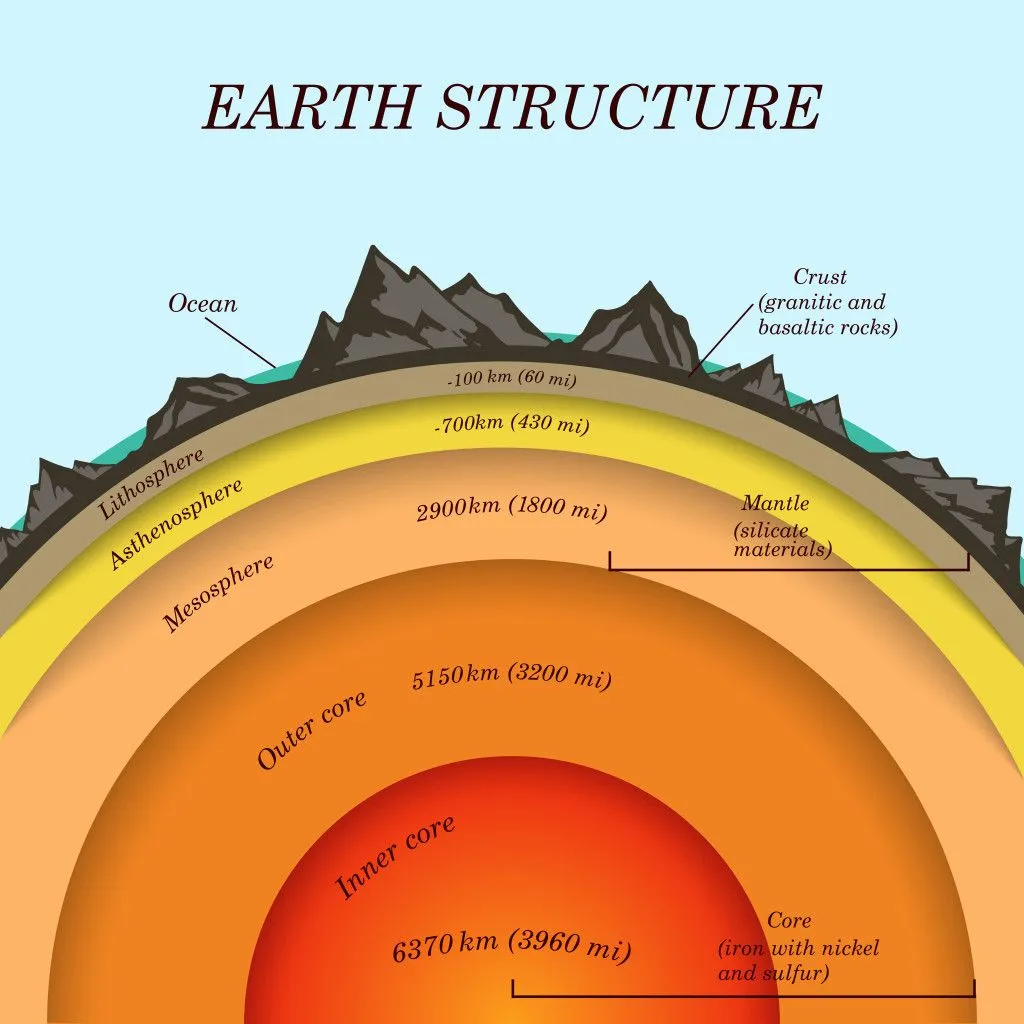
This is explained using an important theory in geology called the principle of isostasy. It is the notion that the thinner crust must float on top of the more dense mantle. Isostasy governs the height of continental land surfaces and the depth of ocean basins.
When the gravitational force pulling down on the lithosphere equals the buoyant force of the mantle pushing up on it, the Earth’s surface is said to be in isostatic equilibrium. A mountain range stands higher than the surrounding plains and the ocean floor because the crust beneath it is thicker, so it floats higher (and sits deeper) in the mantle, just like a taller iceberg.
There are two major hypotheses about how isostasy works to sustain mountain masses.
Airy’s Isostasy
According to Sir George Airy, lighter matter on the earth below balances the mountains’ huge weight. The crust, which is made of lighter material, is resting on a substratum of much denser material. Similar to how a ship floats in water with its large base submerged, the Himalayas “float” in the denser mantle below, with their thickest portion sunk into it. (That mantle is not molten magma but hot, solid rock that flows very slowly over geological timescales.)
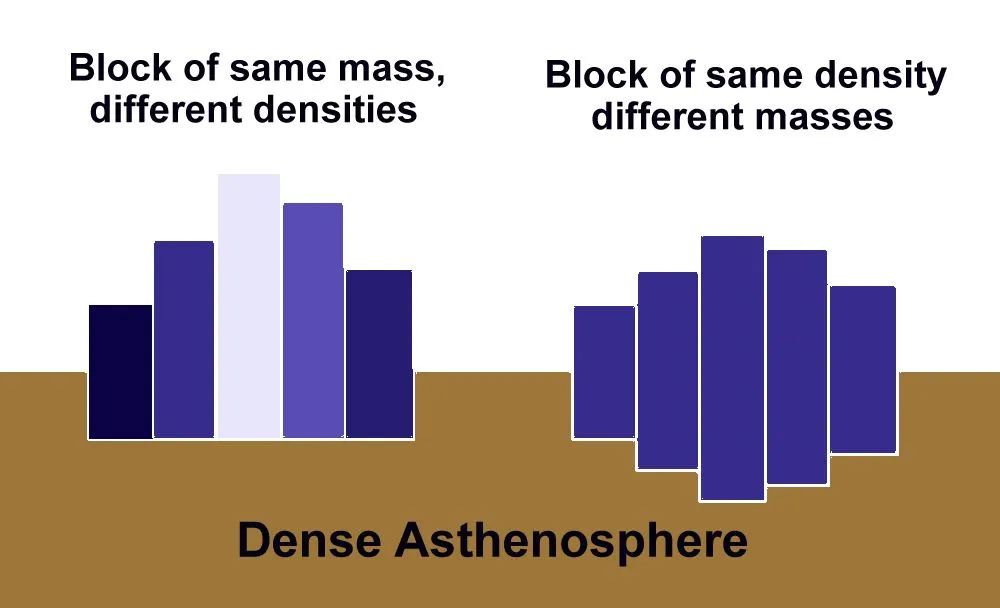
Airy was actually trying to explain a puzzle: surveys in India found that the Himalayas pulled on a plumb line far less strongly than their visible bulk suggested they should. He reasoned that the extra mass of the mountains must be balanced by a deep root of the same lightweight crust pushing down into the denser substratum. He said that if the surface column above the substratum were larger, a bigger portion of it would be buried in the substratum.
If it were smaller, a smaller chunk would be submerged. He asserted that there is no change in the density of the various land columns (mountains, plateaus, and plains), which instead suggests constant density with a difference in thicknesses.
Pratt’s Isostasy
His hypothesis postulates that the density of material in the crust varies depending on the height of the crustal layers. Mountainous regions have lower densities than plateaus, plateaus have lower densities than plains, and the ocean floor is the densest. The blocks composed of lightweight materials are therefore located at a greater height than those built of denser materials. In essence, you can suppose that lighter matter is situated beneath mountains and heavier material is found below seas.
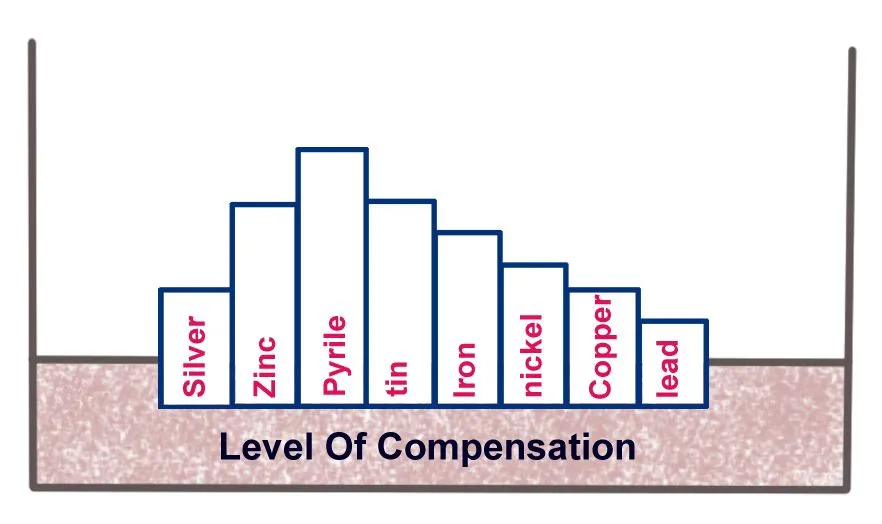
The term “level of compensation” refers to a line that divides the top blocks from the deeper dense rocks at a constant depth. There is no difference in density below this level.
What Are Mountains Made Of?
It is tempting to picture a mountain as one uniform lump of stone, but that image only holds up so far. The bulk of a continental mountain is built from the rocks of the continental crust, and the most abundant of these is granite, a coarse, pale, silica-rich (or “felsic”) rock. Granite forms the cores of many of the world’s great ranges, including the Himalayas, the Andes and California’s Sierra Nevada, often as enormous buried masses called batholiths. Layered on and folded into that granite you also find metamorphic rocks such as gneiss and schist, topped by sedimentary beds that were bent and lifted as the mountains rose.

What matters for our question is not just what mountains are made of, but how heavy that material is. Continental-crust rock has a density of about 2.7 grams per cubic centimeter. That sounds modest until you scale it up: every single cubic kilometer of mountain weighs roughly 2.7 billion tonnes, and a large range holds many thousands of those cubic kilometers. So mountains really are as staggeringly heavy as they look.
The trick is that “heavy” is relative. The rock of the mantle below the crust is a dense material called peridotite, and it is heavier still than granite. Because continental crust is lighter than the mantle it rests on, even a colossal slab of rock can float, in the same way that a heavy log still floats on water. A mountain does not stay up because it is light; it stays up because it is lighter than what lies beneath it.
How Deep Do A Mountain’s Roots Go?
If a mountain floats like an iceberg, then like an iceberg most of it must be hidden. Airy’s insight was that a tall mountain has to be balanced by a deep “root” of light crust pushing down into the denser mantle, and modern geophysics has measured exactly that. The boundary where the crust ends and the mantle begins is called the Mohorovičić discontinuity, or simply the Moho, and its depth tells us how thick the crust is at any given spot.

Beneath a typical continent the crust is roughly 35 kilometers thick, and under the ocean floor it thins to just 5 to 10 kilometers. But under the planet’s highest terrain the crust balloons. Seismic surveys place the Moho beneath the Tethyan Himalaya and the Tibetan Plateau, the region crowned by Mount Everest, at around 70 to 75 kilometers down, close to double the normal continental thickness. That extra wedge of buried, low-density crust is the mountain’s root.
The relationship is remarkably consistent: the higher a range stands, the deeper its root reaches. For every extra kilometer a mountain belt rises above the plains, several more kilometers of crust have to be tucked away below to keep it buoyant. It is also why erosion cannot quickly grind a mountain down to nothing. As the peak wears away and loses weight, the root slowly rises to restore the balance, lifting fresh rock up to be worn away in turn. The visible summit is only the tip; the true architecture of a mountain lies kilometers beneath our feet.
Isostatic Adjustments
Mountain formation begins its final phase upon the completion of plate convergence. Isostatic rebound induces crustal elevation during this stage. The continental crust, which is afloat in the plastic upper mantle, moves vertically as a result of the isostatic rebound. When the mass from the mountaintop is washed away by erosion, the load on the crust decreases. The continental crust performs an “isostatic adjustment”, which causes it to rise vertically (float higher) in the mantle.
Let’s try to understand this a bit more clearly. Wood floats on water, but thicker blocks protrude more from the water’s surface than thinner chunks.
However, the thicker slabs also stretch to a greater depth in the water than the thinner ones. You may consider the submerged portion of a wooden block to be its root. Consider what might happen if one of the wooden slabs was topped with a second piece of wood. The block would then try to find a new isostatic (gravitational) equilibrium. The joined block’s bottom would now be lower, while its peak would be taller than it previously was. “Isostatic adjustment” refers to this process of achieving a new gravitational equilibrium level.
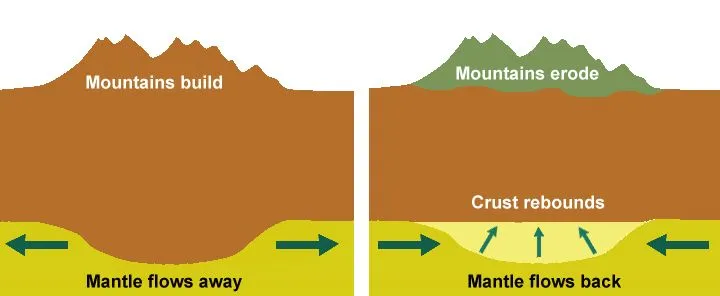
Remember that isostasy is neither an event nor a force. Simply said, pieces of crust with varying thicknesses maintain a natural equilibrium or adjustment pattern that keeps gravity in place and our mountain vistas consistent!
In summary, a mountain cannot sink because isostasy requires it to keep floating in the denser asthenosphere.
References (click to expand)
- The Theory of Isostasy - Prof. Robert B. Laughlin. Stanford University
- Isostasy. Encyclopaedia Britannica.
- A. B. Watts (2001). Isostasy and Flexure of the Lithosphere. University of Wyoming.
- Watts, A. B. (2021). Isostasy. Encyclopedia of Solid Earth Geophysics. Springer International Publishing.
- Earth’s Interior. Geology of California, Geosciences LibreTexts.
- The Crust. National Geographic Education.
- Mohorovičić discontinuity. Wikipedia.
- Crustal structure of the Tethyan Himalaya, southern Tibet. Geophysical Journal International.
- Granite: Igneous Rock. Geology.com.