Table of Contents (click to expand)
- Nikola Tesla And Thomas Edison: The Modern Electrical Age
- Jonas Salk And Albert Sabin : The Polio Vaccine
- Isaac Newton And Robert Hooke : Law Of Gravitation
- Why Did Isaac Newton And Robert Hooke Become Such Bitter Rivals?
- Did Isaac Newton Erase Robert Hooke From History?
- Isaac Newton And Gottfried Leibniz: Calculus
- Humphry Davy And Michael Faraday: Contributions To Electrochemistry
Rivalries between scientists have often driven major breakthroughs in science. Famous examples include Nikola Tesla vs. Thomas Edison (alternating vs. direct current), Jonas Salk vs. Albert Sabin (the polio vaccines), Isaac Newton vs. Robert Hooke (the law of gravitation) and Newton vs. Gottfried Leibniz (the invention of calculus), and Humphry Davy vs. Michael Faraday (electrochemistry).
Advancements in science are brought about by the hard labor of scientists toiling away in their laboratories. Many of the greatest scientific minds need inspiration to work for those crucial moments of clarity. For most, it is the thirst for knowledge, but for others, this inspiration takes the form of a feud – a race to trump others in order to find fortune, gain recognition and change history. Whatever the reason might be, these rivals have prompted each other to better themselves and ultimately make their invaluable contributions to humanity. The most interesting thing about some of these famous feuds is what caused such rivalries between contemporaries, and how those conflicts finally culminated in a breakthrough.
Nikola Tesla And Thomas Edison: The Modern Electrical Age
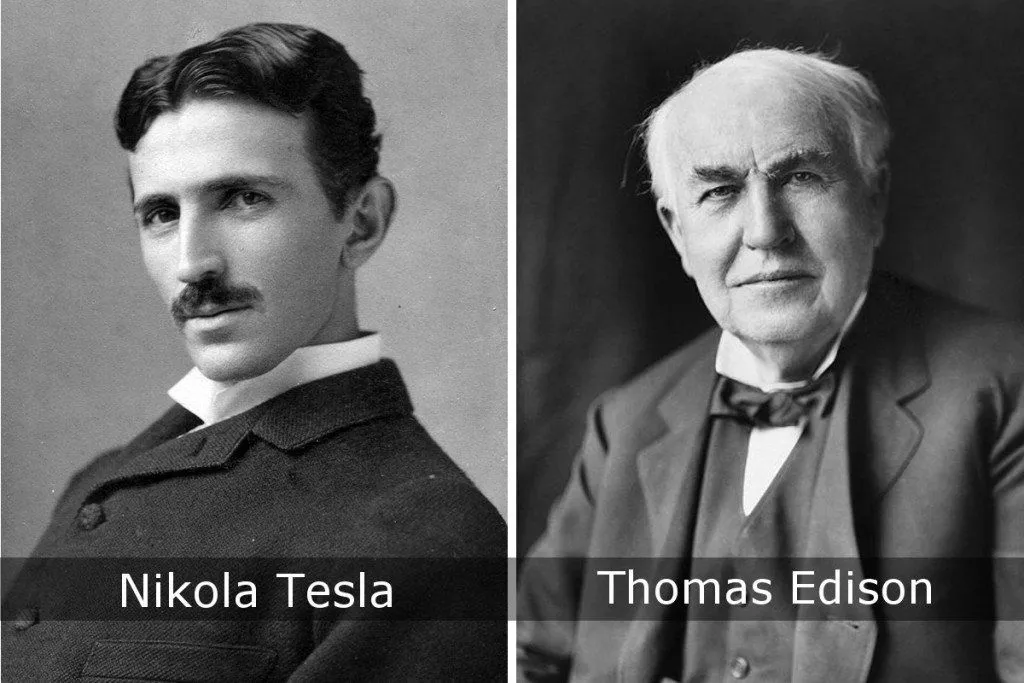
These two geniuses ushered in the era of modern electric systems and held roughly 1,400 patents between them (Edison alone amassed about 1,093 US patents, Tesla close to 300). Tesla actually used to work for Edison when he was a young man, but he left because he disagreed with Edison’s scientific method. It is widely known that Edison was more of a CEO than an engineer, quickly running to the patent office whenever he or one of his employees invented something new. On the other hand, Tesla worked out his inventions in his imagination, making use of his eidetic memory.
The main reason for their disagreement stemmed from the fact that they were trying to market their own forms of electricity. Edison developed Direct Current (DC), while Tesla promoted Alternating Current (AC). Edison slammed AC by focusing on the safety issues in its use, but now that we understand that AC is far more economical and efficient, Tesla has become responsible for powering our homes.
Tesla’s inventions are the backbone of modern power and communication systems, but he faded into obscurity in the 20th century. However, Edison’s legacy survived, due to his legion of factories and patents, including the moving picture camera, kinetoscope and the light bulb.
Jonas Salk And Albert Sabin : The Polio Vaccine
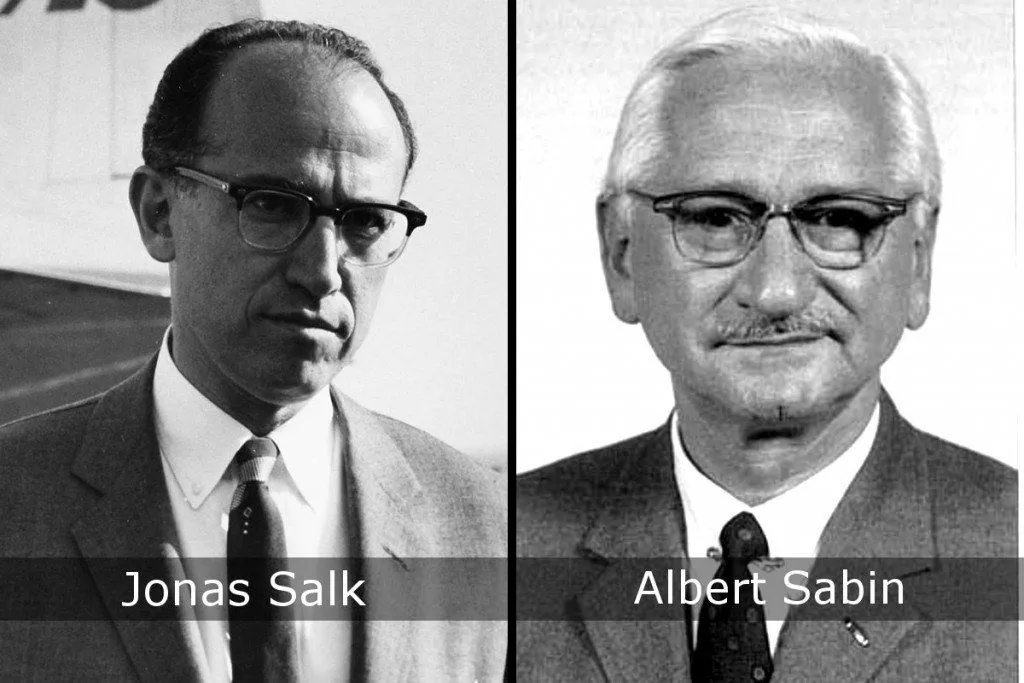
These two bio-chemists created their versions of what they thought was the best vaccine for polio. In 1955, polio was a huge concern for families all over the world, as it paralyzed children and even proved to be fatal in many cases. During this era, the competition between these men proved to be the factor responsible for the eradication of polio in many parts of the world. Jonas Salk was the first to develop a vaccine, using an inactivated (killed) poliovirus, which was licensed in 1955. Albert Sabin followed a few years later, using a live but weakened form of the virus.
The scientists individually promoted their own vaccines with increasing vigor, unknowingly making the war against polio much more successful. Initially, Salk’s ‘injected’ vaccine was used for mass inoculations starting in 1955, and was largely replaced through the 1960s by Sabin’s easier-to-deliver ‘oral’ vaccine. (In recent decades many countries have shifted back to Salk-style inactivated vaccines, because the live virus in Sabin’s formulation can, in extremely rare cases, cause polio itself.) Countless people owe their lives to the egos of these two men!
Isaac Newton And Robert Hooke : Law Of Gravitation
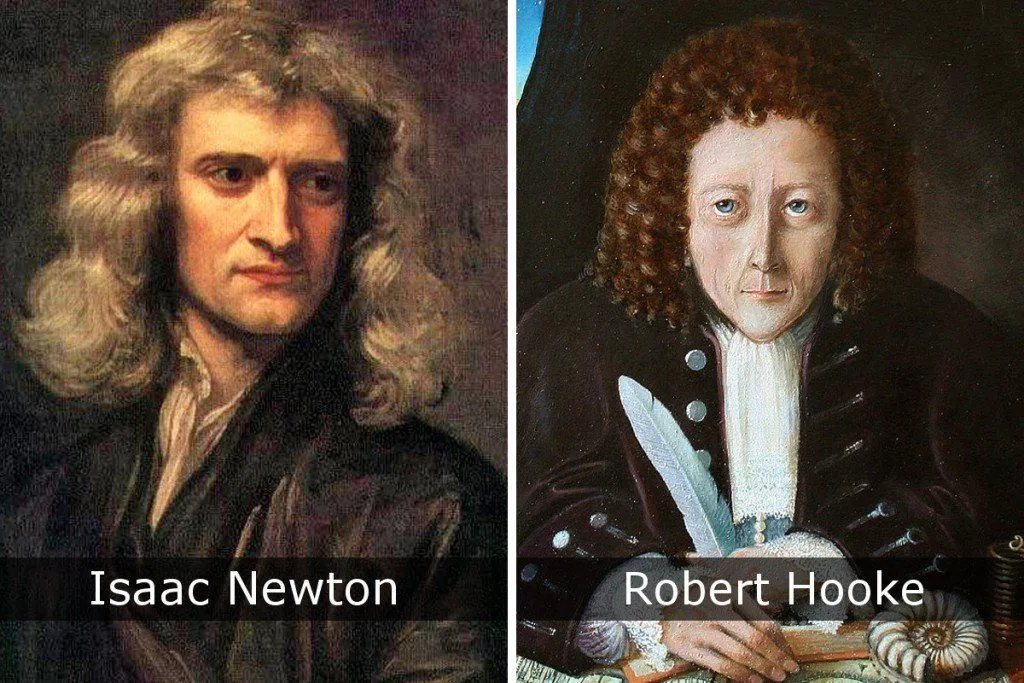
Robert Hooke was a respected scientist who deserves a better place in history, but since he was on the losing side of a bitter rivalry with the most renowned scientist in history, Sir Isaac Newton, he has been almost completely forgotten. Some say that Newton used his position as President of the Royal Society to undermine Hooke’s effort after Hooke criticized Newton’s papers on optics. Some claim that Hooke was insecure and jealous of someone more intelligent or gifted than himself. According to Hooke, Newton stole the idea for the Universal Law of Gravitation from him and always felt short-changed.
In any case, Hooke’s articulation of an inverse-square law of attraction and Newton’s rigorous mathematical formulation of the Law of Gravitation, when coupled together, form the basis of our understanding of Gravity.
Why Did Isaac Newton And Robert Hooke Become Such Bitter Rivals?
The bad blood between the two men did not begin with gravity at all; it began with light. In early 1672, Newton sent the Royal Society a short paper, A New Theory about Light and Colours, describing how a glass prism split sunlight into a spectrum of colors. He argued that white light is really a mixture of colors and that a ray of light behaves like a stream of tiny particles. When the paper was read to the Society in February 1672, it was Robert Hooke, the Society’s Curator of Experiments and the author of the celebrated Micrographia (1665), who was asked to judge it. Hooke praised Newton’s experiments but flatly rejected his conclusions, insisting that light was a wave or pulse and hinting that anything worthwhile in the paper he had already worked out himself. Newton was so wounded by the criticism that he withdrew from public scientific debate for years.

A famous line comes from this uneasy period. In a letter to Hooke dated February 1675, Newton wrote, “If I have seen further it is by standing on the shoulders of giants.” For centuries it was read as a graceful tribute, though a few historians now suspect it was a quiet dig at Hooke, who was slightly built and had a badly curved spine, and so was no ‘giant’ himself. That reading remains debated rather than settled.
Gravity turned the simmering resentment into open warfare. In an exchange of letters in 1679 and 1680, Hooke floated the idea that a planet’s motion might arise from an attractive force weakening with the square of the distance from the Sun, the so-called inverse-square law. He had the intuition but no mathematics to prove it. So when Newton laid the first book of his Principia before the Royal Society in 1686, Hooke demanded credit and accused him of stealing the notion. An enraged Newton went back through his manuscript and struck out references to Hooke, although in the end he did acknowledge Hooke, Christopher Wren and Edmond Halley together in a single passage.
Did Isaac Newton Erase Robert Hooke From History?
Hooke was no minor figure. He gave us Hooke’s Law of elasticity, coined the biological term cell, designed instruments and buildings, and helped rebuild London after the Great Fire of 1666. Yet for all that fame, no verified portrait of him survives, a strange blank for such a public man. That gap has fed one of science’s most repeated stories: that Newton, on becoming President of the Royal Society in 1703, the very year Hooke died, had his old rival’s portrait taken down and destroyed.

It is a tempting tale, but historians are skeptical. The science historian Allan Chapman has called the destroyed-portrait story a myth, noting that there is no evidence Newton did any such thing. A likelier and duller explanation is that the portrait Hooke is said to have sat for simply went astray when the Royal Society moved to new premises in 1710. Hopes of recovering his face have been dashed more than once: in 2003 the historian Lisa Jardine announced she had found a portrait of Hooke, only for it to be identified soon afterwards as the Flemish chemist Jan Baptist van Helmont.
So were Newton and Hooke friends who quietly collaborated on their discoveries? Not remotely. They were rivals who needled each other for decades, and Newton certainly outlived and outmaneuvered his critic. But the idea that he wiped Hooke from the record is more legend than fact. Hooke’s real memorial is the work itself, above all Micrographia, whose astonishing engravings, like the giant flea shown here, still teach us to look closer.
Isaac Newton And Gottfried Leibniz: Calculus
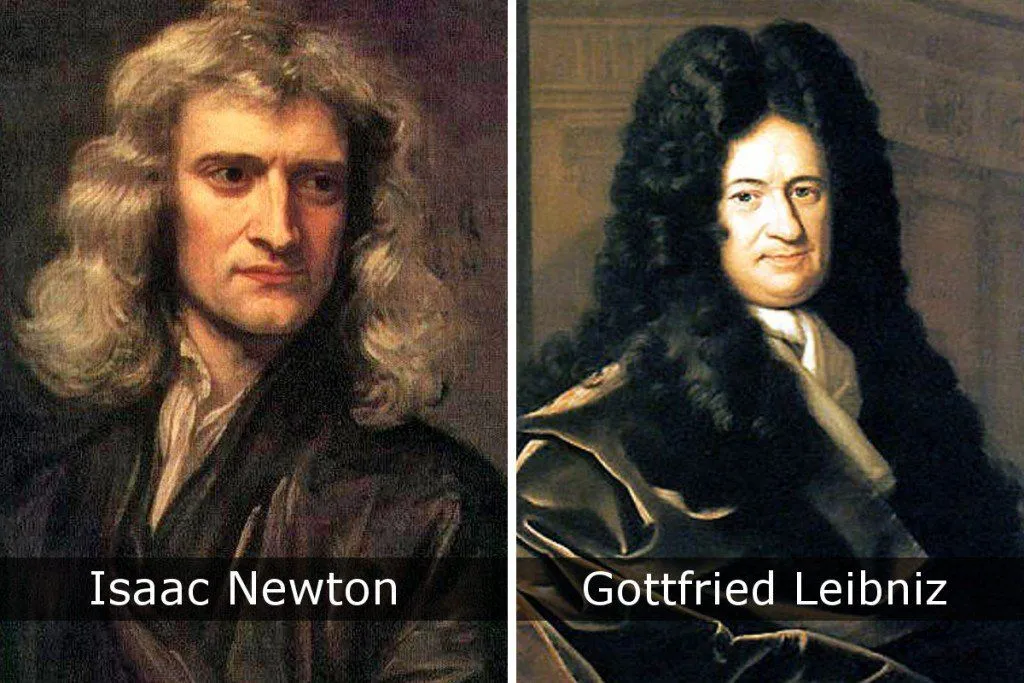
Newton was part of many controversies during his lifetime due to allegations of plagiarism and contradictory claims over scientific papers. For example, he contested claims over who discovered Calculus in a particularly heated argument with mathematician Gottfried Leibniz. Leibniz was certainly the first person to publish on differential and integral calculus, which has been used invariably by every scientist since. Newton claimed that he had already been working on Calculus, but hadn’t published it outside of a minor annotation in the back of one of his publications.
Newton, as the President of the Royal Society, thwarted any claims against ‘his’ theories of calculus by appointing a committee composed of his friends, and even accused Leibniz of plagiarism. Since people on either side of the feud had a reasonable claim on the invention of calculus, this discussion was never resolved. Both Newton and Leibniz are credited with the discovery and the consensus is that they independently invented this indispensable mathematical tool in 17th century Europe.
Humphry Davy And Michael Faraday: Contributions To Electrochemistry
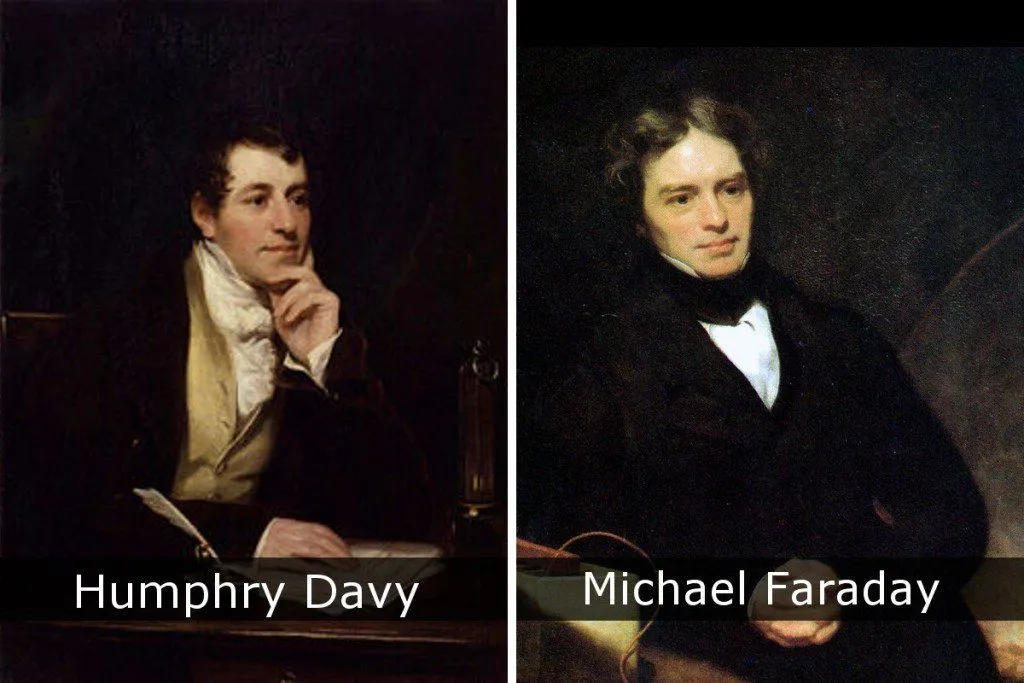
Davy was one of the most influential scientists of his time and was awarded numerous honors, including being knighted by the crown. When Davy invented an incredibly useful lamp for miners, he made it public property and did not lay any claims to its patents. He took on an apprentice named Michael Faraday, despite Faraday’s background as a book-binder, and mentored him. Davy had developed a disinterest in money, which he passed on to Faraday.
During the time with his mentor, Faraday achieved his greatest discovery of electromagnetism. In fact, his research forms the basis of modern electricity generators. Gradually, Faraday’s brilliance started to overshadow Davy’s work, and a gradually increasing resentment drew these men apart. Davy used his stature and influence to boycott his pupil’s work, which inspired Faraday to continue with his independent research in the field of electrochemistry. As he grew older, Davy managed to overcome his insecurities. When Davy was asked what his greatest discovery was, he simply replied “Michael Faraday.”
It can easily be seen that throughout history, some major breakthroughs were brought about during the same span of time, but by different individuals. It’s not so surprising actually, since curious minds often converge on the same idea. Whether this is a coincidence or a causative effect is debatable, but one thing is certain, the main benefactor in such legendary confrontations was science!
References (click to expand)
- War of the currents - Wikipedia. Wikipedia
- History of calculus - Wikipedia. Wikipedia
- The World Cup, courtesy of Isaac Newton and Robert Hooke. telegraph.co.uk
- Salk, Sabin and the Race Against Polio - Smithsonian Magazine. Smithsonian
- Nikola Tesla vs. Thomas Edison: Who was the better inventor?. Live Science
- Robert Hooke’s Considerations of Newton’s theory of light and colours (1672). The Newton Project, University of Oxford
- Newton-Hooke priority controversy for the inverse square law - Wikipedia. Wikipedia
- Standing on the shoulders of giants - Wikipedia. Wikipedia
- Robert Hooke - Wikipedia. Wikipedia