Angular momentum is the rotational counterpart of linear momentum: it measures how much rotational motion an object has, equal to its moment of inertia multiplied by its angular velocity (L = Iω). For a point mass moving in a circle, it can also be written as L = mvr. Like linear momentum, angular momentum is conserved in any closed system as long as no external torque is acting on it, which is why a spinning ice skater speeds up when they pull their arms in.
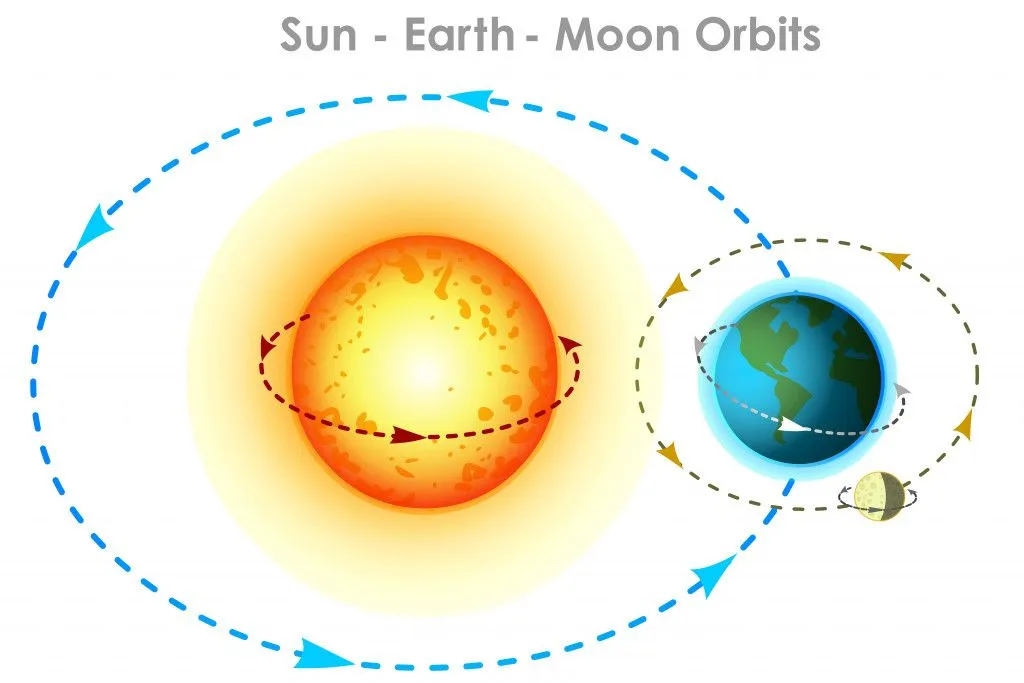
While enjoying a delightful ride on a carousel, or riding your motorcycle to work, or when a ballerina spins gracefully in circles, or when the Earth revolves around the Sun, what we are experiencing is angular momentum in action.

Angular momentum is one of the most important physical quantities and qualities of nature. In fact, the conservation of angular momentum is the reason for our very existence.
However, before we start talking about angular momentum, let’s have a quick recap of momentum itself.
What Is Momentum?
In sports, we say that when a team performs really well at an event, it will take a tremendous amount of effort from other teams in the future to stop its winning streak.

In other words, you could say that momentum makes it difficult to change the state that one is existing in at the moment.
That’s exactly how momentum works in physics! Momentum is the quantity of motion that an object possesses. Think of it as an invisible quantity that things attain once they move.
Momentum tells you how much a certain amount of mass is moving. Just as a winning team needs a stronger opponent to stop their consecutive victories in sports, once an object has gained momentum, you need to apply an external force on the object to change its state, i.e., make it stop.

So momentum depends on how much mass there is and how fast that mass is moving, giving the equation:
P = m · v
P in this equation stands for momentum (since the letter m is already used for mass, scientists use P for momentum from the Latin word Pellere meaning “to push something forcefully”), while v stands for velocity.
The little arrows on top of P and v signify that these are vector quantities, meaning that they have direction as well as magnitude. Thus, when we talk about the momentum of something, we mention how much of it is present and in what direction it is going.

What Is Angular Momentum?
When we introduced momentum, we talked about the motion of the objects in a straight line, but what if the object is just rotating or revolving?
Well, when an object is moving in a circular path, the angular momentum replaces the normal momentum.
Imagine a circle with a small dot at the center. An object moves over the perimeter of this circle. We have already seen that when an object sets into motion, it gains momentum, so now that the object is moving in a circle, it will gain angular momentum.
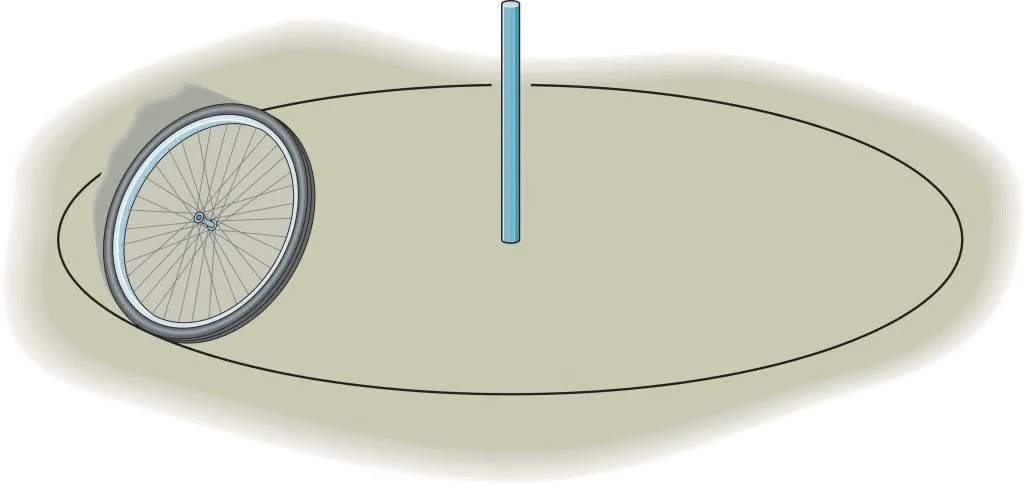
Angular momentum is very similar to momentum. Whereas momentum tells us how much motion a thing has when it is moving in a straight line, angular momentum tells us how much motion an object has when it’s following a circular path.
It is called angular momentum because the angle at which the object is moving from a reference line is constantly changing.
The equation for angular momentum is also very similar to that of momentum.
L = m · vt · r
The product of mass, the velocity that the object has in the tangential direction to the Perimeter of the circle, and the radius of the circle give angular momentum.
Another way to mathematically visualize angular momentum is using the moment of inertia, which acts as mass for objects moving in circular orbits, and angular velocity, which, as the name suggests, acts as velocity for objects in either circular or rotational motion.
We get an equation very similar to that of momentum when we use these two quantities as:
L = I · ω Where I is the moment of inertia and ω is the angular velocity.
Conservation Of Angular Momentum
The most important quality of angular momentum and the reason it is so important in our lives is that it is conserved. Conservation of angular momentum means that the total angular momentum within a system stays constant, unless there is some outside torque (which is the force that makes objects spin) that causes a change. In other words, the angular momentum stays the same as long as one does not disturb it.
If there are a certain number of objects in a system (i.e., there are some objects moving around nearby), their total angular momentum would always remain constant.
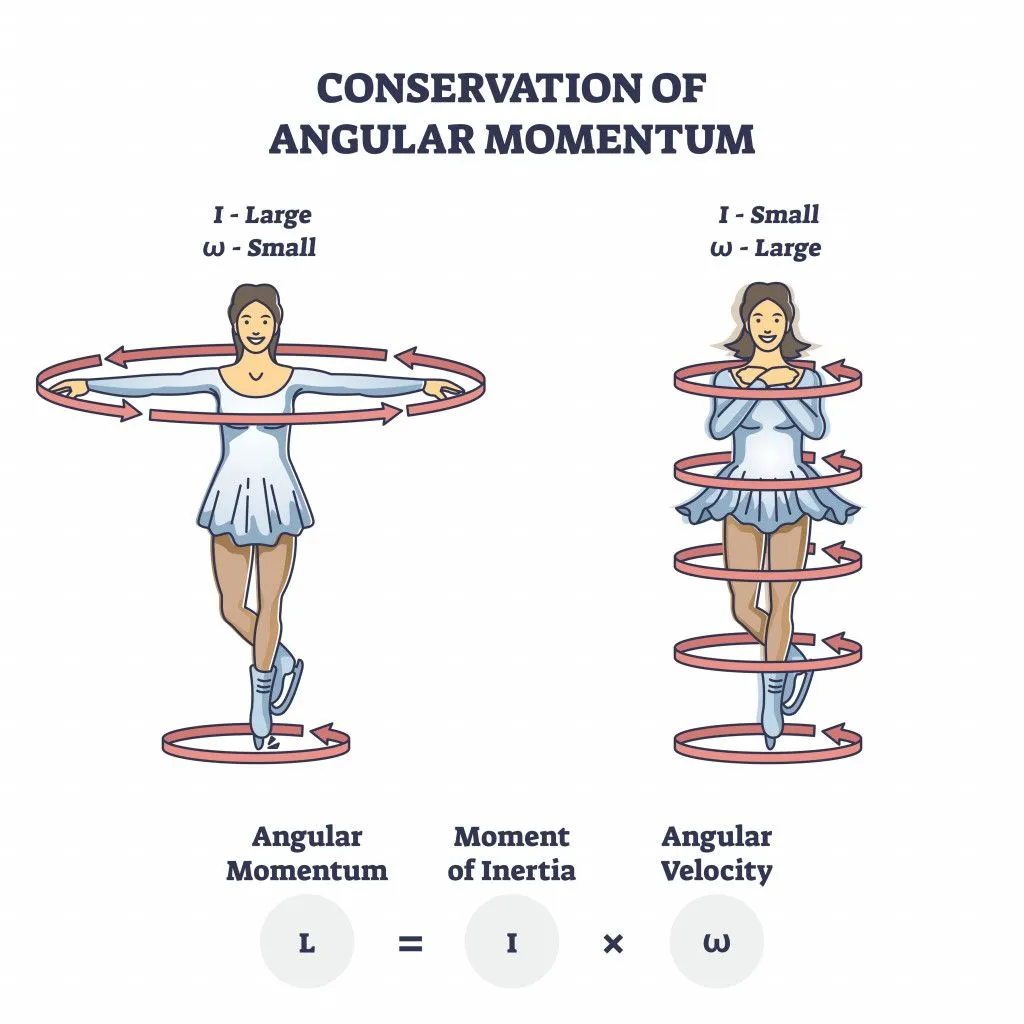
A ballerina can spin faster when she draws her arms in because when the radius of the spinning decreases, the speed of the spinning increases in order to keep the angular momentum constant (or in other words, to make sure that the angular momentum is conserved).
It is an astounding thought. It is as if nature has its own will and ensures that angular momentum is conserved no matter what by making adjustments to the motion of the objects.
Inertia Vs. Momentum: What Is The Difference?
People often toss around the words inertia and momentum as if they mean the same thing, but physics treats them as two separate ideas. Inertia is an object’s built-in reluctance to change how it is moving. A resting object wants to stay at rest, and a moving object wants to keep gliding in a straight line at the same speed, until some force forces a change. That is simply Newton’s first law, and how much inertia a body has depends on one thing only: its mass. A loaded freight train is hard to get rolling and just as hard to stop because it carries a lot of inertia.
Momentum is not a reluctance but a quantity: it is the amount of motion an object actually has at this instant, given by mass multiplied by velocity (p = m · v). The key difference is that momentum needs movement. A parked car has plenty of inertia, but its momentum is exactly zero because its velocity is zero. Nudge it into a roll and it suddenly has momentum, even though its inertia never changed. So inertia depends only on how much mass there is, while momentum depends on both the mass and how fast that mass is moving. Angular momentum is this very idea carried over to spinning and orbiting objects, with the moment of inertia stepping in for mass.
Everyday And Cosmic Examples Of Conservation Of Angular Momentum
The ballerina is the textbook case, but the same rule turns up everywhere, from the skating rink to the far corners of the galaxy. Because angular momentum (L = Iω) stays constant when nothing twists the system from outside, shrinking the moment of inertia forces the spin rate to climb, while stretching it out slows the spin down.

A figure skater is the crowd favorite. She begins a spin with her arms and one leg flung out wide, then pulls them in tight against her body. By drawing her mass closer to the axis she is turning around, she lowers her moment of inertia, and to keep the total angular momentum unchanged, her rotation speeds up dramatically. A springboard diver or gymnast uses the same trick in reverse, tucking into a tight ball to whip through somersaults, then opening up to slow the rotation before hitting the water.
On a far grander stage, the planets play by the same rule. As captured by Kepler’s second law, a planet races around its orbit faster when it is close to the Sun and drifts more slowly when it is far away, precisely because its angular momentum has to stay constant.
The most jaw-dropping example of all is a neutron star. When a massive star runs out of fuel, its core collapses from roughly the size of the Sun down to a ball only about 20 kilometers (12 miles) across, yet it keeps almost all of its original spin. Conserving angular momentum through such a staggering shrink sends the rotation rate through the roof, so these city-sized objects, which cram more mass than the Sun into that tiny space, can whirl around hundreds of times every second. The Crab Pulsar, the collapsed heart of a star seen to explode in the year 1054, still spins almost 30 times per second today.
Where Do We Actually Use Angular Momentum?
Conservation of angular momentum is not just a curiosity for skaters and stars; engineers lean on it to build machines that hold a steady heading. The star of the show is the gyroscope, a heavy wheel spinning quickly inside a set of pivoted rings. Because its large angular momentum resists any attempt to twist its axis, that spin axis tends to keep pointing the same way no matter how the frame around it is turned. This stubbornness is what lets gyroscopes detect rotation and hold a reference direction, which is why they sit inside aircraft instruments, ship stabilizers and even the motion sensors in your phone.

The same principle steers spacecraft. A satellite floating in space has nothing to push against, so how does it swing around to point a camera or antenna? It uses reaction wheels, motor-driven flywheels tucked inside the craft. When a motor spins a wheel one way, conservation of angular momentum forces the whole spacecraft to rotate slowly the other way, letting it aim itself with great precision and without burning a drop of fuel. The Hubble Space Telescope steadies its gaze with four such wheels, and the James Webb Space Telescope carries six.
You count on angular momentum closer to home too. A moving bicycle stays upright far more easily than a stationary one, partly because the angular momentum of its spinning wheels resists tipping over, the same reason a spinning top stays balanced on its point while a motionless one just topples.
Conclusion

Angular momentum is just a different form of momentum, experienced when an object is moving in circles. It can be thought of as the quantity that tells how much motion an object is taking while moving in a circular path.
References (click to expand)
- (1860, December 15). What is Momentum?. Scientific American. Springer Science and Business Media LLC.
- Department of Physics and Astronomy | Vanderbilt University.
- Angular Momentum - an overview.
- Inertia. Wikipedia.
- What figure skaters, orbiting planets and neutron stars have in common. Einstein Online.
- Crab Pulsar. Wikipedia.
- Reaction wheel. Wikipedia.