Helicity is the projection of a particle’s spin onto its direction of momentum, a single number that tells you whether the spin is aligned with (right-handed, h = +1) or against (left-handed, h = −1) the particle’s motion. For massless particles it is Lorentz-invariant; for massive particles it depends on the observer’s frame. The famous 1958 Goldhaber experiment measured the neutrino as left-handed.
We identify and refer to our friends and people around us by their names. The name of an individual is an identification tool. Two people may have the same first name, but different surnames. This makes it easy to identify each other.
What if one does not know someone’s name?
They would instead describe their physical attributes, as every person has unique physical features and behavior.
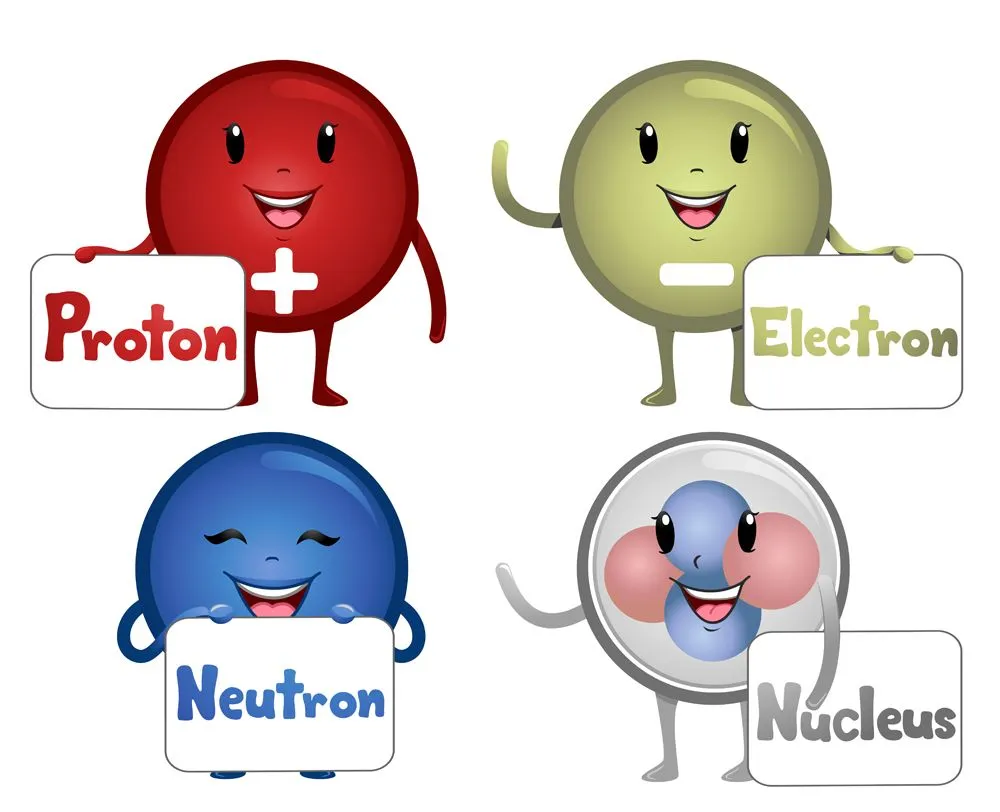
In the atomic world, how do we identify particles?
By name, of course!
Just as we do in the full-scale physical world, we identify atomic particles by their characteristic behavior.
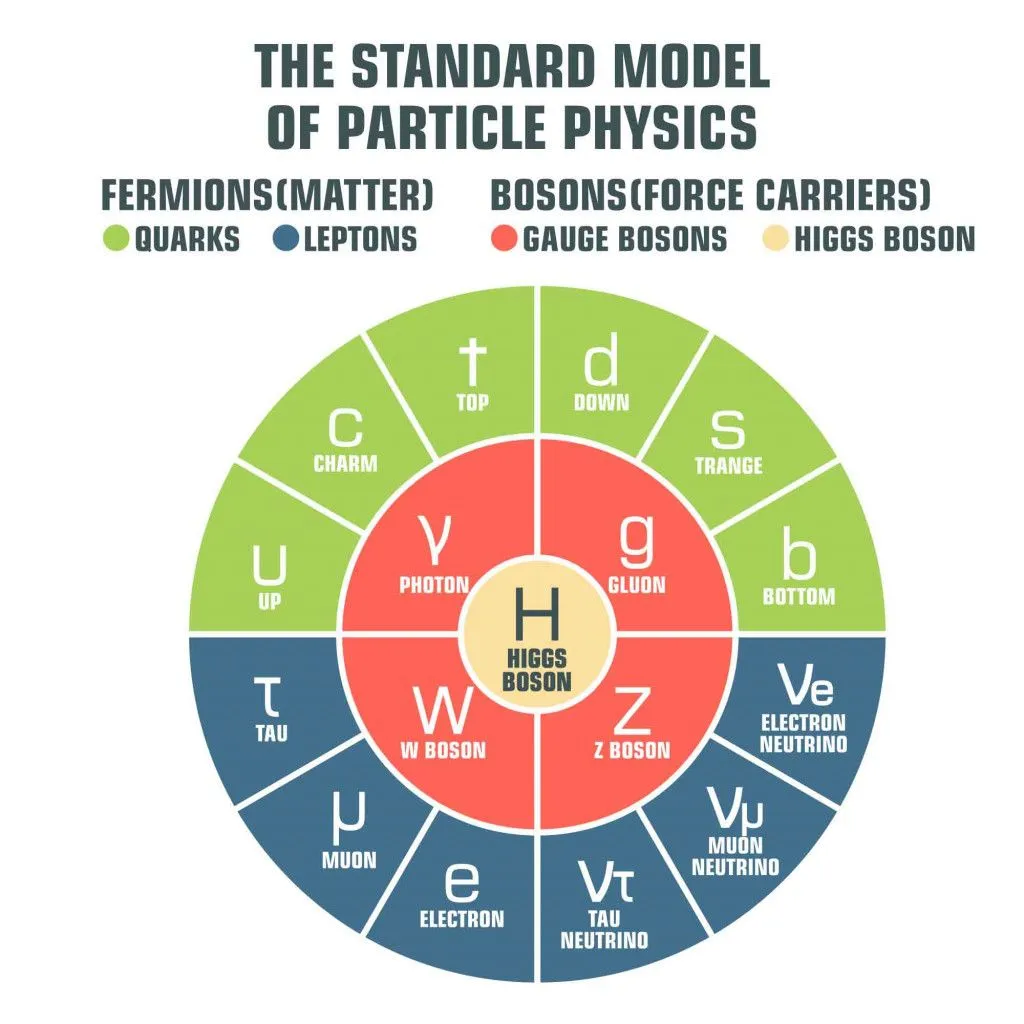
Spin
Each particle has a spin. The rotation of the particle determines its spin, which gives a lot of insight about the particle. The spin also has quantity and direction. The values of spin are either integers or fractional.
Particles with fractional spin values are fermions. Those particles with integer spin values are bosons. Thus, any particle is either categorized as a fermion or boson, based on its spin value.
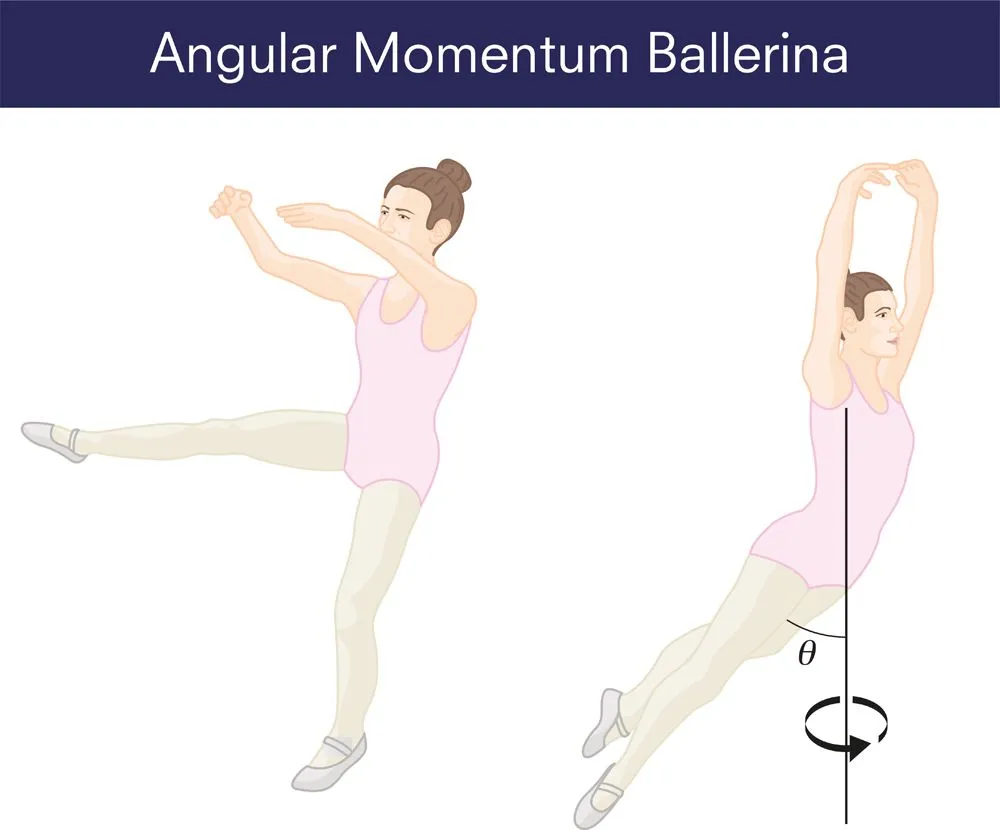
Imagine yourself spinning around with your hands stretched outwards. Now, rapidly bring them closer to your body.
What do you observe?
You will likely find yourself turning much faster than before. This phenomenon is referred to as the conservation of angular momentum. Angular momentum is present in every rotating object or particle. Thus, we can conclude that spinning particles similarly exhibit angular momentum. The spin value of the particle is unique, providing information about the angular momentum of that particle.
Inside An Atom
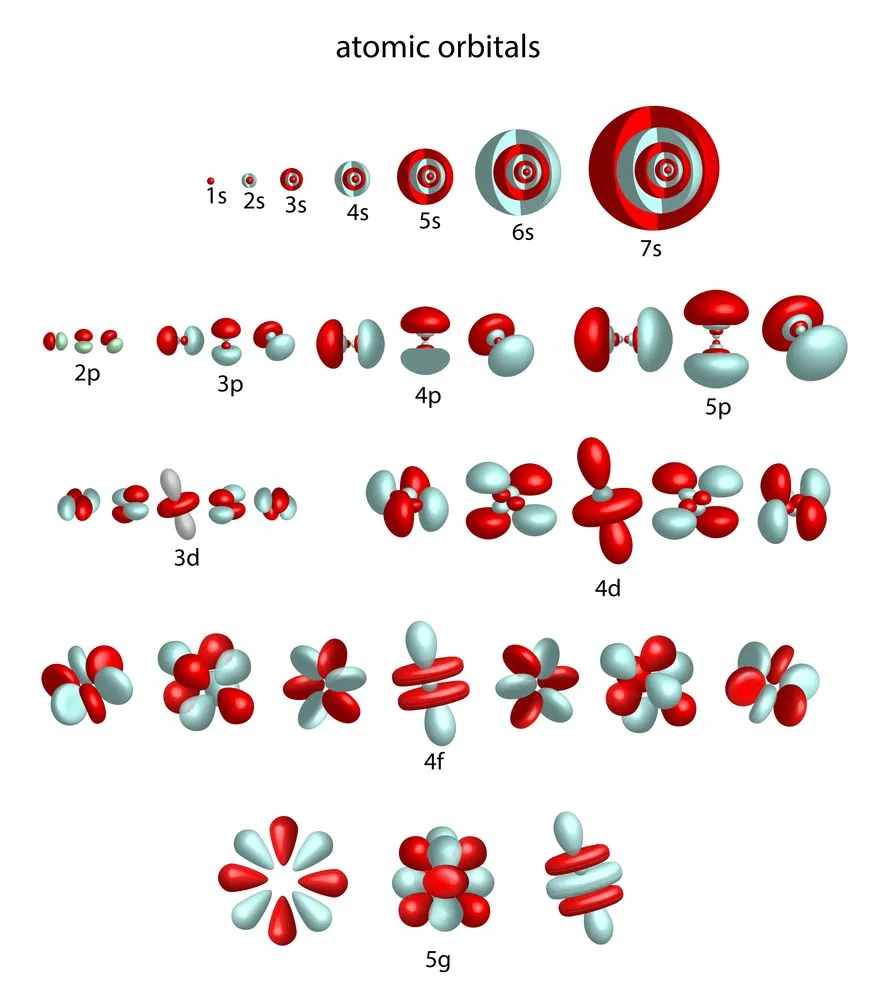
An atom has orbits, which is where electrons are found. Each orbit, in turn, has many orbitals within it.
One can imagine the orbits as roads/paths, while the orbitals are vehicles, and the electrons are people inside the vehicles. An electron is always found in these orbitals. Like the vehicles that move on the roads, the orbitals (vehicles) are aligned in the orbits.
The electrons inside the orbitals have a particular spin. They are often paired inside an orbital. If an electron is rotating clockwise, the other paired electron is rotating anti-clockwise. Thus, electrons have opposite spins that are denoted by ‘+’ and ‘-‘ signs.
This shows that spin has both a value and a direction.
Helicity
Helicity is the projection of a particle’s spin onto its direction of motion. Stated more formally, if S is the spin vector and p̂ is the unit vector in the direction of momentum, helicity is the eigenvalue of S·p̂, a single number that tells you whether the particle’s spin is aligned with, or against, the way it’s travelling.
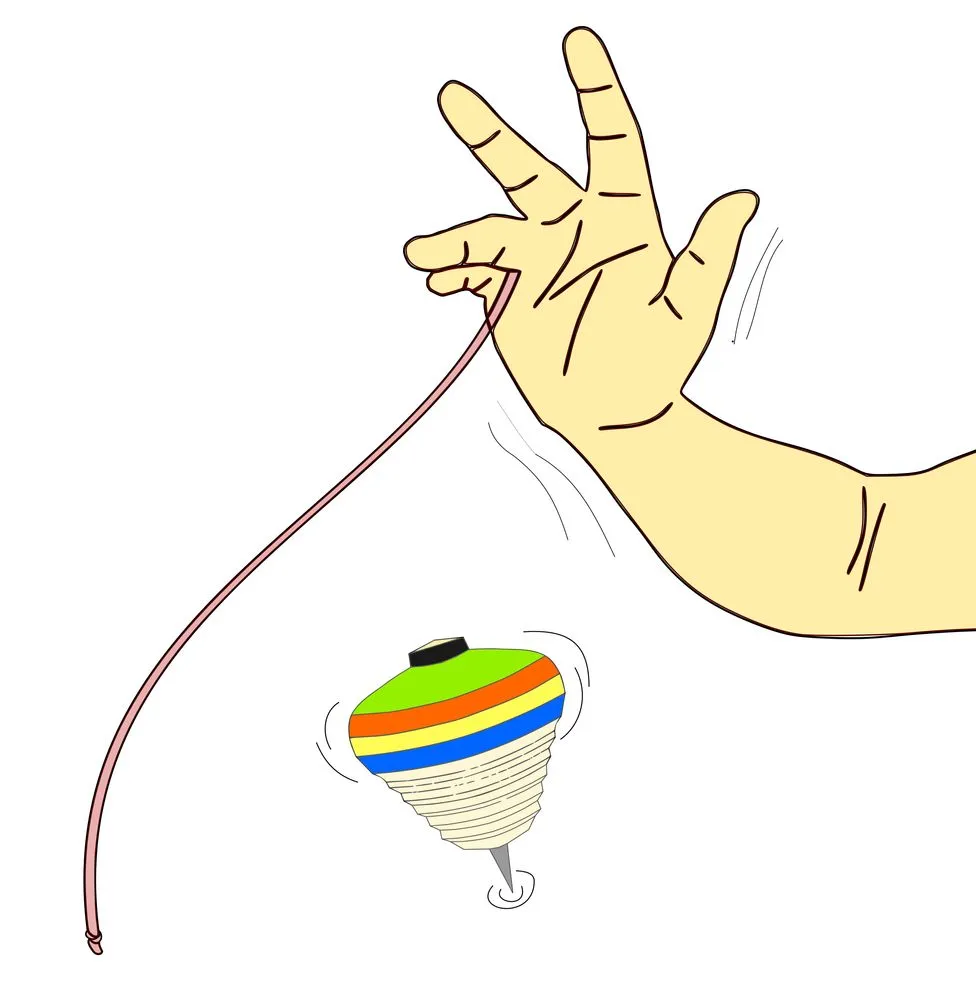
In a sky flier toy, the fan part is set to spinning motion as it separates from the main toy. Now, due to gravity, we observe that the spinning fan also moves downwards. In this moment, the toy has two kinds of motion. One is the rotational motion, which we see as it spins around its central axis. Another is linear motion due to the gravity of the earth. This is analogous to the helicity observed in particles.

A particle has spin (an intrinsic angular momentum) and linear momentum. Whether its spin lines up with its momentum or against it is what helicity captures, much as the sky-flier toy combines rotation about an axis with linear travel.
A heads-up: helicity does not mean the particle is physically tracing a helix in space; that’s a charged-particle-in-a-magnetic-field story. Helicity is a quantum-mechanical projection, not a literal helical trajectory.
DNA string. EPS10 file with reflections(Levente Naghi)S” class=”wp-image-39268″ height=”607″ src=”https://uploads.scienceabc.com/2020/12/Double-helix-vector-illustration-which-resembles-a-DNA-string.-EPS10-file-with-reflectionsLevente-NaghiS.webp” width=”809″/> Helix (Photo Credit : Levente Naghi/Shutterstock)
Left And Right Helicity
Helicity comes in two types: left helicity and right helicity.
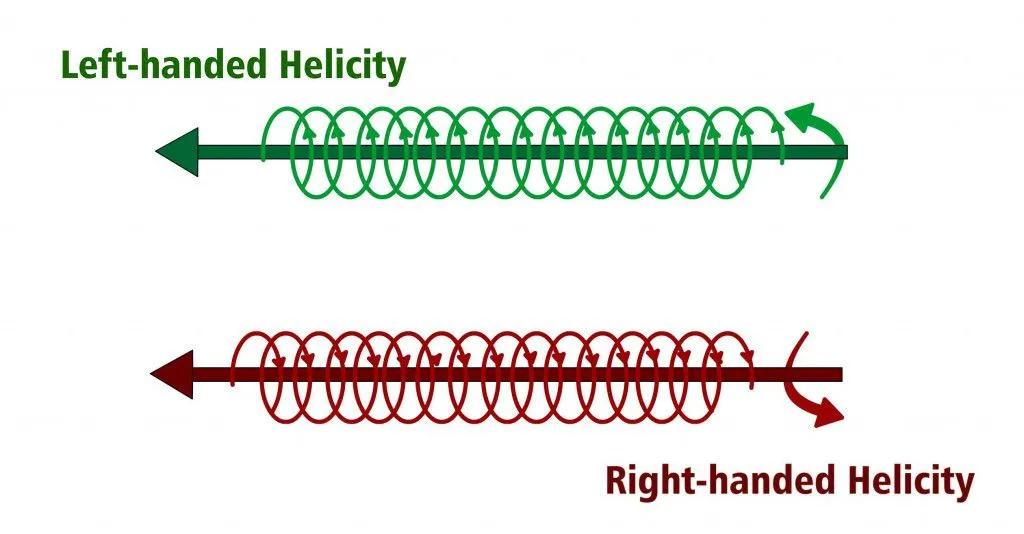
Left helicity is described by the left-hand thumb rule. It uses the left hand to show the direction of motion of the particle, while the curled four fingers of the left hand show the direction of the spin. The thumb points in the direction of the linear motion of the particle.
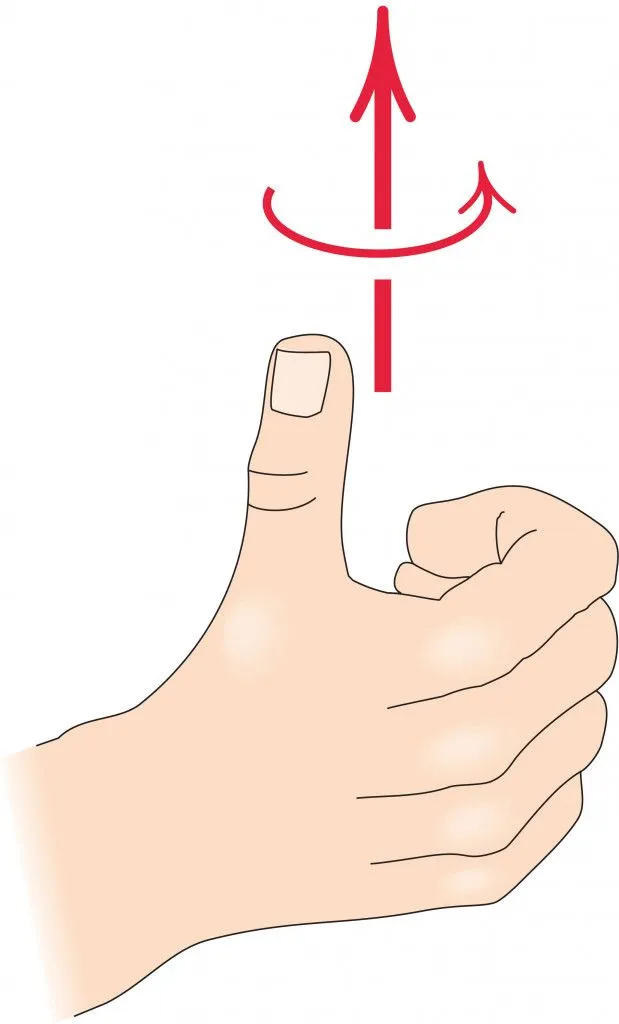
Likewise, right helicity is given by the right-hand thumb rule. The four fingers of the right-hand curl in the direction of the spin, while the thumb points in the direction of linear motion of that particle.
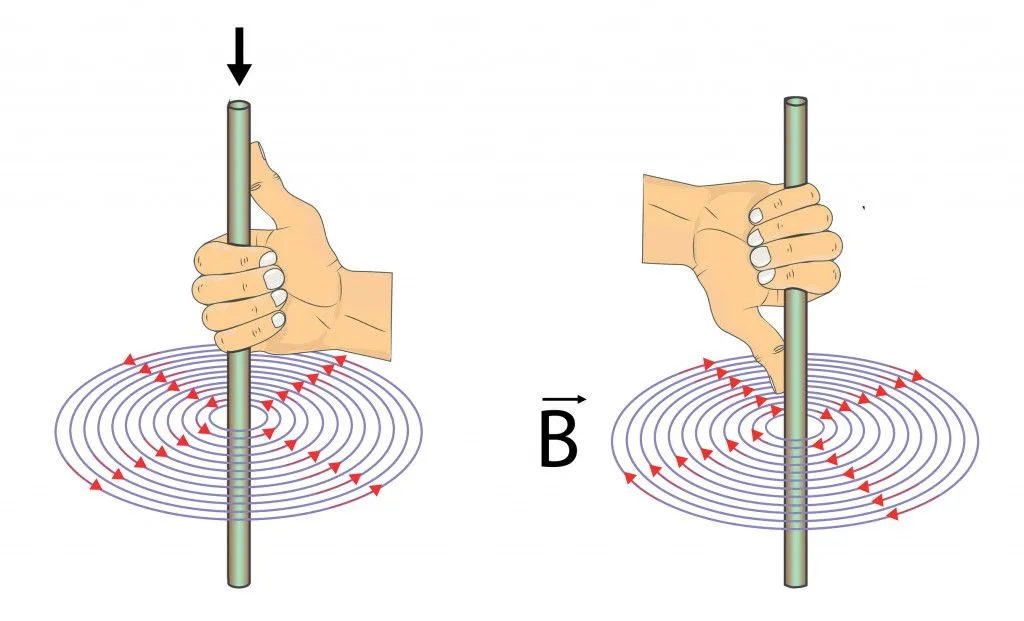
A particle is spinning along the clockwise direction, so the right-hand thumb rule shows that the direction of its linear motion is downwards. Therefore, the particle is in right helicity. If the direction of its linear motion changes to the upward direction, the helicity has changed to left helicity or left-handedness.
In some cases, helicity is constant with time, while in other cases, helicity varies. This variation helps us understand the behavioral patterns of the interacting particle.
Applications Of Helicity
Helicity gives us a lot of information about a particle. It has helped scientists understand the properties and nature of interacting particles, and it plays a key role in our understanding of antiparticles. One important subtlety: helicity is Lorentz-invariant only for massless particles (like photons or, in the Standard Model, neutrinos taken as massless). For massive particles, an observer can in principle move faster than the particle, overtake it, and see its momentum direction reversed, so the helicity actually flips sign depending on the frame. The famous Goldhaber-Grodzins-Sunyar experiment (Brookhaven, 1958) measured the helicity of the neutrino as left-handed (h = −1) by following electron capture in 152Eu, one of the foundational results confirming parity violation in the weak interaction.
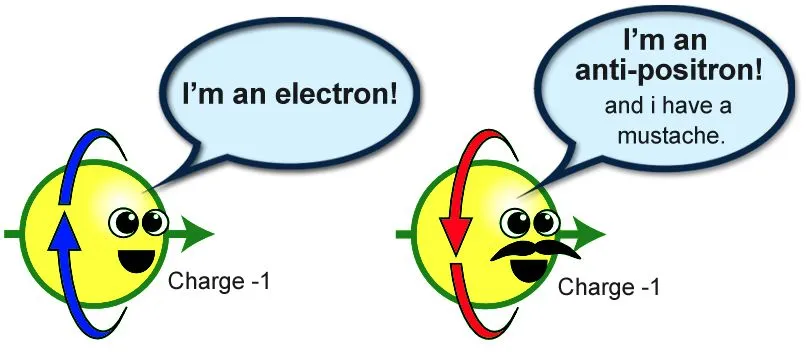
Helicity patterns help scientists better understand numerous physical and chemical observations in laboratories. Beyond particle physics, the word helicity turns up in several other sciences, where it carries related but separate meanings. The sections below untangle how helicity differs from chirality, what it means for a molecule, and how meteorologists use it to forecast rotating storms.
Helicity Vs. Chirality
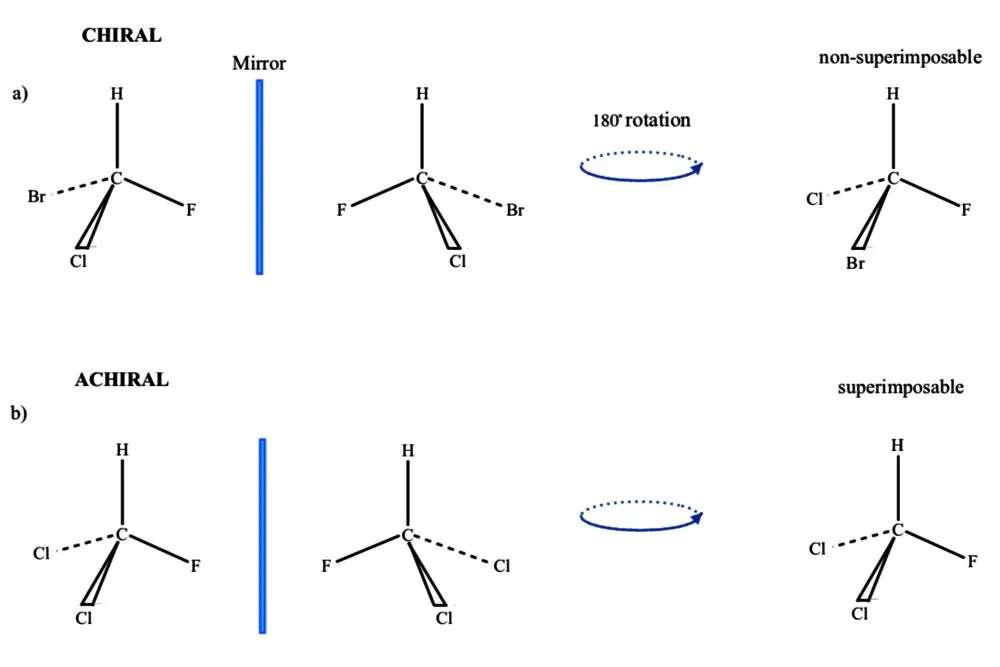
Helicity is often confused with a closely related property called chirality, and for some particles the two line up so neatly that people use the words interchangeably. They are not the same thing. Helicity, as we have seen, is the projection of a particle’s spin onto its direction of motion. Chirality is a more abstract, built-in property described by the mathematics of quantum field theory (formally, it is the eigenvalue of an operator written γ5).
The practical difference comes down to two questions: does the property stay the same as the particle travels, and does every observer agree on it? Helicity is a constant of motion, so it does not change as a free particle moves along, but it is not Lorentz-invariant, which means observers in different reference frames can disagree about it. Chirality is the reverse: it is Lorentz-invariant, so every observer agrees on it, but for a massive particle it is not a constant of motion, because a left-handed state gradually mixes into a right-handed one as the particle propagates. For a massless particle the two properties collapse into one, since nothing can outrun light to overtake the particle and flip its apparent handedness. This distinction is not just bookkeeping: the weak nuclear force, which drives radioactive decay, couples specifically to chirality rather than helicity, which is one reason chirality sits at the heart of the Standard Model.
What Is Helicity In Chemistry?
Chemists borrow the word helicity too, but they use it in a different sense. In stereochemistry, helicity is the handedness of a molecule that is twisted into a helix, propeller, or screw shape. A right-handed molecular helix is labeled P (for plus), and a left-handed one is labeled M (for minus). To assign the label, chemists look down the axis of the helix and trace a path from the nearest high-priority group to the farthest one: if that path turns clockwise the molecule is P, and if it turns anticlockwise it is M.

The textbook examples are the helicenes, molecules built from benzene rings fused in an angular chain so that the whole structure spirals like a staircase. Hexahelicene, made of six fused rings, coils around far enough to complete a full turn. What makes these molecules remarkable is that they are chiral purely because of their twisted shape, without any single carbon atom acting as a traditional center of chirality. That handedness has measurable consequences: a right-handed (P) helicene rotates plane-polarized light in one direction (it is dextrorotatory), while its left-handed (M) mirror image rotates it the opposite way (levorotatory). This link between the direction of the twist and the sign of the optical rotation is sometimes stated as a helicity rule.
Helicity In Fluids And Weather
The idea of helicity also scales up from single particles to entire fluids and storms. In fluid dynamics, helicity measures how closely a fluid’s flow lines up with its own swirl. Mathematically it is the volume integral of the velocity multiplied by the vorticity (the local spinning of the fluid), and it captures how knotted or linked the swirling vortex lines in a flow are. In an idealized frictionless fluid this helicity is conserved, a result worked out by Jean-Jacques Moreau in 1961 and, independently, by Keith Moffatt in 1969. The closely related magnetic helicity plays the same role for the twisted magnetic field lines in plasmas and on the Sun.

Meteorologists put the concept to very practical use. Storm-relative helicity (SRH) gauges the potential for a thunderstorm’s updraft to start rotating, which is the first step toward a supercell and, sometimes, a tornado. It is calculated over the lowest 1 km and 3 km of the atmosphere and reported in units of m²/s². Forecasters at the U.S. Storm Prediction Center treat rising values as a warning sign: 0-3 km SRH above roughly 250 m²/s² and 0-1 km SRH above roughly 100 m²/s² point to an increased tornado threat with supercells, though helicity is only one of several ingredients they weigh.
References (click to expand)
- Helicity, Chirality, Mass, and the Higgs - Quantum Diaries. quantumdiaries.org
- Helicity: - WW2010. The University of Illinois Urbana-Champaign
- Left-Handed Neutrinos - Hyperphysics. Georgia State University
- Helicity and Chirality - sbhep.physics.sunysb.edu
- Chirality (physics) - Wikipedia
- Helicene - Wikipedia
- Assignment of configuration for helical and axial chirality - Making Molecules
- Hydrodynamical helicity - Wikipedia
- Storm Relative Helicity - NOAA Storm Prediction Center