The alphabet’s letters are arranged in the way they are because they have simply always been that way. The modern English letters that we see today have trickled down over the centuries and the basic order of the alphabet has remained relatively the same since the time of the Phoenicians, or even the North Semitics before them!
My three-year-old niece jumbled up the order of the alphabet again while singing that famous song. I giggled and corrected her, but she still wasn’t convinced. With a puzzled look on her face, she asked me, ‘Why?’
Why are the alphabet’s letters arranged in the way they are?
English is considered a very difficult language to master due to the inconsistencies in it, as well as the different ways you can pronounce any given letter. It comes as no surprise that modern-day English has evolved from several languages over the span of hundreds of years.
What Is The Order Of The English Alphabet?
Before we dig into the why, it helps to have the what in front of us. The modern English alphabet has 26 letters, and we run through them in this now-familiar line-up:
A B C D E F G H I J K L M N O P Q R S T U V W X Y Z
Each letter also has a fixed position, or number, in that sequence. A is the 1st letter, B is 2, C is 3, D is 4, E is 5, F is 6, G is 7, H is 8, I is 9, J is 10, K is 11, L is 12, M is 13, N is 14, O is 15, P is 16, Q is 17, R is 18, S is 19, T is 20, U is 21, V is 22, W is 23, X is 24, Y is 25 and Z is 26. Five of these are the classic vowels (A, E, I, O and U), with Y occasionally moonlighting as a sixth, and the remaining 21 are consonants.
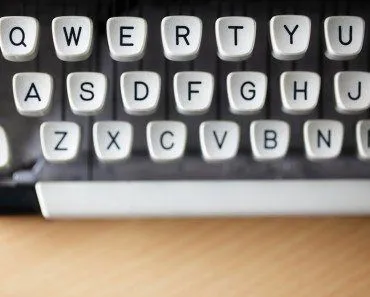
This is the order we recite in the alphabet song, and the order that dictionaries, indexes and phone books rely on to sort words. It is not, however, the order of the letters on your QWERTY keyboard, which was scrambled for entirely different reasons. So how did this particular sequence come to be? The rest of this article is really the story of how the letters ended up in this exact order.
History Of The English Alphabet
The English alphabet was derived from Phoenician script, a writing system that was spread throughout the Mediterranean area by Phoenician traders. This system consisted of twenty-two consonant letters, with its phonetics inherited from its ancestor—the Proto-Canaanite script, which itself evolved out of Proto-Sinaitic, a writing system loosely adapted from Egyptian hieroglyphs around 1850 BC. Both the Proto-Canaanite and the Phoenician scripts—like Hebrew and Arabic today—were written from right to left.
The Greeks, highly influenced by the Phoenician alphabet, began adapting it around 800 BC. They took some of the consonants they did not need and turned them into vowels, while also introducing a few new symbols of their own for the extra sounds that their speech required. After a few centuries of regional variants, the familiar twenty-four-letter classical Greek alphabet (alpha to omega) was finally standardized in Athens in 403 BC.
Another significant change that the Greeks made, in addition to adding vowel sounds, was changing the direction of the writing. The Greeks originally followed the Phoenician trend of writing from right to left, but slowly shifted to boustrophedon (bi-directional), and then finally to the present system of left to right. Boustrophedon is a type of text where the writing goes from right-to-left and left-to-right in alternating lines.
The Etruscan (language of ancient Etruria) alphabet, which was influenced by the Western Greek alphabet, gave birth to Latin (Roman) script, which originally consisted of twenty-one letters. Y and Z were introduced later, in the 1st century BC, from the Eastern Greek alphabets, to help spell Greek loanwords—bringing the classical Latin alphabet up to twenty-three letters. The letters W, J, and U joined much later: W developed from a doubled ⟨U⟩/⟨V⟩ in medieval European scripts around the 7th–8th centuries, while J and U did not split off from I and V until the Renaissance.

As Latin and other forms of writing spread across Europe, various regional scripts and letterforms arose to account for linguistic differences and requirements of different regions. Some of these were accidental shifts that arose from a desire to simplify or speed up the writing process. English gets most of its capital letters from the Roman style of writing. In the later Middle Ages, certain scripts developed in northern Europe that formed modern-day lower-case letters.
Who Actually Arranged The Alphabet?
So who sat down and decided that A comes first and Z comes last? The slightly deflating answer is: nobody in particular. No single person, king or committee ever “arranged” the alphabet. By the time anyone was writing the letters out in a row, the order was already ancient.

The earliest evidence of a fixed order comes from Ugarit (modern Ras Shamra), on the coast of Syria. Among the clay tablets excavated there, archaeologists found abecedaries, which are essentially scribal practice lists of the whole alphabet, dating to around the 13th century BC. These tablets lay out roughly 30 cuneiform signs, and the remarkable thing is that they already run in essentially the same order as the much later Phoenician and Hebrew alphabets. Scholars only know this because they have painstakingly deciphered these long-dead scripts.
That near-match is the giveaway. It tells us the Ugaritic scribes were not inventing a sequence from scratch; they were copying one that already existed and was worth memorising. In other words, the order of the alphabet was inherited rather than designed, handed from one generation of scribes to the next until it eventually reached the Phoenicians, the Greeks, the Romans and, finally, us. The real “arranger” of the alphabet is thousands of anonymous teachers and pupils who simply kept the list in the order they were taught.
Birth Of The Letter U
You may be wondering where U fits into the story (21 Roman letters + Y + Z + J + W = 25 letters—still one short of our modern 26). That’s because the letters U and V were considered a single letter until quite recently, with the letter V standing for both the vowel ‘U’ and the consonant ‘V’. The split was a slow burn: the two shapes started being used for different sounds in the 1500s, and U was fully recognized as its own letter only by the 1700s. That’s likely why the letter W is pronounced as ‘double U’, even though it actually looks like ‘double V’.

Reasons Behind The Alphabetical Order
In certain cultures like Greek, Hebrew and Arabic, there is a system of assigning numerical values to names, words or phrases based on the word’s letters. The Hebrew version is called Gematria, and similar systems exist in Greek (isopsephy) and Arabic (abjad numerals). It is believed that words with identical numerical values bear some relation to each other or to the number itself. However, the timing actually runs the other way—the Phoenician letter order is attested in abecedaries from the 14th–13th century BC, while gematria-style numerical use only appears centuries later. So gematria piggybacked on the pre-existing alphabet order rather than dictating it.
Some letters that were newly added to the system got placed at the end of the line. Once Rome conquered Greece in the 2nd century BC, the Romans began to borrow Greek words wholesale and had to change their alphabet in order to write them. They borrowed Y and Z from the Eastern Greek alphabet, which they put at the end of their alphabet.

Some letters in the system are placed together because they sound similar, or used to sound similar at some past point in time. W sits right next to V because it literally grew out of it—medieval scribes wrote ⟨uu⟩ or ⟨VV⟩ to capture the /w/ sound, and over time that doublet fused into a brand-new letter parked next to its parent. As we read above, the letter U came into the picture much later, when people decided to use it to mean the vowel, while the letter V was used as a consonant. Thus, U, V and W came to be placed together. J first began as a variant of I; a tail was added to the last I when there were several in a row (such as in Roman numerals like ‘viij’ for 8). The Italian grammarian Gian Giorgio Trissino formalized J as a consonant and I as a vowel in 1524; hence, they are placed together.
For the most part, however, the alphabet’s letters are in that order because they have simply always been that way. The modern English letters that we see today have trickled down over the centuries and the basic order of the alphabet has remained relatively the same since the time of the Phoenicians, or even the North Semitics before them!
Has The Order Of The Alphabet Ever Changed?
The sequence itself has been remarkably stable, but the cast of letters filling it has not. English once had more letters than the 26 we keep today, and a few old characters have quietly dropped out of the line-up.

Old English writing borrowed several characters that have since vanished. Thorn (þ) and eth (ð) both stood in for the “th” sound in words like this and thing. Wynn (ƿ) did the job now handled by W, while yogh (ȝ) covered sounds we now spell with “y” or “gh”, including the throaty rasp in the Scottish loch. There was also ash (æ), a squashed-together A and E. As Middle English gave way to modern English, scribes gradually swapped these out for letter pairs like “th”, “w” and “gh”, and the old characters fell away.
Thorn even left a ghost behind. When printing presses reached England, the type imported from the Continent had no þ, so printers substituted a Y that looked roughly similar in the handwriting of the day. That is why old signs read “Ye Olde” shoppe. The word was never meant to be said as “yee”; it was always simply “the”.
One letter clung on even longer. For much of the 1800s, children reciting their ABCs finished with a 27th character: the ampersand (&). Chanting “X, Y, Z, and” sounded odd, so pupils tacked on the Latin phrase per se (“by itself”) and sang “X, Y, Z, and per se and”. That final mouthful slurred together into a brand-new word, ampersand, which was in common English use by 1837. The symbol itself is far older, having begun life as a ligature of the Latin word et, meaning “and”.
References (click to expand)
- Alphabet (Early Greek) - Brown University. Brown University
- Evolution of Alphabets. Shippensburg University of Pennsylvania
- History of English alphabet - yin.arts.uci.edu:80
- About Gematria | Yale University Library - web.library.yale.edu
- An Ugaritic abecedary. Tyndale House
- 12 Letters That Didn't Make the Alphabet. Mental Floss
- Thorn (letter). Wikipedia
- Ampersand. Wikipedia