A coral atoll is a ring-shaped island (an outer coral reef enclosing a shallow lagoon) that forms when a fringing reef grows around a slowly sinking volcanic island and keeps building upward while the original island disappears beneath the surface. The process can take tens of millions of years and was first explained by Charles Darwin in 1842. Famous examples include the Maldives, the Marshall Islands and Bikini Atoll.
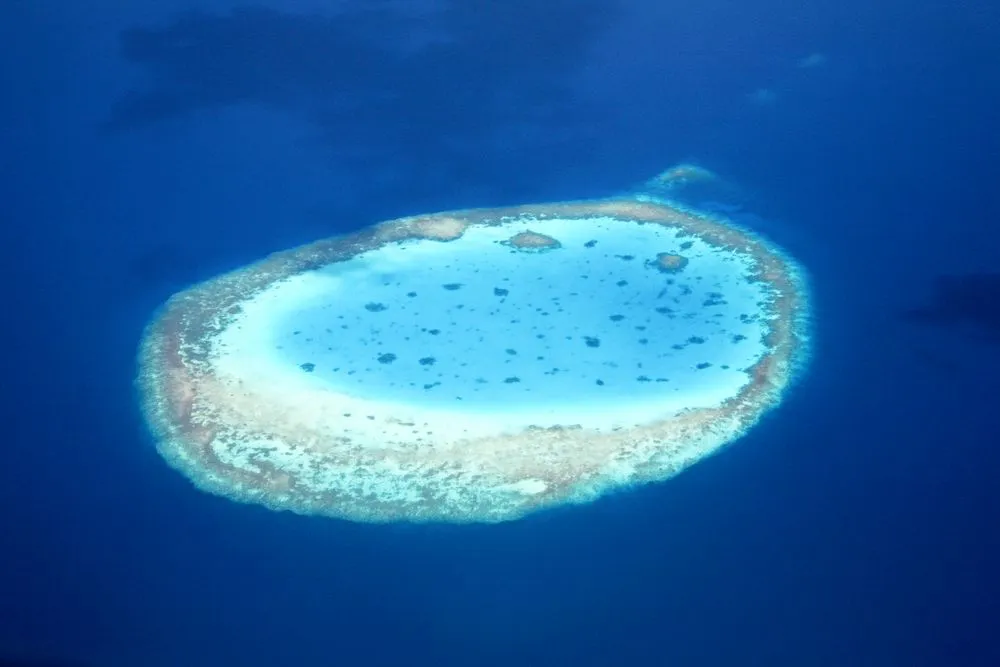
Have you ever seen an image like the one below? Most people tend to think they’re just regular islands, but that’s not entirely true.
These islands are called coral atolls.
If you look closely, the “island” has a little pool in the middle. These pools in the middle are called lagoons. The interesting thing is that this water is actually seawater that has been trapped over time! So how exactly does this water get trapped in the middle of the island?
Well, the process is far more complex than you may think and could take as long as 30 million years!
First, however, let’s talk about what those islands are!
What Is A Coral Atoll?
Scientists have a very disputed definition of what a coral atoll is. For our purposes, a coral atoll is an island composed of a reef on the outside and a lagoon in the center.
The reef has two parts: an outer reef and a reef rim. Looking at the picture above, you see an outer reef, which is greyish and rises above the water in typical cases. You can see a reef rim too, which lies inside. In typical cases, it extends a bit from the outer reef. The rims extend inward as a reef platform in smaller atolls, like the one pictured above.
The beautiful blue lagoon is what really sets an atoll apart from any regular island (in terms of natural beauty, at least). The reef shelters the lagoon from the ocean. This lagoon can also have small patches of reefs inside it.
So how are such atolls formed?
Why Do These Islands Form In The Middle Of The Ocean?
Atolls are formed entirely by corals. The coral cannot form from the bottom of the ocean because sunlight does not reach there and they need sunlight to make their food. Initially, the coral reef forms around the island as described in the article here.
There are many theories on the formation of atolls. Daly proposed that atolls were formed during the end of the last ice age, due to rising sea levels, but one theory has gained the most prominence.
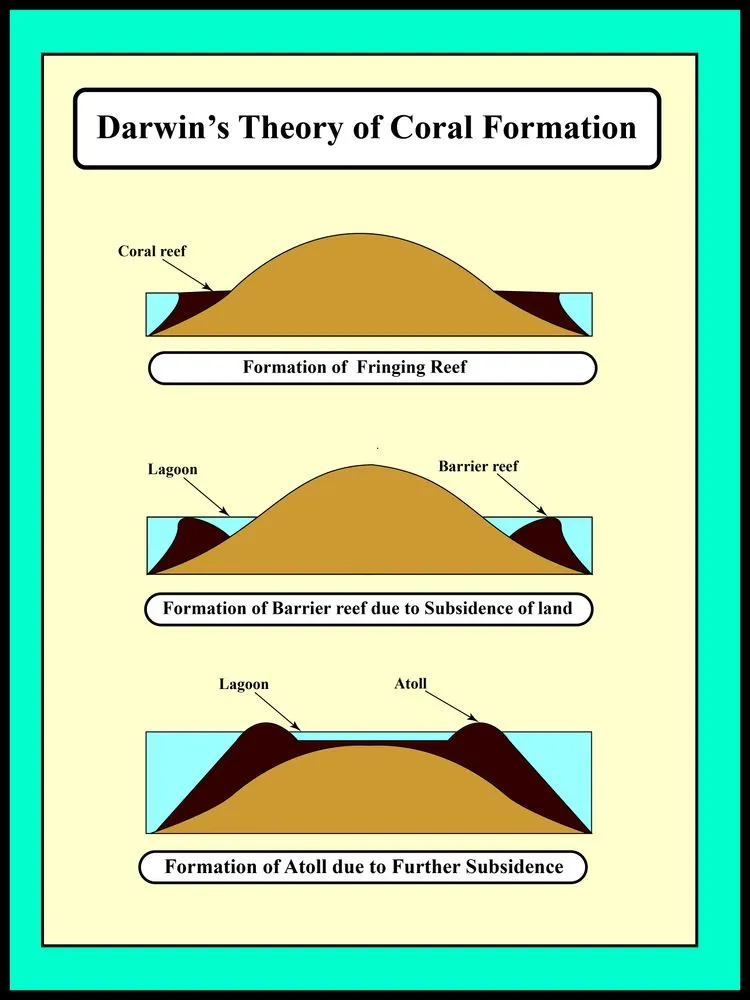
Charles Darwin (yes, the scientist who proposed the theory of evolution) also proposed a theory on how atolls were formed. He believed that, initially, volcanic eruptions formed an island. These volcanic islands acted as new homes for reefs to form.
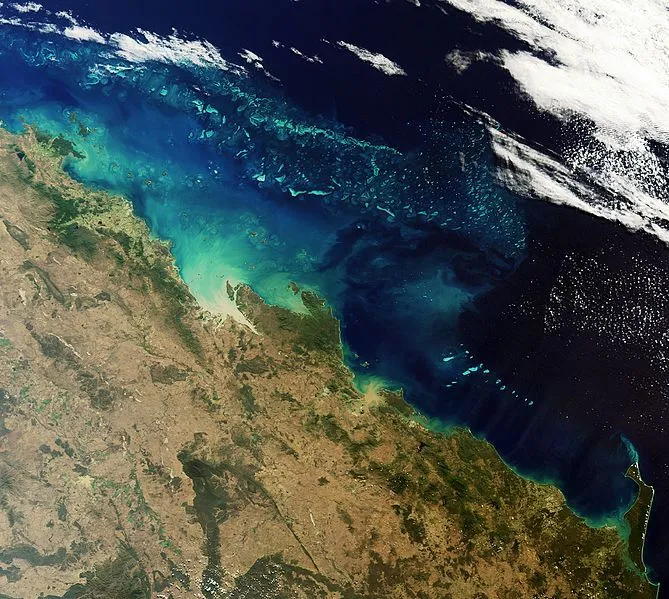
Over time, the land starts to subside, slowly sinking deeper into the water and eroding. When the land starts to subside, the coastal reef turns into a barrier reef. A barrier reef is a coral reef that is separated from the coast by a large lagoon. This can be seen in the Great Barrier Reef of Australia, shown in the satellite image below!
Once the island starts to subside, that barrier reef grows inwards. At some point, the island goes under the water level and the coral grows over it. Now, unlike normal islands, which are composed of sand and rock, these islands are made of chalk!
How Is An Atoll Different From A Regular Island?
When most of us picture an island, we imagine a chunk of rock or a volcano poking up out of the sea, often with hills or even mountains rising well above the waves. An atoll is a completely different beast. It has no rocky core at all: it is built entirely by coral, it hugs the surface in a low ring rather than a solid mound, and its islands rarely rise more than 5 metres (about 16 feet) above sea level.

To make sense of this, marine scientists usually sort coral reefs into three main types, and an atoll is really just the last one. According to NOAA, a fringing reef grows straight out from the shore of an island; a barrier reef is separated from that shore by a stretch of open water, or lagoon; and an atoll is the ring of coral left behind once the volcanic island in the middle sinks completely beneath the surface. Darwin's key insight was that these three are not separate curiosities at all, but three snapshots of the same slow story.
So the next time a quiz asks which type of coral reef forms a ring around a central lagoon, you can confidently answer: an atoll!
Are These Islands Made Of Living Coral?
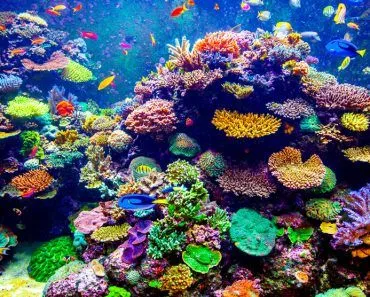
When you think of coral, you normally think of hard structures shaped either like fans, branched-out trees or even platforms, like the examples in this picture below. But what you see there is actually only their skeletons!
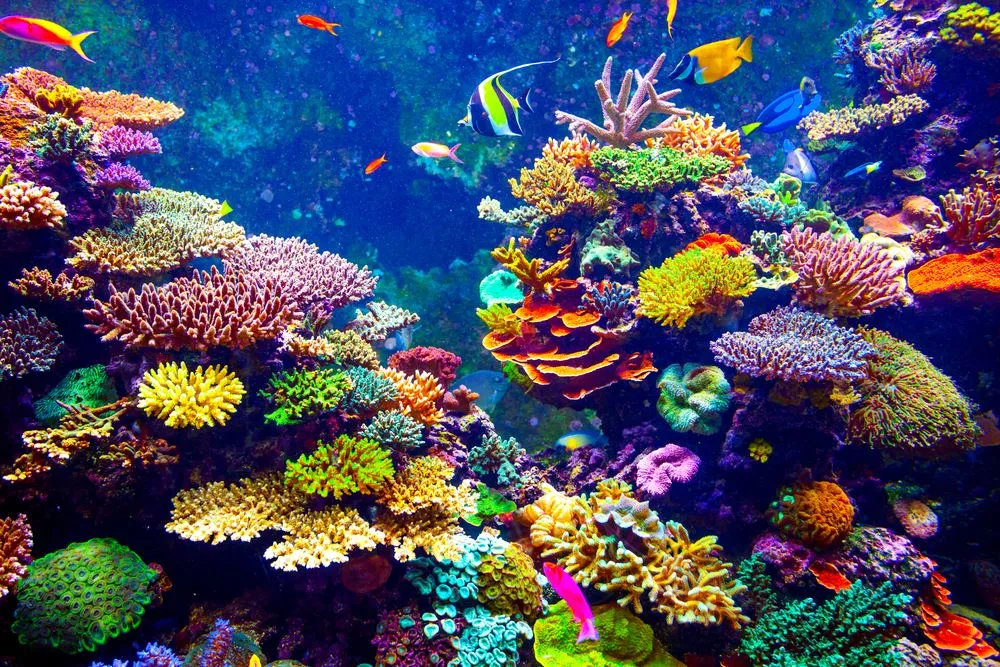
Corals are formed by animals called polyps. Polyps are small animals that are actually related to jellyfish. Much like jellyfish, they are actually soft animals, but then how is coral so hard? Well, polyps secrete calcium carbonate (chalk) that entirely covers them. Over time, when these polyps die, their skeletons remain.
Now, coming back to atolls. Atolls are made of coral reefs, but not living coral reefs. Coral live for a very long time and can even reach 5,000 years of age, but remember that coral atolls can take as long as 30 million years to form!
That’s why coral atolls are not islands made of coral, but islands made of coral skeletons! Their skeletons are made of calcium carbonate, the same thing that makes eggshells and shellfish skeletons.
Where In The World Are Coral Atolls Found?
Because reef-building corals only thrive in warm, sunlit, shallow water, atolls are scattered across the tropics rather than the colder seas closer to the poles. There are roughly 440 of them in the world, and the vast majority sit in the Pacific Ocean, in island groups like the Marshall Islands, the Tuamotus of French Polynesia, Kiribati, Tuvalu and Tokelau. The atoll pictured from space below, Atafu, is one of Tokelau's three.

The most famous atoll nation of all is probably the Maldives, in the Indian Ocean. Its islands are grouped into 26 natural atolls, and the very word “atoll” comes from the Maldivian (Dhivehi) word atholhu. Charles Darwin borrowed the term for his 1842 book on coral reefs, and it has been the scientific name for these ring-shaped islands ever since.
Over in the Pacific, the Marshall Islands are made up of 29 atolls. Two of them are especially well known: Bikini Atoll, the site of nuclear weapons tests in the mid-20th century, and Kwajalein Atoll, whose reef encircles one of the largest lagoons on the planet, roughly 2,170 square kilometres (about 840 square miles) of enclosed water. Because atoll islands sit so low, most of them less than 5 metres above the sea, they are also among the places most exposed to rising ocean levels today.
Conclusion
Even though the islands are made of dead reefs, that does not mean there are no living coral among them. The lagoons can have patches of living coral reefs that act as home to many species of fish and other marine life!
Atolls even host human life. Humans have lived on atolls for millennia; in fact, many famous islands like the Chagos archipelago, the Lakshadweep islands of India, and the island nation of Maldives are actually atolls… we just didn’t know it!
References (click to expand)
- How a coral atoll forms - NOAA’s National Ocean Service
- Hopley, D. (Ed.). (2011). Encyclopedia of Modern Coral Reefs. (D. Hopley, Ed.), Encyclopedia of Earth Sciences Series. Springer Netherlands.
- What are the oldest living animals in the world?. The National Ocean Service
- What are the three main types of coral reefs? - NOAA’s National Ocean Service
- Atafu Atoll, Tokelau - NASA Earth Observatory
- Atoll - Wikipedia