
Table of Contents (click to expand)
- Compressive Strength Of Concrete
- Tensile Strength Of Concrete
- What About The Shear Strength Of Concrete?
- How Can The Tensile Strength Of Concrete Be Increased?
- How Does Wet Concrete Turn Rock Hard?
- Why Can Concrete Cure Underwater, But Extra Water Makes It Weaker?
- Concrete vs Steel: Which Is Actually Stronger?
Concrete has great compressive strength, but poor tensile strength. This is because concrete is made of ‘little’ stones, which means that it always has microscopic cracks in its body. When tensile forces are applied to concrete, these cracks become elongated and eventually the concrete breaks apart. However, concrete is very good at withstanding enormous amounts of weight, so it is used to support buildings and structures.
Gigantic towers, monuments and tall structures are always supported by a very thick layer of concrete that’s blended into their foundation. The purpose of this is quite straightforward: nothing provides greater support to a super heavy (and stationary) structure than a layer of concrete. There may be other things that, in theory, could provide a stronger foundation, but they wouldn’t be nearly as cost effective as concrete.

However, if concrete is so strong and strapping that it supports millions of pounds without budging at all, then why does it break apart when hit by a hammer? Shouldn’t such a strong material be able to hold up against a few blows swung by a human?
Compressive Strength Of Concrete
The reason concrete is used to support buildings and structures is that it has great compressive strength. What this means is that it’s very good at withstanding enormous amounts of weight. Standard concrete typically has a compressive strength of 20-40 MPa (3,000-6,000 psi). This remarkable compressive strength of concrete is attributed to how it’s made. It consists of numerous aggregate materials (crushed stones, gravel, and sand) and a binder (cement paste), which gives it the quality of adhesiveness.
These stones fill up all the little voids in the (concrete) structure, giving it a solid, compact and strong body.
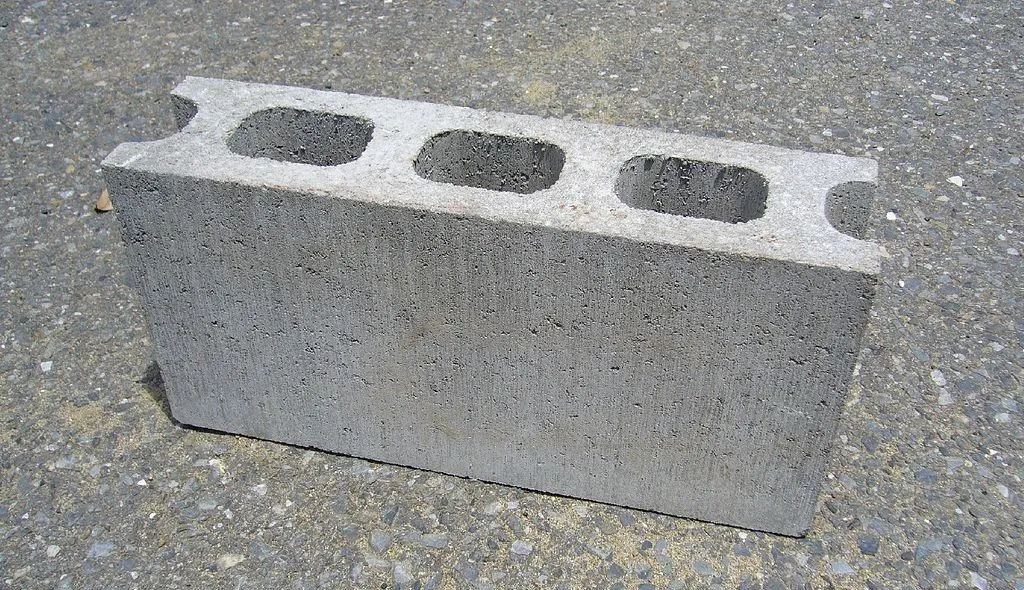
However, concrete itself is a very brittle material. In more technical terms, you could say that concrete has very low tensile strength, typically only about 8-15% of its compressive strength (roughly 2-5 MPa).
Tensile Strength Of Concrete
The tensile strength of a material is simply the measurement of the force required to pull something to the point that it breaks. In other words, you could say that the tensile strength of a material is the maximum tension it can withstand without breaking.
Since concrete is made of ‘little’ stones, it always has microscopic cracks in its body. Now, these cracks don’t cause any trouble when compression is applied to concrete, but when tensile forces are applied, those same microscopic cracks become elongated. This continues for as long as tensile forces are applied to the concrete, before it ultimately breaks apart.
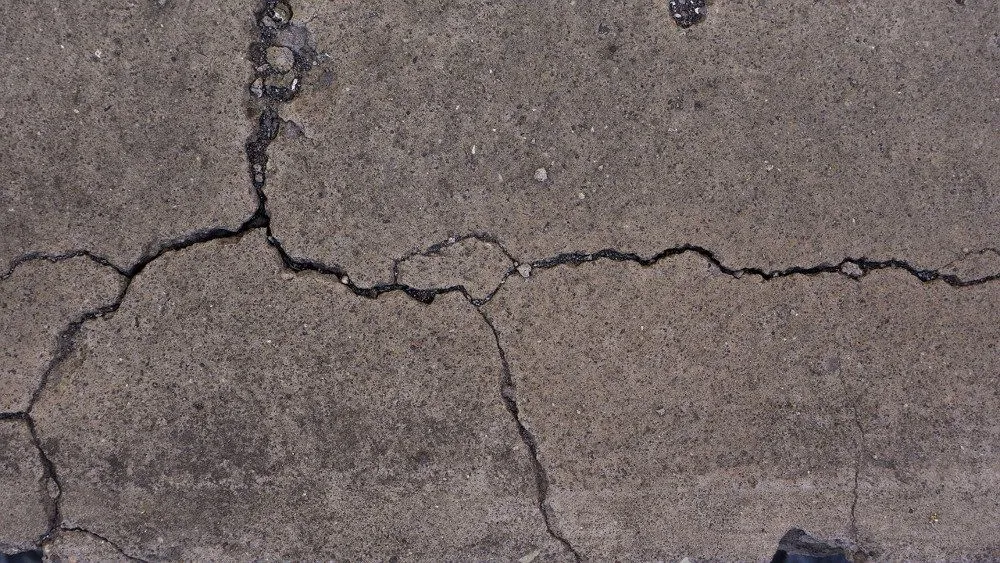
In addition to that, concrete is especially weak in handling shear stress (the force that tends to cause deformation in a material) and has poor elasticity. What this means is that it doesn’t have the ability to absorb forces by temporarily stretching or compressing (on a microscopic level, of course) like a rubber band or spring.
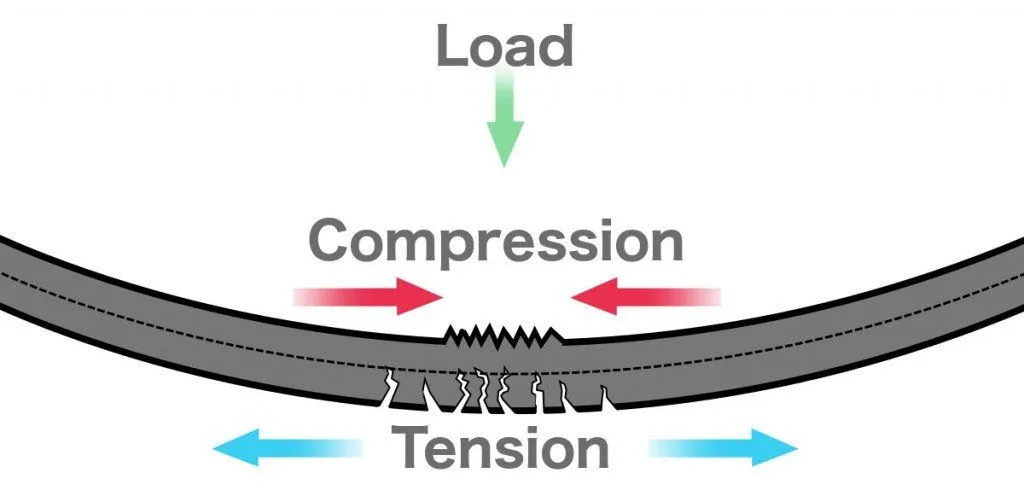
That’s why a concrete slab wouldn’t break with just one hammer blow (unless the hammer is wielded by the Hulk), but after a few powerful hits, the cracks in the slab become large enough to disintegrate the entire slab.
If you want to get technical about why the tension side is so feeble, look at the boundary between the stones and the cement paste that glues them together. That thin shell around each piece of aggregate, known as the interfacial transition zone, is the most porous and weakest region in the whole mix, and it is exactly where tensile cracks like to start. Engineers have measured this weakness directly: the tensile strength of concrete usually works out to just 7-15% of its compressive strength, which is why those microscopic cracks open up so readily when you pull rather than push.
What About The Shear Strength Of Concrete?
Compression and tension are the two forces that get all the attention, but there is a third one that quietly limits concrete just as much: shear. Shear is the force that tries to slide one part of a material past the part right next to it, like pushing the top of a deck of cards sideways. In a loaded beam, shear shows up as diagonal stress, and here is the catch: a diagonal shear stress is really just tension dressed up in a different direction. Since concrete is hopeless in tension, it is equally hopeless against this diagonal pull, and a beam loaded too hard will split along a slanting crack near its supports rather than snapping straight across.

How weak is it, exactly? Design codes don’t treat shear capacity as a fixed number; instead, the shear that plain concrete can carry rises with the square root of its compressive strength rather than in step with it. So doubling the compressive strength only nudges the shear capacity up by about 40%, which is why even very strong concrete still needs help. That help comes in the form of stirrups, the closed loops of steel you can see being bent in the photo above. Spaced along a beam, they stitch across the diagonal crack and carry the shear so the concrete doesn’t have to. It’s the same lesson as tension, just pointed at a 45-degree angle: concrete supplies the bulk and the compression, and a little steel covers everything that involves pulling.
How Can The Tensile Strength Of Concrete Be Increased?
Although concrete is bad at handling tensile forces, that doesn’t mean there’s nothing to be done about it, right?
Concrete has tremendous compressive strength, so to make it sturdier, engineers add steel bars inside concrete structures. This adds to the tensile strength of the concrete structure to make it a strapping, robust building.
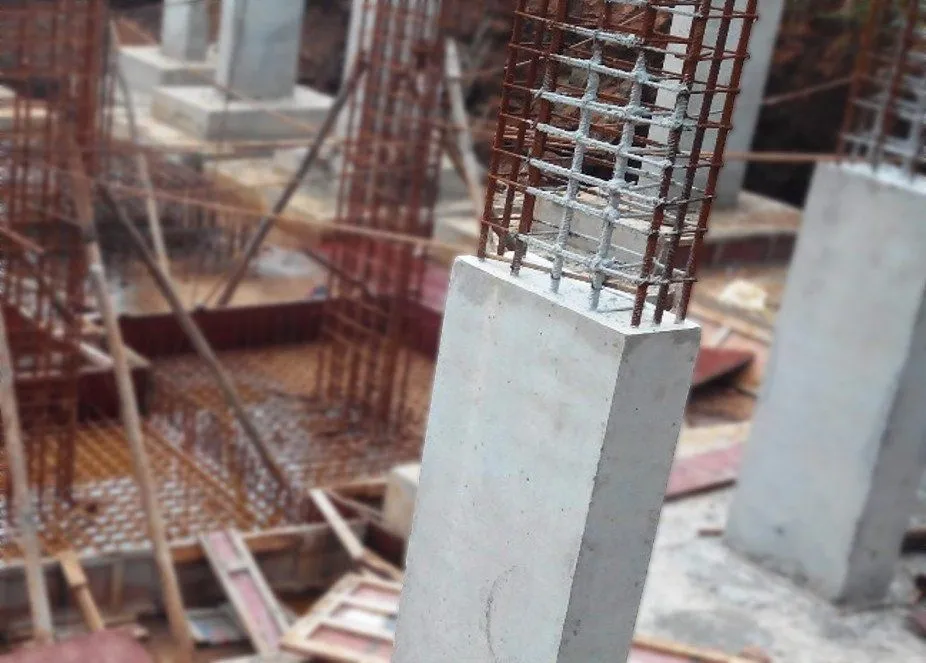
This kind of concrete, i.e., that has steel in it, is called reinforced concrete, as it makes concrete not only stronger, but also allows it to flex and bend slightly without breaking! Steel and concrete also have similar coefficients of thermal expansion, meaning they expand and contract at nearly the same rate with temperature changes, which prevents internal stress from building up.
How Does Wet Concrete Turn Rock Hard?
We've spent this whole article talking about how strong concrete is in compression, but here's a question that trips up most people: where does that strength actually come from? Ask around and you'll hear the same confident answer, that the water simply dries out and evaporates away, leaving the hard stuff behind. It sounds obvious. It's also wrong.

Concrete doesn't dry. It reacts. The water isn't a temporary delivery vehicle that politely leaves once the job is done; it's an ingredient that gets chemically swallowed. Concrete achieves its strength through a series of chemical reactions known as hydration, which are set off the moment water meets the cement powder. This is why the industry calls Portland cement a hydraulic cement, defined by the American Concrete Institute as a cement that sets and hardens by chemical reaction with water.
So what's actually growing in there? As the cement's calcium silicates dissolve and react, they precipitate a new solid called calcium silicate hydrate, mercifully shortened to C-S-H. This is the dominating hydration product of Portland cement, and it is the main component of hardened cement paste. Rather than a tidy, well-behaved crystal, C-S-H is a nanoscale gel with a layered structure resembling the tobermorite family of minerals. Think of it as billions of microscopic fibers sprouting outward from every cement grain, tangling into their neighbors and knitting the sand and gravel into one continuous, interlocking solid. That tangle is the strength. (If the idea of a solid that isn't neatly crystalline intrigues you, our piece on whether glass is a solid or a liquid explores the same blurry boundary.)
The tell that this is chemistry and not evaporation is the heat. Hydration is an exothermic process, meaning the reaction releases energy as it proceeds, so a curing pour warms itself from the inside. Evaporation does precisely the opposite, which is why a drying puddle cools rather than heats. And the reaction is in no hurry: as long as water is present, hydration will continue for many years.
This flips the practical advice on its head. If concrete hardened by drying, you'd want it to dry as fast as possible. Instead, builders do the opposite and keep it damp, a process called curing. Let a slab dry out in air and it will gain only about 50% of the strength of concrete that is kept continuously moist. The mechanism is unforgiving: the relative humidity inside the cement pores must stay above roughly 80% for hydration to continue at all. Below that, the crystals stop growing, and the strength they would have added simply never arrives.
Why Can Concrete Cure Underwater, But Extra Water Makes It Weaker?
Once you accept that concrete hardens by reacting with water rather than losing it, a strange consequence follows: concrete has no particular need for air. The full ACI definition of a hydraulic cement is one that sets and hardens by chemical reaction with water and is capable of doing so under water. That isn't a theoretical footnote. Navy dive teams pour concrete around submerged bridge piers and pilings, and it sets down there just fine.

Which raises the obvious follow-up: if water is the ingredient that makes concrete strong, why not be generous with it? Wetter mix, stronger concrete, surely?
Exactly backwards, and this is where the myth does real damage on job sites. The cement can only consume so much water. Engineers track this with the water-cement ratio, the mass of water divided by the mass of cement. Above a ratio of about 0.40, there is already more than enough mixing water present to completely hydrate the cement. Every extra splash beyond that point has nothing left to react with.
So where does the surplus go? It stays put, occupying space inside the paste while the C-S-H grows around it. When it eventually does leave, it leaves behind capillary pores, and the pore sizes get coarser the more water you added. Porosity is one of the key parameters directly affecting the strength and durability of cement-based materials, and lower porosity means stronger concrete. In other words, a sloppy, easy-to-pour mix is quietly manufacturing voids.
Now recall why concrete fails in tension in the first place: microscopic flaws that stretch open under a pulling load. Every needless liter of water is another batch of exactly those flaws. The contractor who waters down a mix to make it flow more easily gets a slab that is weaker in compression and even feebler in tension than it should have been. It's a rare case where the lazy shortcut and the correct move are, chemically speaking, opposites.
Concrete vs Steel: Which Is Actually Stronger?
If steel is the thing that rescues concrete in tension, a fair question is why we don’t just build everything out of steel and skip the concrete entirely. The answer is that the two materials are strong in completely different ways, and a quick look at the numbers makes the partnership obvious.

Ordinary structural steel begins to yield at around 250 MPa (36,000 psi) and can be pulled to roughly 400-550 MPa before it actually breaks. Crucially, steel behaves almost identically whether you squeeze it or stretch it, so it is strong in both compression and tension. Concrete is a one-trick champion by comparison: superb at compression (20-40 MPa for everyday mixes) but, as we’ve seen, able to handle only a tiny sliver of that in tension. So per kilogram, steel wins on raw strength in every direction.
Why bother with concrete at all, then? Because strength per kilogram isn’t the whole story. Concrete is cheap, pours into any shape, shrugs off fire and weather, and doesn’t rust away. Steel is strong but expensive and corrodes. Reinforced concrete simply lets each material do what it’s best at: the concrete forms the cheap, bulky, fireproof body that takes the compression, while a relatively small mass of steel handles the tension and shear. That division of labor, and not the strength of either material on its own, is what holds up nearly every bridge, dam and skyscraper you’ll ever stand on.
References (click to expand)
- The Science of Concrete Homepage - www.iti.northwestern.edu:80
- Mechanics of Materials: Bending – Shear Stress. Boston University
- Shear strength - Wikipedia
- An Innovative Test Method for Tensile Strength of Concrete. PMC, NCBI
- Shear Strength of High-Strength Concrete Walls and Deep Beams. NIST
- ASTM A36 Mild/Low Carbon Steel. AZoM
- Curing Concrete - Normal, Hot and Cold Weather. Penn State College of Engineering
- Definition of concrete, hydraulic cement, mortar, and grout. American Concrete Institute
- Guide for Curing Portland Cement Concrete Pavements, II (FHWA-HRT-05-038). Federal Highway Administration
- Guide for Curing Portland Cement Concrete Pavements, II: Draft Guidelines. Federal Highway Administration
- Multi-step nucleation pathway of C-S-H during cement hydration from atomistic simulations. Nature Communications, PMC
- Impacts of Space Restriction on the Microstructure of Calcium Silicate Hydrate. Materials, PMC
- Influence of Pore Structure on Compressive Strength of Cement Mortar. The Scientific World Journal, PMC



